
The lowest-cost capacity path is a property-specific comparison, not a rule that always favors controls or always favors more service. Load management coordinates selected loads so the home stays within an established limit. A service upgrade increases available capacity, but may also require utility engineering, meter work, conductors, trenching, or scheduling.
Compare complete scopes
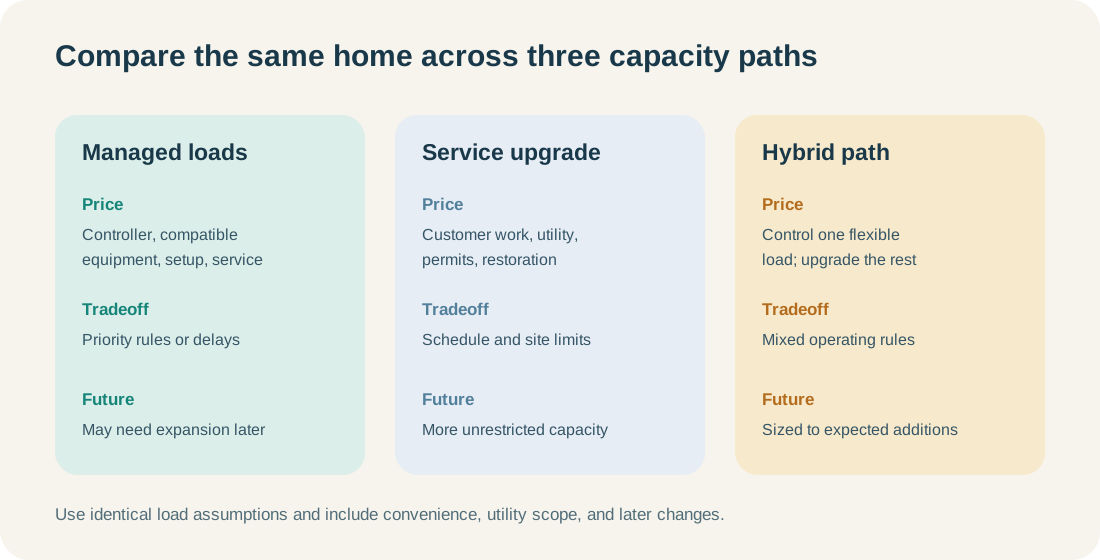
For the service-upgrade option, price the interior equipment, service entrance, utility-owned work, permits, restoration, and any temporary arrangements. For the management option, price the controller, sensors, compatible equipment, electrician labor, commissioning, communications, subscriptions, and any panel changes. Ask what happens if the control fails or communications are unavailable; serviceability is part of ownership cost.
An inexpensive control quote can be misleading if it assumes equipment that is not compatible or omits the professional analysis and acceptance process. A service quote can be misleading if it stops at the panel and ignores utility-side constraints. Normalize both around the same proposed loads.
When management can win
Management is more attractive when the limiting loads are flexible or can be assigned priorities: vehicle charging, water heating, or selected auxiliary equipment may not need to run at the same time as another large load. It can preserve an existing service and avoid invasive work. Lower-power charging and scheduled operation are examples of the broader strategy, but each home needs its own approved design.
The tradeoff is operational. A vehicle may charge later, water heating may be deferred, or backup heat may have a priority rule. Make sure the controls behave acceptably in winter, during occupancy changes, and when several household members use equipment simultaneously.
When more capacity wins
A service upgrade is often easier to live with when the household wants unrestricted simultaneous use, expects additional future loads, or does not want proprietary controls. It may be the better long-horizon investment if the existing service is near end of life or the property is already opening walls for another project.
The apparent simplicity can disappear when the utility has limited transformer capacity, the service is underground, or the contribution and schedule are unclear. Confirm these facts before treating “200 amp” as a fixed-price product.
Model three ownership cases
- Short horizon: a control may avoid a large capital project, but include subscription costs and resale disclosure.
- Medium horizon: compare the present control cost plus likely future modifications with the complete service project.
- Long horizon: value unrestricted capacity, future additions, equipment replacement, and simpler troubleshooting more heavily.
Do not assign a universal payback. Use the actual service quote, utility response, equipment priorities, and expected years of ownership. A control that is cheap today can be stranded if a future renovation removes the operating assumptions behind it.
Acceptance is a gate, not a detail
Electrical code adoption and utility practice vary by jurisdiction. Research material can show that energy-management approaches are recognized as a technical topic, but vendor claims do not establish that a particular product is accepted at your property. Confirm listing, installation requirements, control failure behavior, and approval with the electrician, utility, and authority having jurisdiction.
Red flags in the comparison
Be cautious when the management proposal claims to replace a service upgrade without naming its listing or accepted method, when the service proposal excludes utility work, or when either quote omits future loads. Also question a control system that assumes reliable internet, a subscription, or a homeowner override that is impractical during a cold event.
Ask each bidder to state what is retained, what is changed, and what future project would require reopening the decision. The best comparison makes inconvenience and future flexibility visible beside dollars.
Questions to put in both quotes
Request the load assumptions, future loads, utility scope, permit responsibility, warranty, commissioning, and change-order triggers. Ask what loads are shed first, how the household is notified, and what the fallback is. The cheaper option is the one that solves the same capacity problem with acceptable convenience and a credible path for the next project—not the one with the lower first line.
Normalize the alternatives
Use a common schedule of loads and ask both proposals to state the same winter and future assumptions. For the service path, include interior work, service entrance, utility engineering, meter, conductors, trenching, restoration, permits, and delay. For management, include sensors, controllers, compatible equipment, installation, commissioning, software, subscriptions, and failure or replacement allowance.
Describe the operating rule in plain language. “Manages demand” is not enough. Which load is delayed first? Can the homeowner override it? What happens if internet access is lost? Does the control prevent resistance backup from operating when comfort requires it? These questions can make a modest price difference economically unimportant.
Ownership horizon
For a short horizon, management may avoid disruptive work and preserve cash. For a long horizon, unrestricted service can be more valuable if the household may add a vehicle, workshop, addition, or second dwelling. A control system is strongest when it remains useful if the next phase is delayed. A service upgrade is strongest when it is feasible at a known total cost and future demand is likely.
Put the published cost examples in their proper columns
A 2026 Berkeley Lab survey reported a USD 3,500 median estimate for single-family panel replacement from 34 U.S. industry respondents. For service-rating increases, the study reported a separate customer-side equipment median of USD 2,800 (22 responses) and utility-side owner-pass-through median of USD 3,500 (19 utility respondents). The categories are not a single job estimate, respondent samples differ, and the figures do not cover every utility contribution, trench, permit, or restoration case. They can help frame questions about which side of the meter is being priced, not establish the cost of an upgrade at your address.
A local equipment example adds a different comparison. SPAN’s U.S. manufacturer MSRP ranges from USD 2,550 to USD 4,100 depending on panel form, before installation, shipping, or applicable tax. A Lower Mainland contractor lists a straightforward residential EV energy-management installation starting at CAD 2,000 plus an electrical permit; the stated scope excludes the charger circuit and hardware, panel or service work, and other changes. A Canadian retailer’s CAD 869.99 Emporia charger and Vue monitor bundle is equipment only. These are three unlike scopes, in different markets and currencies; they should not be ranked as if each were a complete managed-load installation.
Create a comparison sheet with three complete columns: managed-load equipment, programming, commissioning, and future software or service; customer-side service work plus utility charges and restoration; and any hybrid design that controls one flexible load while upgrading the rest. State what each path enables, the inconvenience it introduces, and what work remains outside the price. This keeps the comparison economically useful while respecting the limited evidence.
Compare present value without hiding inconvenience
For each path, list upfront work, recurring charges, future replacement risk, and any service upgrade that may still be needed later. A control system can defer capital spending, but its value falls if the home adds loads that exceed its capacity soon afterward. A service upgrade may simplify operation, but a larger service does not itself improve panel condition, equipment compatibility, or utility availability.
Keep nonfinancial effects visible. A delayed charge window, interrupted water heating, limited resistance backup, app dependence, and a restricted future load are real costs even if they do not appear as invoice lines. The homeowner can decide that these tradeoffs are acceptable, but the comparison should not describe the managed option as equivalent to unrestricted service unless that is what the operating design provides.
Ask both bidders to price a named final home, not a generic “future electrification” allowance.
Compare the risk of a later upgrade
The managed option is stronger when the controlled load is flexible and the service constraint is limited to a small number of new loads. It is weaker when the household expects a major addition, needs unrestricted charging, or relies on backup heat during the same periods the controller would shed it. Ask the electrician to describe the upgrade path if the managed system reaches its limit.
For the service option, verify whether the utility expects a larger meter, conductors, or transformer work before assuming the higher rating is available. For the management option, verify product support and local acceptance before assigning it the value of the avoided project. Price the cost of the possible later change in both scenarios. A comparison that counts every upgrade as avoidable for management, or every upgrade as guaranteed for service, is incomplete. A final comparison should show a present-day case and a likely future case. The present-day case answers whether the home can proceed with selected equipment now; the future case tests whether a second EV, larger heat pump, or addition changes the preferred path. Ask how much it would cost to expand the control system or change service later. This avoids choosing a temporary solution without understanding its expiration point.
Keep the utility estimate, management-system scope, and homeowner operating assumptions in the same record. Review the comparison if the household’s future loads or service territory changes.