
Replacing a two-prong receptacle with a three-slot device does not, by itself, create an equipment-grounding path. The economical scope depends on whether the homeowner needs a device change, a documented circuit correction, an accepted protective-device approach where applicable, or new grounded wiring.
A U.S. specialist source reports roughly $80–$150 for a standard existing-outlet replacement and $150–$350 for a new outlet installation. A Canadian specialist guide reports CAD $80–$200 for representative outlet replacement. Those figures assume a much narrower device scope than rewiring an ungrounded circuit. A service-call minimum can dominate a one-location job.
What the two-prong device tells you
It indicates an older-style receptacle, but not the complete condition of the circuit. The box, conductors, grounding path, panel, alterations, and protection arrangement still need evaluation. A three-slot face can be misleading if the underlying circuit is still ungrounded or incorrectly altered.
Do not install a new device, add a jumper, or change circuit protection as a DIY workaround. CPSC warns against untrained panel and wiring work. Exact retrofit methods and labeling requirements depend on the applicable U.S. or Canadian rules.
Possible project paths
- Device-only replacement: Existing wiring and box are suitable, and the electrician installs a compatible replacement under the applicable rules. This does not necessarily solve an ungrounded-circuit concern.
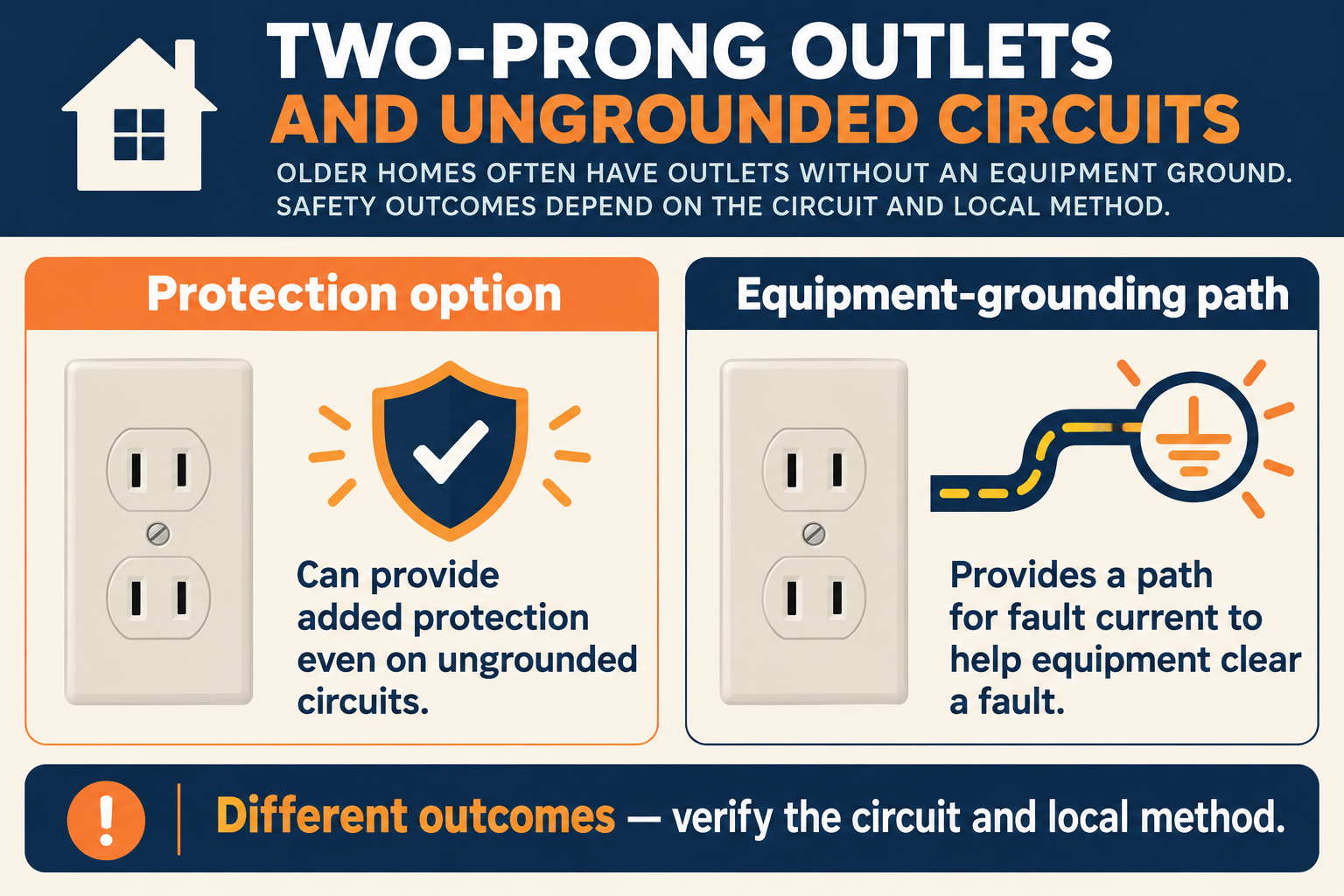
- Protection-based correction: A GFCI or other accepted method may be relevant in some jurisdictions and installation conditions. It addresses a particular protection function; it is not automatically the same as adding an equipment-grounding conductor.
- Circuit rewiring: A new grounding path or replacement circuit requires cable routing, access, panel work, testing, and possibly finish restoration.
- Broader legacy correction: Knob-and-tube, aluminum wiring, damaged insulation, or obsolete equipment may expand the scope.
Cost drivers
One location near an accessible junction is different from multiple circuits behind finished plaster. Cost grows with number of outlets, circuit length, panel distance, access, wall and ceiling restoration, device type, legacy wiring, grounding/bonding, permit or inspection, and documentation. Grouping several locations in one visit can reduce duplicated minimum charges, but each circuit should be listed.
Scenarios
Single-device question: The homeowner wants a safe, documented answer for one receptacle. Budget a service call plus a defined device or circuit assessment, not simply a replacement part.
Several outlets on one circuit: The electrician maps the circuit and determines whether the issue is a device, grounding path, protection option, or rewire. Quote by circuit scope and access.
Older-home upgrade: Multiple ungrounded circuits, legacy wiring, or a renovation create a partial or whole-house decision. Compare access now with future repeat work and require a schedule of retained wiring.
Quote and documentation checklist
Ask what condition was found, whether the circuit is grounded, what method is proposed, which outlets and circuits are included, whether protection is being added, what labels or documentation are required, how panel and grounding work interact, and whether permits, notifications, inspections, patching, and painting are included. Do not accept “upgrade all outlets” as a complete scope.
Ontario ESA distinguishes GFCI, AFCI, and tamper-resistant purposes and notes that its guidance is Ontario-specific. Other jurisdictions differ. The correct economic choice is the one that matches the actual circuit condition and accepted local method—not the one that merely changes the outlet shape.
Compare one location with a circuit project
For one outlet, the service minimum may dominate and the electrician may recommend assessment before any device change. For several outlets on one circuit, mapping the circuit and its grounding condition is more useful than multiplying a single-location price. For multiple circuits, the decision can become a partial rewire, grounding/bonding correction, or broader legacy-system project.
Ask whether the proposed method changes protection, creates a grounding path, requires labeling, or simply replaces the face device. Keep these outcomes separate in the quote. A protection device may reduce a particular shock risk while leaving the circuit’s grounding status unchanged; the applicable authority and electrician must determine the accepted method.
Decide whether to phase the work
Phasing can make sense when a renovation opens one area or when a defined circuit is the immediate concern. It is less attractive when every future phase requires the same plaster repair or when the retained circuits remain undocumented. For a long ownership horizon, include the cost of future access and circuit mapping. For a short horizon, avoid promising a resale or insurance benefit without confirmation from the relevant party.
The decision is complete when the homeowner knows what the new receptacle means electrically, what the existing circuit retains, and what documentation proves the work performed.
Separate protection from grounding
The homeowner’s desired outcome matters because a new-looking receptacle can represent different electrical results. Replacing a two-prong device with another two-prong device is not an upgrade. A permitted protection method may improve shock protection in a defined situation, but it should not be described as creating a grounding conductor. A new grounding path may require access to the circuit, the panel, bonding, or broader rewiring.
Ask the electrician to state which result is being provided, how it was verified, and what labeling or documentation applies. If the work is prompted by a buyer, insurer, or inspector, send that party the proposed method before relying on an assumption about acceptance. A quote that uses “grounded,” “protected,” and “upgraded” interchangeably is difficult to evaluate.
When several two-prong locations are involved, group them by circuit rather than by room. The circuit boundary often determines whether a device-level solution is economical or whether access for a larger correction should be purchased once.
Price the result you need
Clarify whether the goal is a safer device, a grounding path, improved protection, a transaction requirement, or a broader modernization. Those goals can lead to different work. Ask the electrician to describe the retained circuit and the evidence used to select the method. If the goal comes from an inspection or insurer, confirm the requested deliverable directly.
For many outlets, compare a circuit-defined rewire with device-by-device work, including access and patching. A lower per-location number is not a saving if it leaves the central condition unresolved. A complete quote should state the applicable local method and its limits.