
Angi’s Cost Insights section reports $570–$1,000 for a U.S. dedicated-circuit installation. Its opening text instead says $250–$1,100, and its calculator shows $750–$1,520 for a circuit total, with a still higher optional panel-upgrade total. The page does not reconcile these different presentations or their assumptions. This guide uses the Cost Insights figure as one U.S. planning observation and does not combine it with the other ranges. Labor, amperage, distance, access, inspection, and finish restoration can all change a local quote. A Canadian guide gives separate CAD labor observations but not a complete dedicated-circuit range, so use a local quote in Canada rather than converting the U.S. figure.
A dedicated circuit is a branch circuit serving one defined equipment load or use. The circuit itself is the subject here; appliance selection, EV charging, generators, and whole-home electrification belong to related categories.
What the installation includes
The scope may include circuit design, breaker and panel space, cable or conductors, routing, boxes, receptacle or hardwired termination, protection device, labeling, testing, access, patching, permit or inspection, and commissioning with the equipment. A quote that lists only “new wire” is incomplete.
Whether an appliance or use actually requires a dedicated circuit depends on the equipment instructions and applicable rules. Do not infer requirements from an internet list. Ask the electrician to identify the load and the source of the requirement.
Main cost drivers
| Driver | Economic effect |
|---|---|
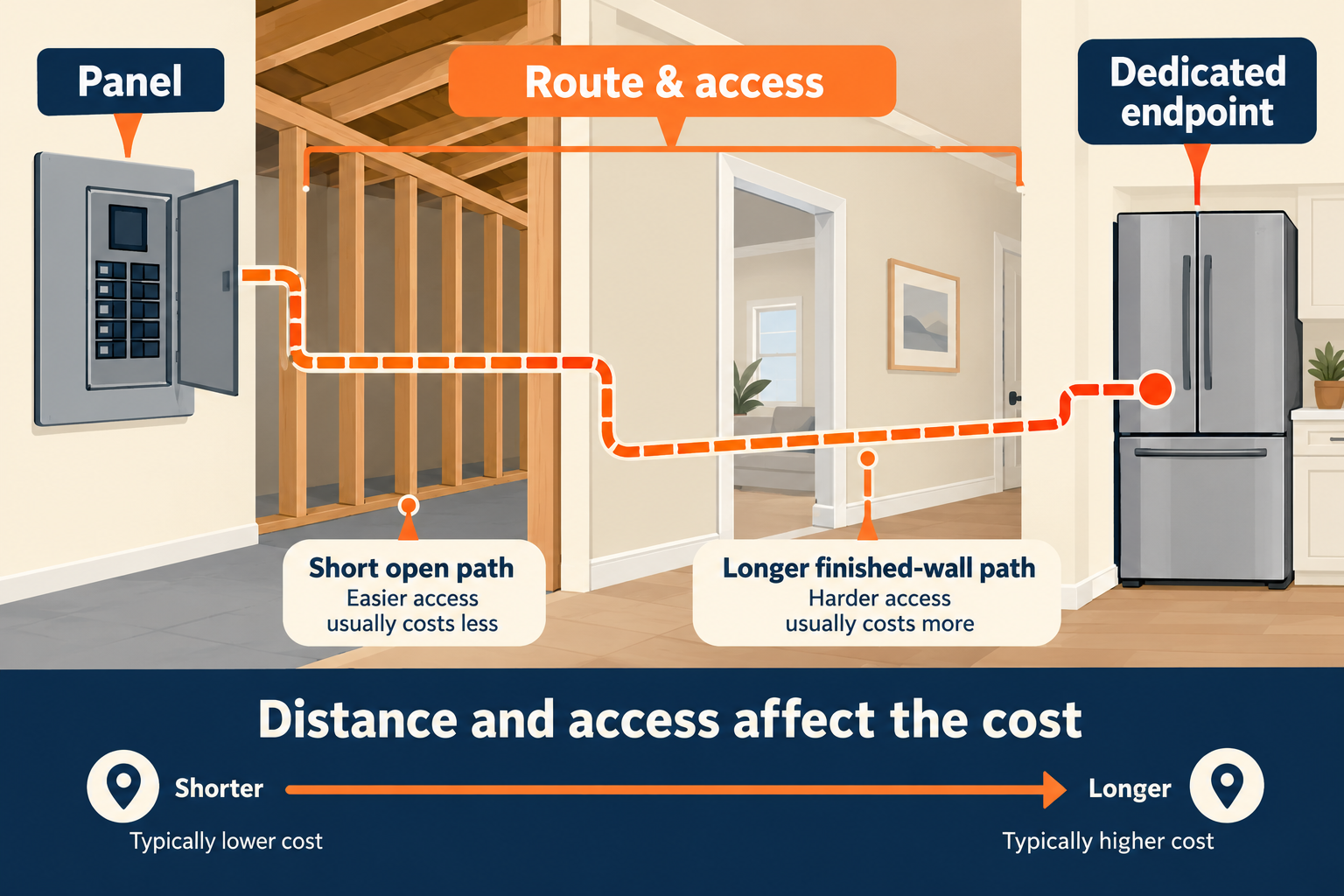
| Distance from panel | More conductor and a longer route increase material and labor. |
| Access | Open basement/attic routes are different from finished walls, masonry, or insulation. |
| Circuit load | Amperage and equipment type can change conductor, breaker, termination, and protection scope. |
| Panel condition | Limited spaces, obsolete equipment, or a service limitation can require panel work. |
| Endpoint | Receptacle, disconnect, or hardwired equipment has different material and installation work. |
| Restoration | Cutting, patching, painting, trenching, or landscape repair may be separate. |
These drivers interact. A high-load circuit near an accessible panel can be simpler than a modest circuit that must cross finished floors and ceilings.
Low, expected, and difficult scenarios
Short accessible run: One circuit, a clear panel space, an accessible route, and an existing service that can support the load. Labor, materials, testing, and local administration dominate.
Finished-home route: The circuit crosses concealed areas, needs a new box or termination, and requires restoration. Ask whether the electrician or another trade owns the patching.
Capacity escalation: Several proposed circuits or a large load expose a panel or service limitation. A subpanel may improve distribution but does not automatically increase utility capacity. The next step may be load planning, panel work, or a service decision.
Permits and inspection
Technical Safety BC’s 2026 homeowner schedule lists CAD $136 for one new circuit or existing-circuit modification in its jurisdiction. Ontario’s process and fees differ; its 2026 guide has notification classifications and minimums rather than the same B.C. fee. These are administrative examples, not the installed circuit price and not universal Canadian requirements.
If work will be concealed, ask the contractor when required inspection occurs. Do not close walls based on a generic assumption that inspection is unnecessary.
Compare circuit quotes
Ask for the endpoint and equipment assumptions, breaker/protection, panel space, route and distance, access, circuit load, wiring, box, permit/inspection, testing, finish restoration, and exclusions. For an appliance, preserve the boundary: the electrician prices the circuit and its connection; the appliance price and manufacturer installation requirements may be separate.
The best circuit budget explains why the dedicated path is needed, what it serves, and what happens if the existing panel or service cannot support it. The breaker and cable are only the visible parts of the decision.
Choose the project boundary
State the assumed load and ask how a later equipment-model change could affect the breaker, conductors, endpoint, protection, and price. Have the quote say whether it ends at a receptacle or junction, or includes connection and testing of named equipment. Appliance purchase, cabinetry, ventilation, plumbing, and broader renovation work may be separate, so identify each boundary before comparing totals.
One defined load with suitable panel space and a clear route can remain a contained installation. Several new loads may require coordinated capacity planning before individual circuits are priced. A subpanel can organize distribution but does not create utility capacity; a service upgrade driven by multiple electrified loads belongs to a broader capacity decision. When the equipment or route is uncertain, ask bidders to price the same open-route or finished-route assumption and name who owns patching, painting, ceiling access, drilling, trenching, and other restoration. This shows whether the circuit is a contained installation or the first stage of a distribution project, and makes exclusions visible before they become change orders.