
A Canadian specialist guide reports a representative CAD $200–$450 observation for ceiling-fan installation. U.S. specialist sources describe cost as varying with fan type, ceiling height, existing wiring, support, controls, and outdoor rating. These are planning observations, not a universal installed range or a U.S. price.
Replace versus add
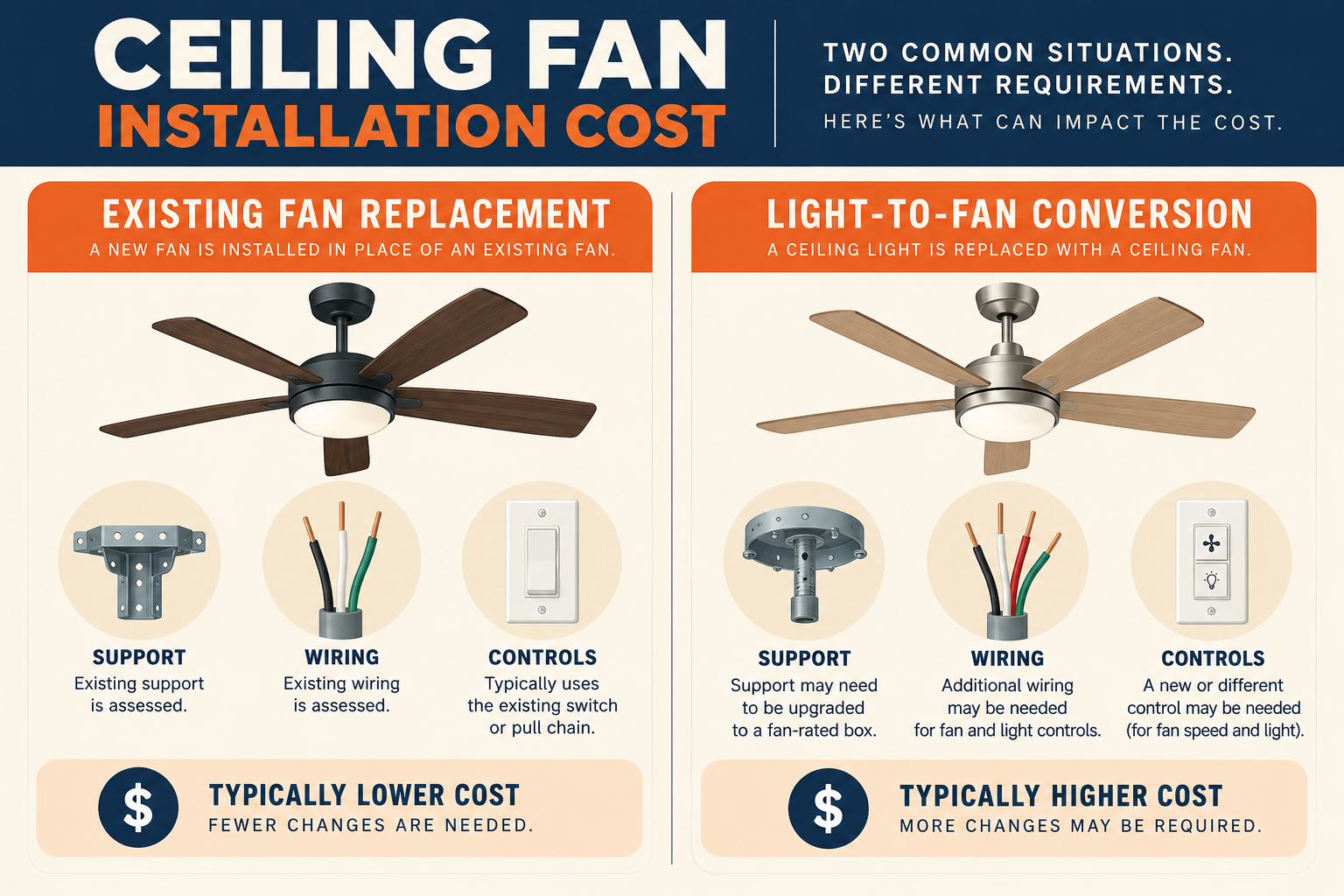
Replacing an existing fan can be the narrowest project if the support, box, wiring, and controls suit the selected model. The quote may still need to account for removal, assembly, mounting hardware, and testing. Replacing a light with a fan may require a different support and control; a new location can require a rated support, cable route, switch, access, and ceiling restoration. A light fixture box is not automatically suitable to carry a fan. The installer should assess the ceiling construction and verify the selected fan’s weight, mounting method, and instructions.
Bathroom exhaust fans are ventilation equipment and belong to a different project scope.
Cost drivers
- existing fan-rated support and box condition;
- new versus existing circuit and wiring;
- ceiling height, stairs, lift, and access;
- fan weight, downrod, slope, and assembly;
- fan/light combination and wall controls;
- finished ceiling, plaster, insulation, or framing obstructions;
- indoor, damp, or outdoor-rated equipment;
- permit, inspection, product certification, and testing.
The fan’s retail price is separate from electrical labor. A smart fan may add controls or network decisions but does not remove the need for suitable support and wiring.
Scenarios
Existing fan replacement: Support and wiring are confirmed, the replacement is compatible, and no new control is needed. Budget for service minimum, assembly, mounting, testing, and disposal. Ask whether the old fan’s control and mounting parts can be reused or whether the selected model changes them.
Light-to-fan conversion: Support, controls, and wiring are reviewed. The ceiling opening may be usable, but the electrical scope is not merely a fixture swap. A fan/light kit may need a different control arrangement from a fan-only model.
New fan location: New box/support and concealed routing add labor and finish risk. Coordinate patching and paint, and ask what happens if framing or other obstructions prevent the assumed route.
High or exterior location: A lift, staging, damp/outdoor equipment, or difficult access changes the project. Bathroom exhaust fans are ventilation equipment and belong to a different scope.
Quote checklist
Ask for the fan model or weight assumption, support and box, wiring and circuit, wall control, ceiling height, access equipment, product rating, assembly, removal and disposal, permit or inspection, testing, and restoration. If you supply the fan, confirm who handles missing parts or a defective or unsuitable unit. Have the quote identify any support or wiring prerequisite as a separate line if it cannot be confirmed before work begins.
Compare replacement, light-to-fan conversion, and a new location with the same access and restoration assumptions. Several installations during an open renovation may share access, while a later single-fan job may not. Give the electrician the exact product information before accepting a fixed allowance: a heavier fan, different mounting method, remote receiver, or added light control may change the work. If the model is not selected, write the assumed weight, support, and control type into the quote so a later substitution has a clear price boundary.