
Angi reports a U.S.-oriented fixture-installation range of USD $158–$1,021 and a USD $589 average across 5,281 Angi Pro projects. Its ceiling-mounted examples are USD $70–$250. HomeStars reports a representative CAD $100–$300 observation for a ceiling light at an existing location. Keep each source’s scope and currency separate: the broad Angi range is not directly comparable to the HomeStars existing-location example, and neither is a guaranteed quote. Recessed lighting, ceiling fans, outdoor trenching, and new circuits have different scopes.
Existing box versus new location
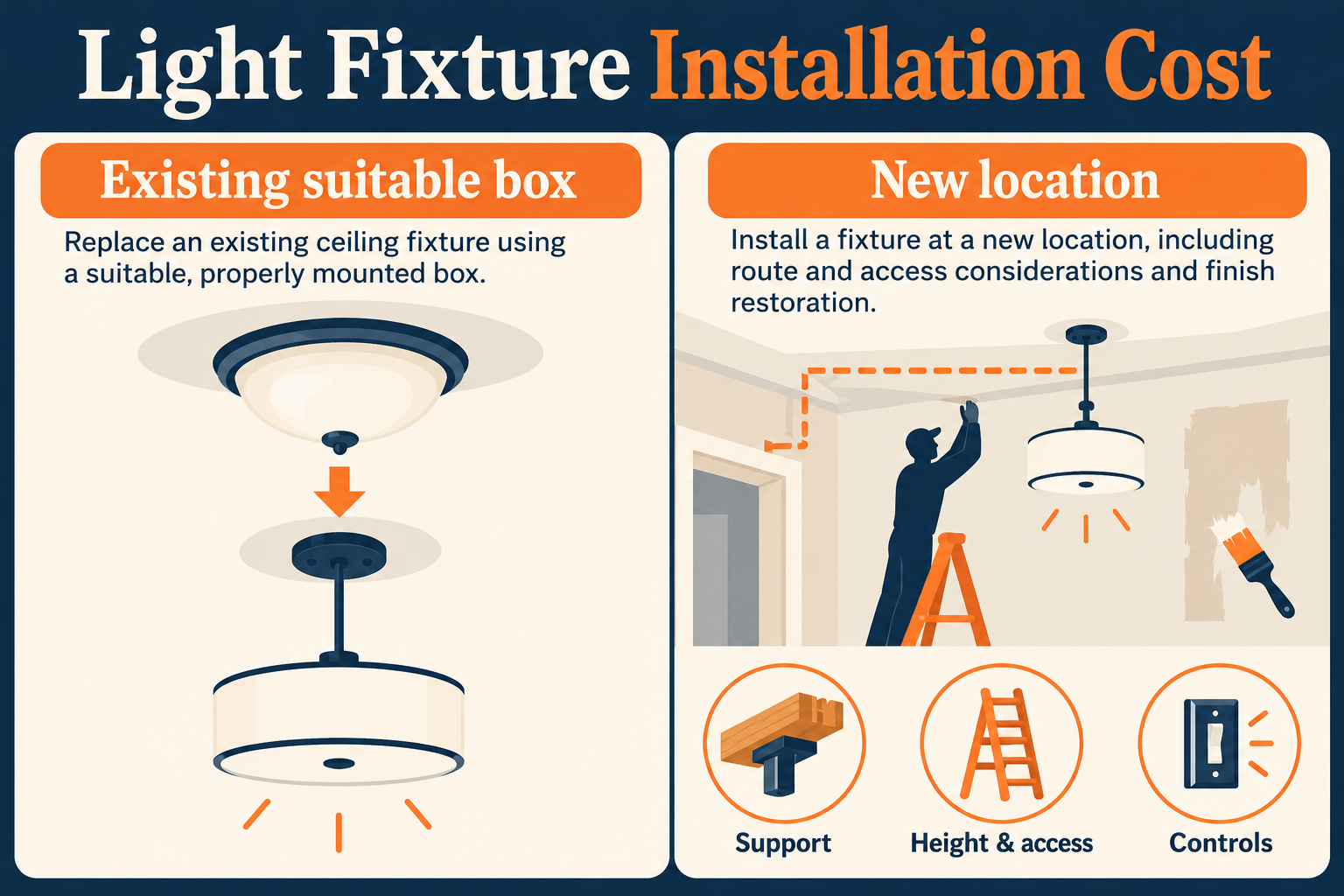
Replacing a fixture at an existing suitable box is usually the narrowest project. The electrician still needs to assess fixture weight, support, wiring, controls, ceiling height, access, and product instructions. A new location adds a box and wiring route, wall or ceiling access, and potentially a new circuit. Finished plaster, tile, insulation, or framing can make access and restoration the main uncertainty.
An expensive chandelier’s purchase price should not distort the electrical installation estimate. A homeowner-supplied fixture that lacks instructions or required parts can still create a compatibility issue or return visit. Keep product, assembly, and electrical labor as distinct quote items.
What changes the cost
- existing box, support, and wiring condition;
- fixture weight, mounting method, and ceiling height;
- stairs, lift, staging, or other difficult access;
- new wiring or a new location rather than an existing-box replacement;
- switch, dimmer, or multi-location control work;
- number and layout of fixtures, shared setup, and mobilization;
- removal, disposal, patching, painting, permit, and inspection.
Health Canada recommends recognized electrical product certification marks in Canada and warns that misuse can cause shock or fire. Certification does not establish that a particular box, dimmer, or circuit suits the fixture; the actual installation must be assessed.
Common project scopes
Existing-box replacement: A suitable support and sound wiring are accessible. The service minimum, mounting labor, and testing may matter more than the fixture itself.
Heavy or high fixture: Support, assembly, lift or staging, and careful handling add labor. Confirm whether removal and disposal are included.
New location: The box and cable route require access and possibly finish repair. Compare a whole-project layout for multiple fixtures instead of multiplying a one-fixture price.
Control-dependent installation: A dimmer or new switch may be needed. Confirm whether that control work is included; the fixture price alone does not define the electrical scope.
Product remedy and timing
Product warranty and certification are separate from the electrician’s workmanship. Agree who handles missing hardware, a defective supplied fixture, and any return visit. If the exact model and installation condition match a recall, check the current notice for covered work, including removal, professional labor, return, or reinstallation. For example, the CPSC recall for Currey & Company Electra chandelier models 9000-1234 and 9000-1235 says the company pays or reimburses the full professional installation cost for its in-home repair. That model-specific remedy is not a normal market-price observation and does not apply to similar-looking fixtures.
If renovation will open a ceiling, compare coordinated box, support, or control work now with later access and mobilization. For multiple fixtures, make sure any shared setup price names the locations and mounting assumptions it covers.
Compare complete quotes
Ask each installer to use the same fixture, location, mounting, access, and finish assumptions. State who supplies the fixture and whether the quote includes assembly, an existing or new box/support, new wiring, switch or dimmer, permit or inspection, lift, removal/disposal, testing, patching, and painting. If reusing a box, ask that its suitability be assessed and recorded; price the access and correction separately if it is not suitable.
A fixture swap and a new location are different jobs, and a recall remedy is different from either. Comparing those boundaries makes it easier to see whether a bid covers a complete, testable installation without hiding product choices or finish work in an electrical labor line.