
U.S. specialist observations place recessed-lighting projects around $300–$8,000, with representative fixture labor/material observations around $100–$300 per fixture. Those figures vary with count, access, ceiling condition, labor, and permits; they are not Canadian prices. A Canadian budget should use a local CAD quote and separate the fixtures, electrical labor, controls, and finish restoration.
Why this is a project rather than a fixture swap
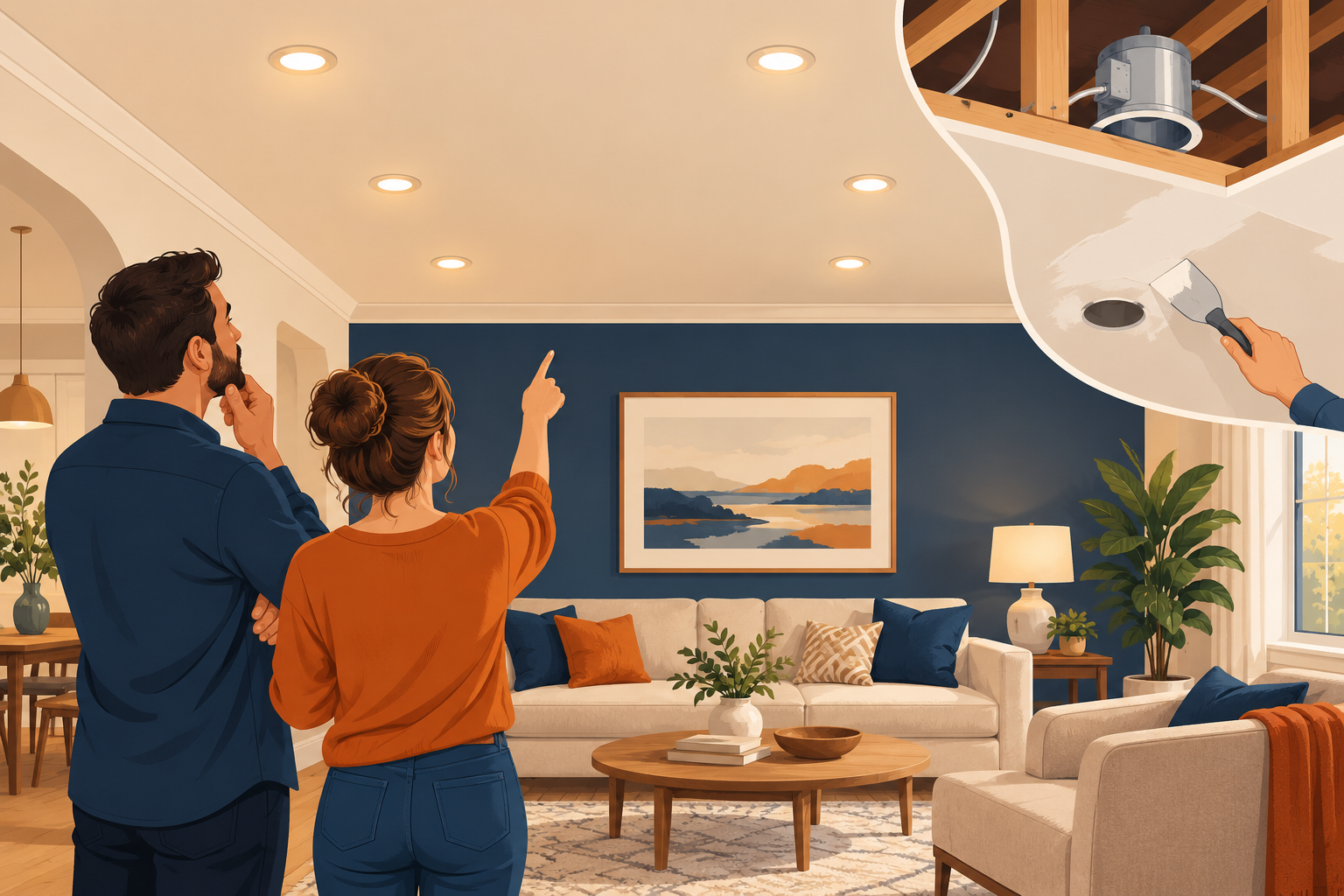
Several recessed lights require a layout, repeated ceiling penetrations, circuit and switch planning, fixture selection, access around framing and insulation, and coordinated patching. A retrofit in a finished ceiling is economically different from installation before drywall. The number of fixtures changes scale, but not always linearly: a larger layout can share mobilization while also creating more obstructions and finish work.
Main cost layers
- fixture and trim selection;
- layout and cutouts;
- wiring and circuit or panel work;
- switch, dimmer, or multi-location control;
- ceiling access and obstruction handling;
- insulation/fixture and product compatibility;
- patching, painting, and cleanup;
- permits, inspection, testing, and documentation.
Manufacturer/listing requirements for insulation contact, damp or wet locations, and compatible controls must be checked for the selected product. Health Canada product-safety guidance supports using recognized certification marks in Canada but does not establish every installation condition.
Retrofit versus open construction
Open ceiling: Wiring and boxes are accessible before finishes. The electrical installation can be efficient, and inspection can occur before concealment where required.
Finished ceiling: Fishing cable, avoiding framing, protecting insulation, and patching openings add uncertainty. A low per-light price may exclude restoration or assume unusually easy access.
Difficult retrofit: Multiple floors, plaster, tile, dense framing, insulation, high ceilings, or a new circuit can move the project outside a simple fixture range.
Quote normalization
Ask every bidder for fixture count and model assumptions, layout, circuit source, wiring, controls, ceiling access, insulation/product condition, patching and painting, permit/inspection, testing, removal, and tax. If a per-light rate is offered, identify which shared setup and restoration costs it includes and the access conditions that make the rate valid. Compare the complete room or ceiling scope rather than multiplying a unit price blindly.
Compare the lighting result and ownership cost
If the goal is more usable light, compare recessed fixtures with a surface fixture, track system, or improved existing fixture. Recessed lighting may provide a cleaner layout, but can require more penetrations, patching, and future access to replace trims or drivers. A simpler surface option may deliver the needed light with less disruption in a finished ceiling; an open renovation can change that comparison.
Compare the result, appearance, control zones, installation access, restoration, and future service rather than the fixture count alone. If the lights are part of a kitchen or bathroom renovation, coordinate the electrical route with the room schedule and keep other trade costs separately visible.
Make the layout, access, and price assumptions explicit
Request a reflected ceiling or location plan, fixture model assumptions, switching zones, circuit source, and a route that accounts for framing, ducts, insulation, and existing openings. A larger layout may share mobilization and setup, but it adds fixtures, cutouts, connections, and possible patching points; two difficult locations in a finished ceiling can cost more per light than a larger open-ceiling installation. Ask bidders to show shared setup separately from per-fixture work, then compare the same count, route, access, patching, painting, and change-order assumptions.
If the ceiling will be open for a kitchen, bathroom, or other renovation, coordinate the electrical route and any required inspection before insulation and finishes close. Keep decorative design and broader room-renovation costs separate while including every finish consequence caused by the electrical work.
Account for future replacement
Ask how drivers, trims, and fixtures will be accessed when they fail and whether the proposed product has a documented replacement path. A low initial per-light price may use a product or layout that creates difficult future service. Conversely, a premium product is not automatically better; compare the installation, availability, warranty, and maintenance terms.
If an electrician prices patching separately, obtain a complete room budget before approving the ceiling cuts. The economic choice is the lighting result plus the access and restoration cost, not the number printed beside each fixture.