
A main sewer line cleaning visit is often a service call to restore flow through a building drain or private sewer lateral. In US consumer-market data, Angi reports an illustrative range of about $99 to $1,600, with an average around $380 for main sewer clog repair in 2026. It also reports roughly $100 to $250 for snaking as a separate illustrative service range. These are not bids and do not establish Canadian pricing. Access, urgency, blockage severity, and what the contractor does beyond clearing the line can move a bill substantially.
What the base visit is trying to accomplish
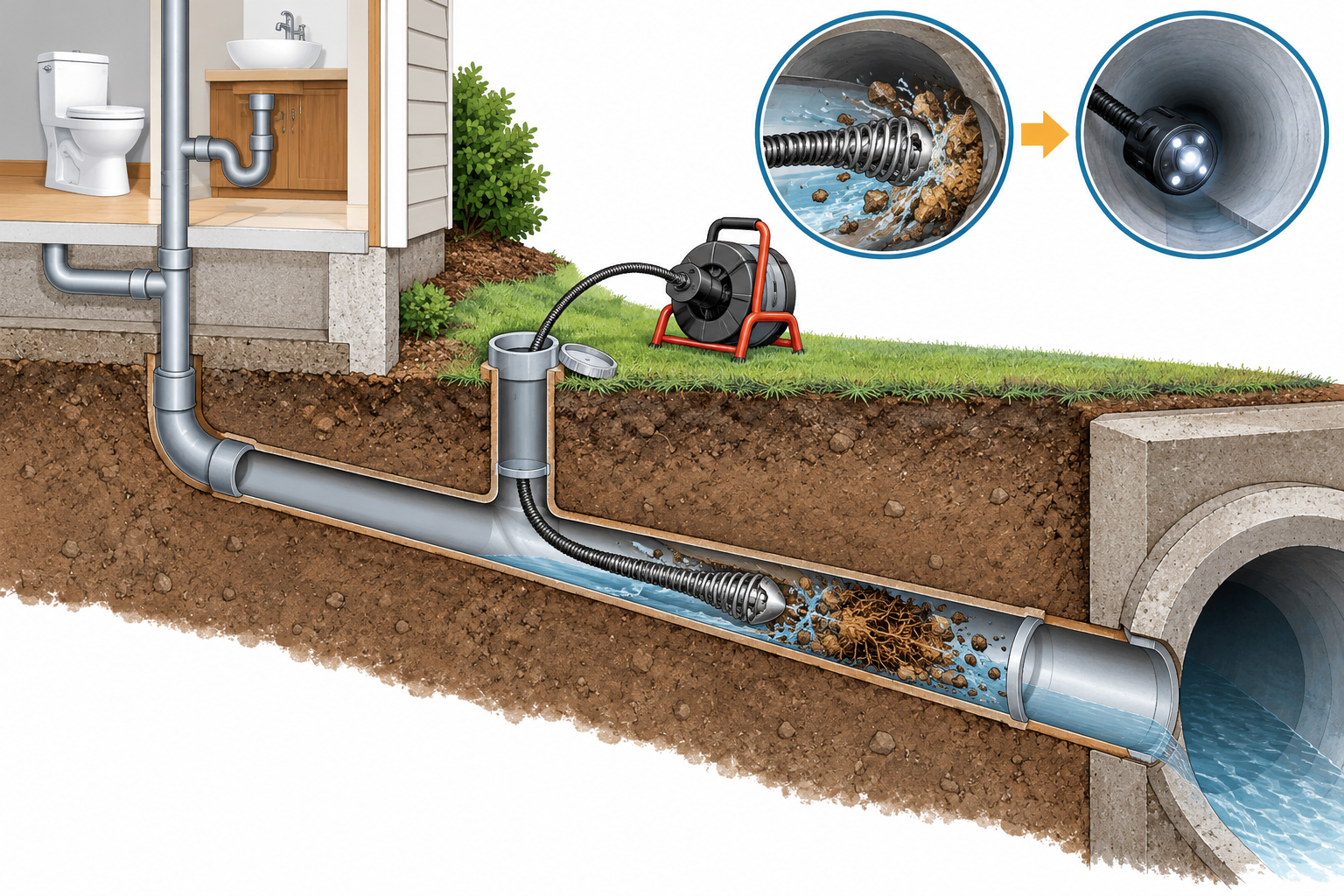
The first objective is usually to identify an accessible entry point, clear the obstruction with mechanical equipment, and confirm whether wastewater flows again. A contractor may work through an existing cleanout or another access point. The service may be called snaking, rodding, augering, root cutting, or main-line clearing; names do not guarantee identical equipment or deliverables.
The base price may include a service call, labor, ordinary equipment, and a limited attempt to restore flow. It may not include camera inspection, electronic locating, excavation, installation of a cleanout, hydro jetting, root treatment, structural repair, emergency response, or restoration. Ask for the stopping point before work begins: is the goal simply to open the line, or is the visit also intended to document its condition?
A practical cost framework
| Situation | What the project may involve | Cost implication |
|---|---|---|
| Accessible, isolated blockage | Existing cleanout, ordinary mechanical clearing, flow check | Lower uncertainty; often a service minimum governs |
| Difficult access | Searching for an entry point, opening a surface, or longer setup | More labor and possible access restoration |
| Heavy or resistant blockage | Roots, scale, compacted debris, or repeated passes | May shift the quote toward hydro jetting or a second service |
| Emergency backup | After-hours mobilization and urgent clearing | Premium response cost; permanent repair remains separate |
| Flow returns but the problem repeats | Cleaning followed by camera inspection and repair evaluation | Higher initial spend can reduce repeat-call uncertainty |
These bands are more useful than a single “average” when the line condition is unknown. A scheduled visit through a good cleanout is economically different from an emergency call where wastewater is already entering a basement.
What moves the price
Access is one of the first questions. A visible, usable cleanout reduces setup time. A buried, damaged, inaccessible, or missing cleanout may require additional locating or opening work. The line’s length and route matter because equipment must reach the obstruction and the contractor may need to work from more than one direction.
The blockage mechanism changes the service. Soft debris may respond to ordinary mechanical clearing. Roots, scale, grease, or a deformed pipe may require a more intensive cleaning approach. Clearing a symptom does not repair a broken or collapsed pipe.
Timing matters. An after-hours or holiday visit may cost more because the contractor is mobilizing under emergency conditions. Do not compare that response price with a normal scheduled maintenance visit as if they were the same scope.
The line segment matters. “Main sewer line” may mean the interior building drain, the exterior private lateral, or the whole run to the public main. Tell the contractor where fixtures are affected and ask which segment the quote covers. Responsibility may change at the property line or elsewhere under local rules.
When a camera inspection is worth adding
If the line has never been inspected, the blockage required unusual effort, or the same failure has returned, a camera can be a rational second step. Angi reports a broad US illustrative camera-inspection range of about $200 to $1,300 or more, depending on access and service scope. Another Angi guide reports $271 to $1,726 per visit. The difference illustrates why you should ask whether the price includes cleaning first, recording, a written report, locating, or emergency work.
Camera visibility may be limited while a line is fully blocked. Seattle Public Utilities notes that inspection is generally more useful after a blockage has been cleared. That does not mean every cleaning visit needs a camera; it means a homeowner should understand what the camera can and cannot show before paying for it.
When another cleaning is a poor bargain
Another clearing visit may be sensible when the first event is isolated, the line is flowing normally, and there is no sign of deterioration. It becomes less attractive when invoices are accumulating, the interval between blockages is shrinking, multiple fixtures are affected, roots recur, or the contractor cannot explain why the obstruction returns.
Keep prior invoices, dates, affected fixtures, photographs, and any camera footage. Ask a contractor to compare the cost of another cleaning with inspection and a defined repair investigation. There is no universal number of visits at which replacement is justified. A repeated clog is a reason to investigate, not proof that the line has failed.
Questions before approving the work
- Which pipe segment is included: building drain, private lateral, or a stated length?
- Is the quoted amount a service minimum, a fixed clearing price, or an hourly allowance?
- Is an existing cleanout usable, and what happens if access is inadequate?
- Is root cutting, hydro jetting, camera inspection, recording, or locating separate?
- What evidence will show that flow has been restored?
- If the blockage cannot be cleared, what charges remain and what is the next recommended step?
- Are emergency premiums, taxes, permits, or restoration excluded?
Cleaning is a useful service when the economic decision is “restore flow now.” When the decision has become “why does this keep happening, and what should I repair,” the next dollar is often more valuable when it buys information rather than another unexamined repeat visit.
Define the stopping point
Before work starts, agree on what happens after the first clearing attempt. If flow returns, will the contractor stop, test, and offer a camera as an option? If the line cannot be cleared, does the service continue at an hourly rate, or does the contractor need approval for hydro jetting, access work, or excavation? A clear stopping point prevents a routine service call from expanding under pressure.
Also ask whether the cleaning method could affect a fragile or older line and what condition the contractor will document. Professional drain-cleaning guidance emphasizes a systematic approach intended to protect underground infrastructure; that is not a promise that any service will reveal every defect. The homeowner should receive enough information to decide whether the next visit is maintenance or structural investigation.
How the service is priced
A service minimum can be the main charge even when the obstruction takes only a short time to reach. Other quotes may distinguish an initial attempt from additional time, a second access point, a different head or cutter, or work performed after ordinary hours. Ask whether the quoted amount covers one defined attempt, a period of labor, or work until flow is restored. Those are different commitments, especially when a contractor cannot see the blockage before arriving.
The invoice should separate work that restores flow from work that documents condition. A camera video, electronic locate, cleaning through a second access point, or removal of an existing cleanout may answer a different question and can be priced separately. If the contractor offers a bundled service, ask what each part would cost alone and whether the bundle still applies if the line cannot be cleared. A package is useful only if its stopping point and deliverables are clear.
Match the first call to the likely decision
For a one-time blockage in an accessible line, a scheduled mechanical clearing and flow check may be the whole project. If wastewater has already backed up, the first invoice may instead reflect urgent dispatch and stabilization; compare that charge with regular service only after the emergency has passed. For roots or scale that recur, a cleaning may restore use but should be followed by evidence about the entry point or pipe condition before a larger method is chosen.
The information path matters. If a camera cannot pass before the obstruction is removed, a cleaning-first sequence may be unavoidable. If the contractor already has a clear camera finding, repeating cleaning without a reason may add little. If the line is old, the homeowner should disclose known material and repairs so the provider can explain method limits. A useful budget records both what restored flow and what remains uncertain.
Compare the cost of another visit with its information value
Keep a simple service history with each date, symptom, affected fixture, method, time until recurrence, price, and documented observation. Then compare three things: another service call, a cleaning plus inspection, and an inspection or repair assessment after flow is restored. The next service need not be the most intensive one; it should answer the question left open by the previous visit.
For example, an isolated clog that does not return supports a different plan from a line that needs a second clearing at the same measured distance. If two services have already been performed but neither included inspection, the homeowner may be paying for access repeatedly without learning why. That does not prove replacement is warranted; it identifies a point where an information purchase may improve the next quote. Include disruption and restoration if each visit requires opening the same surface.