
“Main drain” can describe several different pipe segments. This guide focuses on the principal wastewater building drain within or immediately beneath the home, before it becomes the exterior private sewer lateral. That distinction matters because an interior replacement may require finished-space demolition, slab access, branch reconnections, and restoration that do not appear in an exterior-lateral quote. The evidence does not establish a dependable national price range for this narrow project, so a useful budget is scenario-based rather than falsely precise.
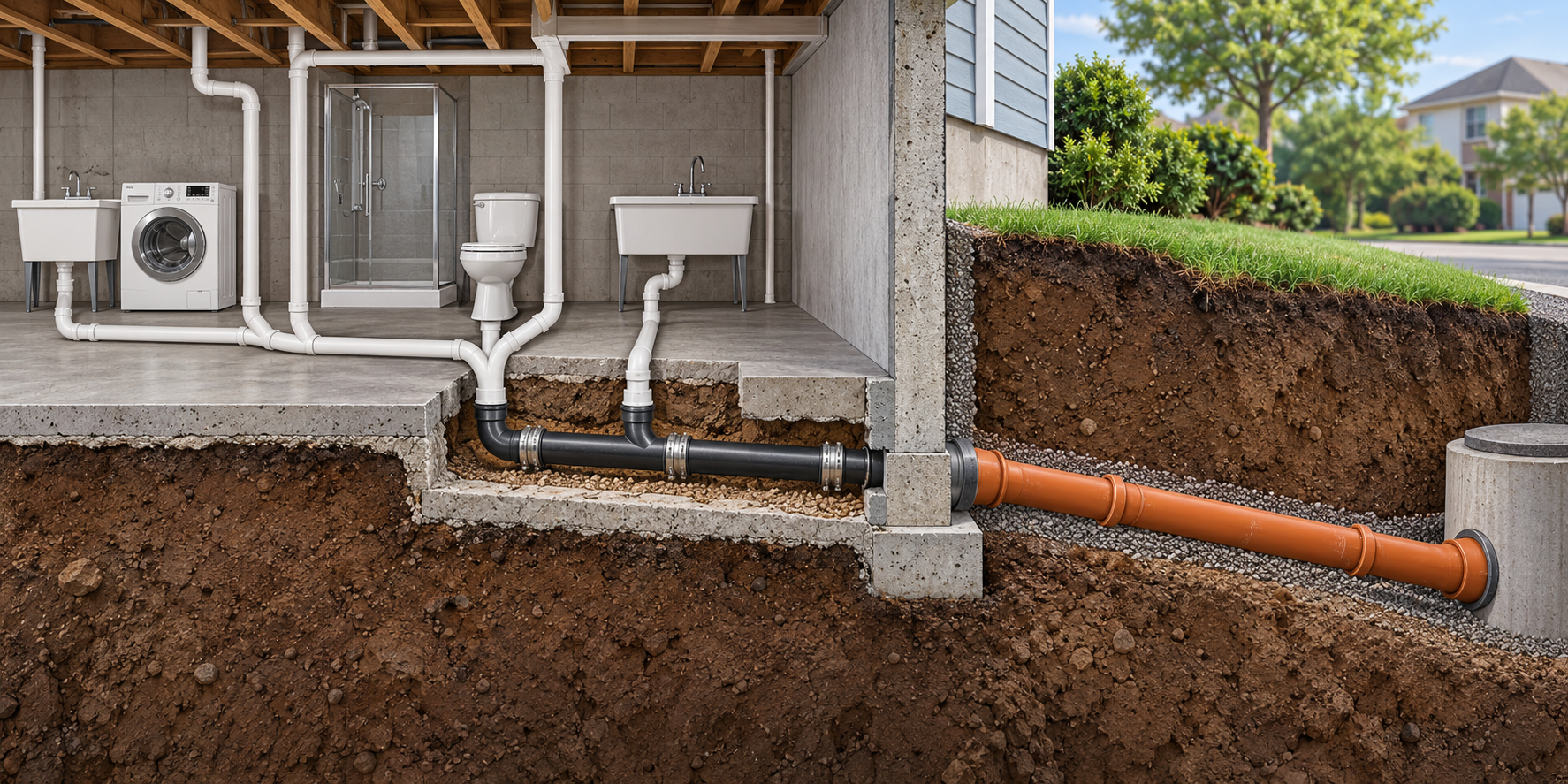
Define the boundary first
The building drain collects wastewater from branches and carries it toward the building sewer. The exterior lateral then carries it toward the public system. Consumer sources often call both a “main sewer line,” which can make unrelated quotes look comparable. Ask the contractor to mark the start and end points, identify retained pipe, and state whether the connection to the exterior line is included.
The cost layers
| Layer | Lower-uncertainty case | Why it expands |
|---|---|---|
| Diagnosis | Accessible inspection or known failed section | Blockage, incomplete camera view, or uncertain route |
| Pipe work | Short exposed replacement | Longer run, multiple branches, difficult material or connections |
| Access | Open basement or crawl-space route | Concrete slab, finished floor, walls, cabinets, or tight work area |
| Utilities and coordination | Existing compatible connections | Electrical, venting, structural, or other trade coordination |
| Restoration | Limited patching | Flooring, drywall, cabinetry, concrete, or custom finishes |
The pipe itself is only one layer. A bid that includes plumbing but excludes removal and restoration may be appropriate, but it is not a complete project total.
Three practical scenarios
Accessible basement drain: The failed section is visible, the surrounding pipe can be inspected, and a plumber can replace it without opening finished surfaces. Labor and connections dominate, while restoration is limited. Ask whether branches and cleanout access are included.
Concealed run under a slab or floor: Diagnosis and access become the main uncertainty. The contractor may need a defined opening, several openings, or another access strategy. Compare the direct replacement path with a carefully scoped reroute only when the proposed route remains code-compliant and serves the same fixtures; do not assume a reroute is automatically cheaper or better.
Older line with several weak sections: A short patch can be attractive if the defect is genuinely isolated. If inspection shows distributed deterioration, repeated access can make a longer replacement more coherent. Pipe age or material alone does not prove that every section requires removal.
Material and connection choices
Older cast-iron or other legacy pipe may have different cutting, support, connection, and disposal requirements from newer plastic pipe. The material should be identified, but condition and the connection to retained sections are usually more useful than age as a standalone decision factor. Ask how the new section connects to existing branches and the exterior lateral, and whether the contractor is pricing unknown transitions as an allowance or a unit rate.
Avoid a proposal that calls the entire interior line “replaced” while leaving a known damaged connection or inaccessible branch outside the scope. Conversely, do not expand a localized failure into a whole-house replacement without explaining what evidence justifies the added length.
Interior restoration can change the economics
Plumbing work may require removing flooring, opening walls or ceilings, cutting slab, moving fixtures, protecting occupied rooms, and rebuilding finishes. Drywall, tile, cabinets, flooring, paint, and structural work may be separate trades. If sewage or contaminated water is involved, cleanup and remediation are separate from the pipe-replacement scope.
Ask for a room-by-room access plan and whether the price includes temporary protection, debris removal, patching, and final finish. If finish matching is uncertain, request allowances or unit prices rather than an open-ended contingency.
Compare repair with replacement
A repair is more credible when inspection identifies a bounded defect and surrounding pipe is serviceable. Replacement becomes more credible when defects are distributed, branches repeatedly fail, the material cannot be integrated reliably, or access would be repeated for several separate repairs. A camera finding does not automatically settle the choice; the method, retained length, access, and ownership horizon still matter.
Seattle Public Utilities separates cleaning and root removal from structural methods such as spot repair and open-cut construction. Use that distinction here too. Clearing a building drain is not replacing it, and replacing one visible section is not necessarily replacing the complete principal drain.
What to put in the quote request
- a marked drawing or description of the pipe segment;
- inspection evidence and the limits of what was viewed;
- access openings, demolition, protection, and disposal;
- pipe material, size, length, connections, and retained sections;
- slab, wall, floor, or crawl-space assumptions;
- branch reconnections and testing;
- finish restoration and separate-trade boundaries;
- permit or inspection requirements where applicable;
- unit prices for concealed deterioration;
- warranty coverage for new and retained work.
The right budget question
Do not ask only, “What does a main drain replacement cost?” Ask, “What is the cost to replace this defined interior segment, make all required connections, restore access, and leave the exterior lateral outside or inside the scope?” That question turns a vague national estimate into a quote that can be compared.
For an exposed, isolated failure, replacement may be a focused project. For a concealed run beneath finished rooms, the access and restoration budget may dominate. The important economic decision is to pay for the smallest coherent scope that corrects the demonstrated failure without hiding the next weak section.
Sequence the work around access
If access requires removing a fixture, cabinet, floor, or wall, ask whether inspection and location can be completed before demolition expands. A staged opening may cost another mobilization but can prevent replacing a longer section based on a guess. If the contractor already has the area open, request photographs and measurements before approving added pipe length.
Coordinate plumbing and finish trades in writing. The plumbing price can be complete for the drain and still leave concrete, flooring, drywall, tile, cabinetry, painting, or contaminated-material work to others. A schedule that does not name those handoffs is not a complete occupancy plan.
Ask where the building drain becomes the lateral
The point where interior plumbing ends and the exterior building sewer begins can affect both price and responsibility. Ask the plumber to show that transition on a sketch and identify whether the quote includes the connection, cleanout, and any pipe just outside the foundation. If the failure is near the wall, a contractor may need to inspect both sides of the transition before deciding whether the project is an interior drain replacement or an exterior lateral repair.
This matters when one estimate prices pipe beneath the home and another includes the run to the property line. It also matters for restoration: interior work may include floors, cabinets, walls, or a slab, while exterior work may include landscaping or public permits. Put the endpoint and excluded adjacent system in every bid request so the total has a clear boundary.
Stage access and concealed-condition approvals
For a concealed run, ask whether the contractor can inspect through existing access before removing finishes and whether a small exploratory opening can verify the pipe condition. The first stage should have a defined price, location, and report. If it reveals more deterioration, require a revised scope and approval before replacing additional length. This allows the contractor to respond to actual conditions without turning the initial authorization into an unlimited demolition budget.
Request unit prices for added pipe length or common concealed transitions where available. Confirm whether debris disposal, temporary protection, fixture removal and reconnection, testing, and final cleanup are included. Ask who is responsible for plumbing work versus concrete and finish restoration, and whether the trades are scheduled consecutively or separately. A clear handoff can reduce the time a room is open and help distinguish an accurate plumbing estimate from an incomplete full-project budget.
Use records to protect the work that remains
Before the new section is covered, request photographs of the exposed defect, connection to retained pipe, and new route. Keep the material, length, location, test result, permit or inspection record, and warranty with the property documents. If the rest of the drain remains in service, note its known condition and any camera limitations. That record will help a future contractor determine whether a later blockage is related to the replaced segment or a different branch.
If only one branch fails, ask whether its connection to the principal drain can be assessed without replacing the whole collector. If several branches show defects, ask which findings justify the longer scope and whether the replacement will restore access for future inspection. The quote should connect each added length to an observed condition or a clear construction requirement.
Where retained pipe is left behind, ask for its inspected limits so the next maintenance decision does not assume the whole building drain was renewed.
Close out the interior project as one system
Before paying the final balance, ask for the test result, a marked record of the replaced segment, confirmation that each branch and cleanout was reconnected, and any permit or inspection close-out. If the contractor and finish trade are separate, record who owns a leak or finish defect discovered after the room is closed. A full building-drain estimate should make that handoff visible alongside the pipe price. Keep the records with the home so a future buyer or plumber can tell which portion was renewed and what remains original.