
Under-slab drain repair has no dependable national price range because the pipe may be inexpensive compared with finding it, reaching it, supporting the building, and restoring the slab and finished room. Treat a proposal as several projects: diagnosis and location, access, pipe repair or replacement, testing, and restoration. A contractor who quotes only a pipe repair may not be quoting the homeowner’s final cost.
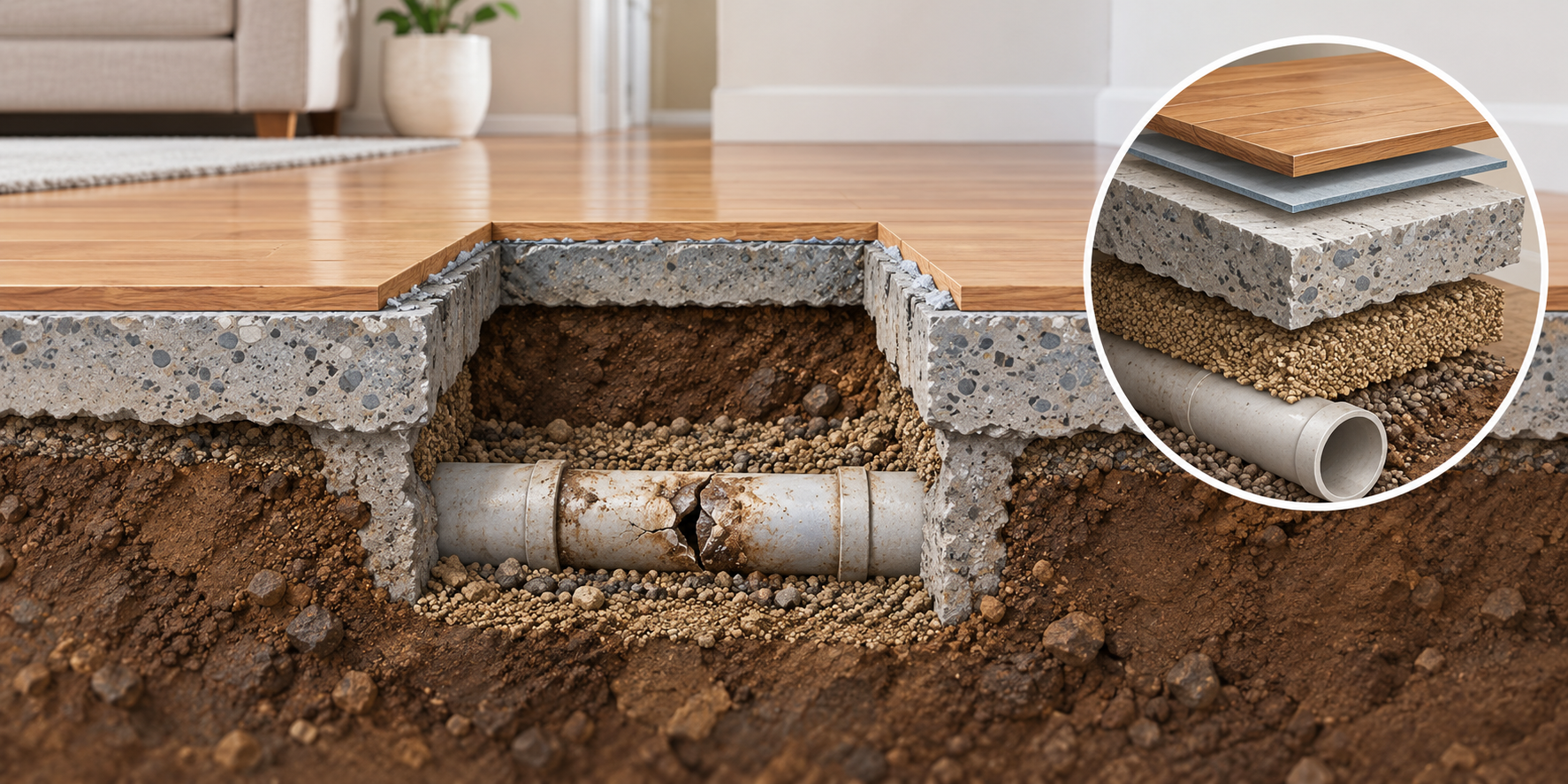
Why access dominates
The pipe is concealed below concrete and may run beneath flooring, walls, fixtures, or structural elements. The failure may be localized, but the route to it may require one opening or a larger exposed area. Depth, reinforcement, finish material, occupied-room protection, soil conditions, and the need to keep fixtures usable can all change labor and sequencing.
The first cost question is therefore not “How many feet of pipe?” It is “How certain are we about the location, and what surface must be opened to reach it?” A camera can identify a condition from inside the pipe, but it may not provide an exact surface location or depth without additional locating work.
Access approaches at a high level
Direct opening: The slab and finish are opened above the failed section, the pipe is repaired or replaced, and the opening is rebuilt. This may be efficient when the location is certain and the finish restoration is manageable, but it creates dust, demolition, and a direct restoration obligation.
Multiple or limited openings: The contractor may expose only selected points to confirm route and condition before committing to a longer repair. This can control uncertainty but may add mobilization and temporary restoration.
Reroute or alternate access: In some properties, a new route or different access strategy may be considered. It is not automatically cheaper, shorter, or suitable. Slope, fixture connections, clearances, code, structural effects, and finish work require project-specific professional assessment.
Do not treat these as homeowner instructions. Cutting concrete, tunneling, or changing wastewater routing can affect structure, utilities, safety, and code compliance.
Build the budget in layers
| Budget layer | Questions to answer |
|---|---|
| Diagnosis | What evidence identifies the failure and its limits? |
| Location | Is route, depth, and surface position confirmed? |
| Access | What concrete, flooring, walls, fixtures, or soil must be disturbed? |
| Pipe scope | Is this a point repair, a segment replacement, or a larger drain run? |
| Coordination | Are structural, plumbing, electrical, or permit reviews needed? |
| Restoration | Who rebuilds slab, moisture control, flooring, walls, and fixtures? |
| Contingency | What concealed condition triggers extra work and approval? |
The EPA condition-assessment guidance identifies access, inspection, analysis, reporting, surface restoration, and service disruption as possible assessment costs. Those categories are useful even though the report is not a current residential price schedule.
Scenario comparison
Known short failure in an unfinished basement: Camera and locating evidence identify a short section, access is ordinary, and restoration is limited. A focused repair may have the lowest total and preserve sound surrounding pipe.
Failure beneath a finished kitchen or bathroom: Access and finish restoration can rival the plumbing. Compare direct opening with any professionally designed alternate path, and keep flooring, cabinets, tile, and fixture work visible in the budget.
Repeated failures along the same drain: Several openings may cost more than a coherent segment replacement. Ask for evidence of the affected length and the consequences of leaving adjacent sections in place; do not authorize a whole-run replacement solely because one section is difficult to reach.
Uncertain location or conflicting diagnoses: Pay for better location evidence or an independent assessment before committing to broad demolition. A low initial diagnostic cost can be poor value if it leads to an opening in the wrong place.
Repair versus broader replacement
Spot repair is strongest when the defect is localized and the host pipe is otherwise serviceable. A longer replacement may make sense when deterioration is distributed, the same access would be repeated, branches are failing, or the proposed repair would leave a known weak section immediately adjacent. Structural access does not by itself prove that replacement is warranted.
If a contractor suggests lining or another trenchless method, ask whether that method applies to an interior under-slab building drain and the actual geometry. Exterior sewer methods cannot be assumed to transfer to every interior configuration. A method must address both the defect and the access problem.
Quote and approval controls
Request a marked scope, photographs or video evidence, access assumptions, protection plan, pipe materials, testing, and restoration responsibilities. For concealed work, use a unit price or allowance tied to a measured condition. Agree on who must approve added demolition and what evidence will be provided before the scope expands.
Ask whether the home will have usable wastewater service during the work, whether fixtures must be removed, and whether the contractor is coordinating with a structural professional or separate restoration trade. If sewage has contaminated materials, route cleanup and remediation to the appropriate specialist scope rather than assuming the plumber’s patch includes it.
When professional review matters
Under-slab work can involve structural loads, buried utilities, moisture, contaminated water, and confined or dusty work areas. The homeowner should not receive slab-cutting or tunneling instructions from a cost guide. Ask the contractor what local permits, inspections, engineering input, and safe work controls apply.
The most reliable estimate is not the one with the narrowest number. It is the one that clearly separates a known pipe repair from the access and restoration risks that make under-slab projects expensive.
Buy enough location evidence to limit demolition
Before authorizing concrete removal, ask what the camera or other inspection established about the fault’s distance from the access point and whether a locate can place it on the surface. A camera finding inside a line can be precise by distance but still leave uncertainty about the route, depth, slab, and nearby fixtures. The contractor should identify that uncertainty rather than promise that one mark gives an exact excavation boundary.
If the pipe cannot be inspected fully, ask for an initial access stage with a price ceiling and a report before extending the opening. A known short leak below an unfinished slab differs from a blockage under a tiled bathroom where the camera stopped at the obstruction. A targeted opening may confirm which segment failed, while multiple exploratory cuts can add restoration and labor. Compare the diagnostic cost with the size of the repair it may prevent or better define.
Coordinate plumbing, structure, and finishes
The work may affect fixture connections, a slab, walls, floor covering, cabinetry, electrical or other buried services, and occupied rooms. Ask the plumber what other professional review or permit is needed and who arranges it. Do not assume a drain quote includes structural review, concrete work, moisture barrier reinstatement, finish matching, or cleanup of contaminated material. Request a sequence that identifies when the plumbing can be tested and when the slab may be closed.
If the home remains occupied, clarify which fixtures can be used during work and for how long. Ask about dust containment, furniture protection, debris removal, and temporary closures. These are project and restoration costs, not pipe costs, but they affect the total disruption and may involve separate contractors. Keep the plumbing base scope visible so a finish allowance does not obscure what repair is being purchased.
Compare a direct repair with a reroute carefully
A reroute can avoid a difficult access point in some layouts, but it may require a longer or more complex path, additional connections, wall or ceiling openings, and finish work. Compare the new route’s fixture connections, slope and serviceability with the direct under-slab repair. Ask a qualified professional to explain compatibility and local requirements; a cost guide cannot establish that the alternate route is feasible.
If one option involves less concrete but more interior reconstruction, put each surface and trade into the comparison. Include access for future service and the condition of pipe left in place. A small opening is not automatically the least-cost durable outcome if the route must be accessed again, while avoiding a slab opening is not by itself a reason to change the drain layout.
Use a staged approval for concealed work
When the exact failure cannot be located confidently, ask for a first-stage diagnostic and access scope with a defined limit. Require photographs, measurements, and a new price before expanding the opening or replacing additional pipe. This preserves control without requiring a contractor to predict concealed conditions that no one has seen.
If a reroute is proposed, compare the complete route, fixture connections, access, finish restoration, and future serviceability with direct repair. A shorter plumbing path is not necessarily the lower-cost project if it adds walls, ceilings, fixtures, or code-sensitive coordination. The decision is about a durable, inspectable wastewater route, not just avoiding one slab opening.
Ask for before-and-after photographs and the final test result before finishes are restored. These records establish what the repair included if a later symptom occurs.
Save those records with the floor plan and any later finish-restoration invoice.
Reconcile the final invoices
A plumbing quote, concrete opening, and finish invoice may cover separate parts of the same repair. Match each to the approved access area, the pipe segment repaired, and the agreed surface standard. If the opening grew, ask for the measurements and approval that support the additional work before accepting the final total. This is especially useful when the direct repair and restoration trades were contracted separately.