
Demolition is optimized to remove a structure efficiently. Deconstruction reverses construction so that selected materials can be recovered with less damage. The right choice depends on the building, the local reuse market, the schedule, and the value of avoiding disposal—not on the promise that every salvaged item will pay for extra labor.
Three approaches to compare
| Approach | Main objective | Typical economic question |
|---|---|---|
| Conventional demolition | Reduce the structure to manageable debris quickly | Is the shortest practical removal path worth the disposal and equipment cost? |
| Partial deconstruction | Recover selected assemblies or materials before ordinary demolition | Are a few high-value items worth the added labor and coordination? |
| Full deconstruction | Dismantle much of the building in a planned sequence | Can recovery, reuse, and avoided disposal justify a longer and more labor-intensive project? |
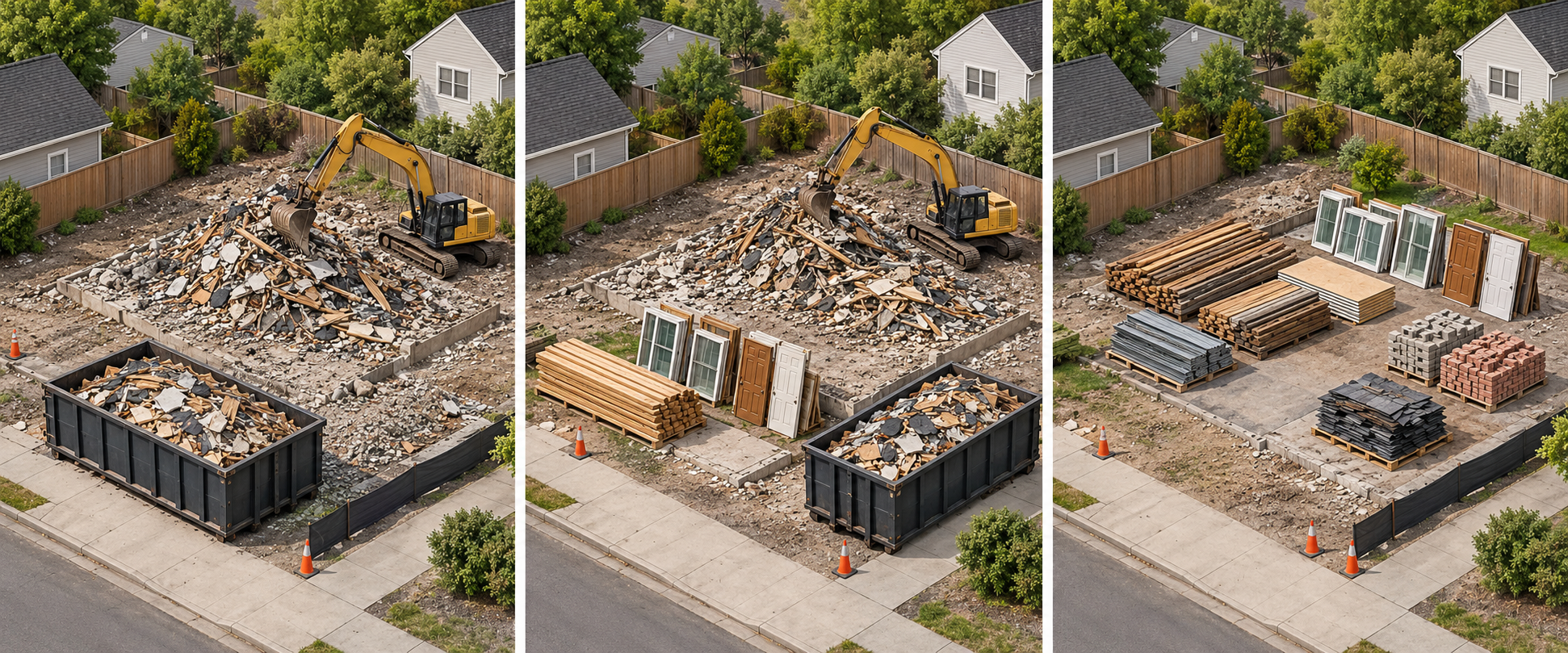
A hybrid approach is common: salvage selected items first, then use conventional demolition for the remaining structure.
Where salvage value may exist
EPA identifies wood-framed buildings, specialty materials, quality brick, and structurally sound buildings as potentially favorable for deconstruction. Examples of specialty materials can include hardwood flooring, windows, moldings, doors, fixtures, lumber, millwork, and brick. These are opportunities, not guaranteed prices. Condition, dimensions, removal damage, testing, storage, transport, cleaning, and local buyer demand all affect value.
Treat expected salvage as a conditional credit, not cash in hand. A bid should state who removes, owns, stores, transports, markets, and carries the risk for recovered material.
Labor and schedule trade-offs
Deconstruction is more deliberate. The work may proceed from trim and casing to fixtures and openings, then finishes and systems, and finally roof, walls, frame, and floor-support structure. That ordered pattern is a general description of recovery work, not an instruction for homeowners to dismantle a building.
Extra labor can be worthwhile when the material is unusually reusable, disposal is expensive, or a local program values diversion. It can be a poor fit when the structure is unstable, badly deteriorated, contaminated, inaccessible, or under a tight schedule. The owner should compare the net project cost and risk, not only the demolition line.
Compare the net cost
Ask each bidder to show:
- labor for assessment, careful removal, sorting, and preparation;
- equipment and mobilization for both recovery and remaining demolition;
- containers, hauling, disposal, and any avoided heavy or mixed-waste charges;
- storage, transport, listing, donation, or resale costs;
- expected salvage credits, with their assumptions and timing;
- schedule, weather exposure, security, and responsibility for unsold materials;
- cleanup and final site condition.
The useful calculation is:
Deconstruction labor and handling + remaining demolition + storage and transport + residual disposal − realistic salvage or diversion credit = expected net cost.
Do not count an item as a credit merely because it could theoretically be reused. A material that must be stored for months or shipped to a distant buyer may have negative net value.
Disposal and Canadian context
Separating material can make reuse and recycling possible, but it also takes space and coordination. Government of Canada reporting distinguishes construction, renovation, and demolition streams such as commingled material, metal, plastic, gypsum, masonry, concrete, asphalt, and wood. Its federal-project data shows that diversion varies by material and jurisdiction; it is not a national private-home fee schedule or mandate.
U.S. and Canadian requirements, reuse markets, tax treatment, and disposal acceptance are not interchangeable. If a donation or tax deduction is part of the financial case, obtain jurisdiction-specific tax advice rather than treating a possible deduction as a guaranteed project credit.
When to investigate deconstruction
It is worth asking for a deconstruction or salvage option when the building is reasonably sound, contains identifiable reusable materials, and there is a known local outlet. Request a separate option even if the final decision is conventional demolition. That gives you an evidence-based comparison of added labor, recovered value, disposal savings, schedule, and risk.
For full-teardown scope, see house demolition cost. For the disposal side of the decision, see construction debris disposal cost.
Compare outcomes before comparing methods
“Demolition” and “deconstruction” describe different levels of material recovery, but a homeowner is ultimately comparing what each bid accomplishes on the property. One proposal may remove the structure, foundations, and debris; another may remove selected reusable elements, leave part of the shell, or stop at a different site condition. Ask every bidder to state the same starting condition, included structures, below-grade scope, material ownership, disposal, and final condition. Without that shared endpoint, a lower total may reflect less work rather than a more efficient method.
Deconstruction can be partial, selective, or more comprehensive. The value depends on which elements can be removed intact, the time needed to do so, whether a reuse outlet exists, and who bears storage and transport cost. A building’s age or appearance alone does not establish that materials are reusable or valuable. Condition, prior alterations, fasteners, damage, size, and current demand all matter. Ask for a specific list of recoverable items and how the bidder arrived at any credit rather than relying on a general promise of salvage value.
Test the salvage calculation
A useful comparison separates the extra recovery cost from the benefit it might create. On the cost side, consider careful labor, selective removal, sorting, temporary storage, transport, and schedule extension. On the benefit side, identify a confirmed buyer, donation recipient, or reuse outlet, the condition it will accept, and whether the material’s value is credited to the homeowner or retained by the contractor. Avoid counting both an avoided disposal fee and a resale value unless each is separately supported and contractually allocated.
If the outlet is uncertain, request two versions of the estimate: one with the recovery work and its stated assumptions, and one with ordinary demolition and disposal. The comparison should show whether the owner pays for recovery even if materials are not accepted. This is especially important where the project has limited staging space or a firm start date for replacement work.
Schedule and access can reverse the apparent savings
Conventional mechanical removal may be faster once utilities, access, and site preparation are ready. More careful deconstruction may need additional labor days, sequential work, and protected storage. The added duration can affect equipment rental, site security, temporary weather protection, temporary services, and the date the next contractor can begin. A salvage credit that looks attractive before those costs may have little net effect after schedule impacts are included.
The reverse can also be true: a project with specific reuse requirements or a local rule may make recovery necessary, and a plan prepared early can avoid late redesign or disposal changes. Portland and Vancouver have their own eligibility tests and material rules; they do not create a general U.S. or Canadian requirement. Boulder County says buildings in its unincorporated area must be deconstructed and lists recovery and closeout documentation, while noting that cities and towns may have different rules. Its webpage is a code summary, so verify current code and project coverage with the relevant authority rather than applying another city’s example to your address.
Conditional grants can change net outlay only when the property, work, timing, and records qualify. Hennepin County’s 2026 residential program offers up to $5,000, capped at $2 per square foot, for eligible projects on owner-held properties in the County with up to four units, built before 1970, and at least 500 square feet. The County page displays “$” without a currency code. The grant requires at least five recovered materials, 1,000 pounds of lumber for reuse, non-reusable material sent to a facility with a minimum 60% recycling rate, documentation, and an agreement before funded work; applications run through November 1, 2026, or until funds are depleted. The ceiling is not an expected credit. As of October 12, Edina reports that its 2026 match is fully allocated, though Hennepin County funding may remain. Confirm current availability and keep the gross contract price, approved support, and possible salvage proceeds separate.
Use a decision table for the bids
| Comparison item | Conventional demolition | Deconstruction or selective recovery |
|---|---|---|
| Included scope | Structure, foundation, contents, and site endpoint stated | Exact elements to be recovered or retained stated |
| Labor and timing | Equipment, crew, loading, and schedule assumptions | Additional careful removal, sorting, and staging time |
| Material value | Disposal destination and charges identified | Outlet, acceptance condition, ownership, and credit identified |
| Site constraints | Machine access, neighbors, and haul route considered | Storage area, pickup timing, and protection considered |
| Change risk | Concealed conditions and rejected loads addressed | Unusable material, failed outlet, and extra storage addressed |
Use the same assumptions for both. If the recovery bid credits only a possible future sale, compare project cost without treating that amount as guaranteed. If the conventional bid includes a disposal allowance but no receipts, ask how overruns are handled. A net-cost claim is only as sound as the quantities, scope, destinations, and risk allocation behind it.
When to investigate further
Ask for a material assessment when the structure contains elements likely to be reused or when local project requirements may prescribe recovery. Ask the next builder or designer what condition the site must reach and whether retained elements affect the new plan. If there is no likely outlet, no room to stage materials, or no schedule flexibility, the additional recovery work may not make economic sense even when it reduces waste.
Keep hazardous-material assessment separate. Suspected lead, asbestos, or other regulated materials can affect whether ordinary salvage handling is appropriate and may require specialist work before any recovery plan. Do not treat a material as reusable until the responsible professional determines relevant safety and acceptance conditions. For the full removal budget, compare house demolition cost and keep debris handling visible through construction debris disposal cost.