
A full house demolition is a site project, not just the act of knocking down a structure. The final quote can combine preparation, utility coordination, equipment, crew time, debris handling, disposal, access, and closeout. A useful estimate shows those pieces clearly enough for you to compare bids.
What “full demolition” usually means
Full demolition generally means removing the house as a structure and leaving the site in the condition described in the contract. That may include breaking the building down, loading debris, hauling it away, and rough grading or cleanup. It does not automatically mean removing every foundation element, disconnecting every service, obtaining every approval, testing for hazardous materials, or preparing the lot for new construction.
Ask the contractor to define whether the scope includes:
- the house only or attached porches, decks, garages, sheds, and site features;
- interior contents and appliances;
- basement walls, slabs, footings, and buried foundations;
- utility coordination and service disconnection interfaces;
- hauling and disposal, including weight or material surcharges;
- backfilling, rough grading, erosion control, and final site condition.
How a teardown quote is assembled
The core price often reflects crew and equipment time. The enabling portions can be just as important:
| Quote component | What can move the cost |
|---|---|
| Preparation | Contents removal, neighbor protection, utility coordination, and site isolation |
| Teardown | Stories, framing, construction type, equipment choice, and sequence |
| Access | Gate width, overhead lines, slope, ground bearing, and room for machines |
| Debris handling | Volume, weight, sorting, loading distance, and number of hauls |
| Disposal | Material stream, contamination, facility, distance, and local acceptance |
| Foundation | Thickness, reinforcement, depth, buried conditions, and whether removal is required |
| Closeout | Cleanup, rough grading, backfill, and the condition promised at handover |
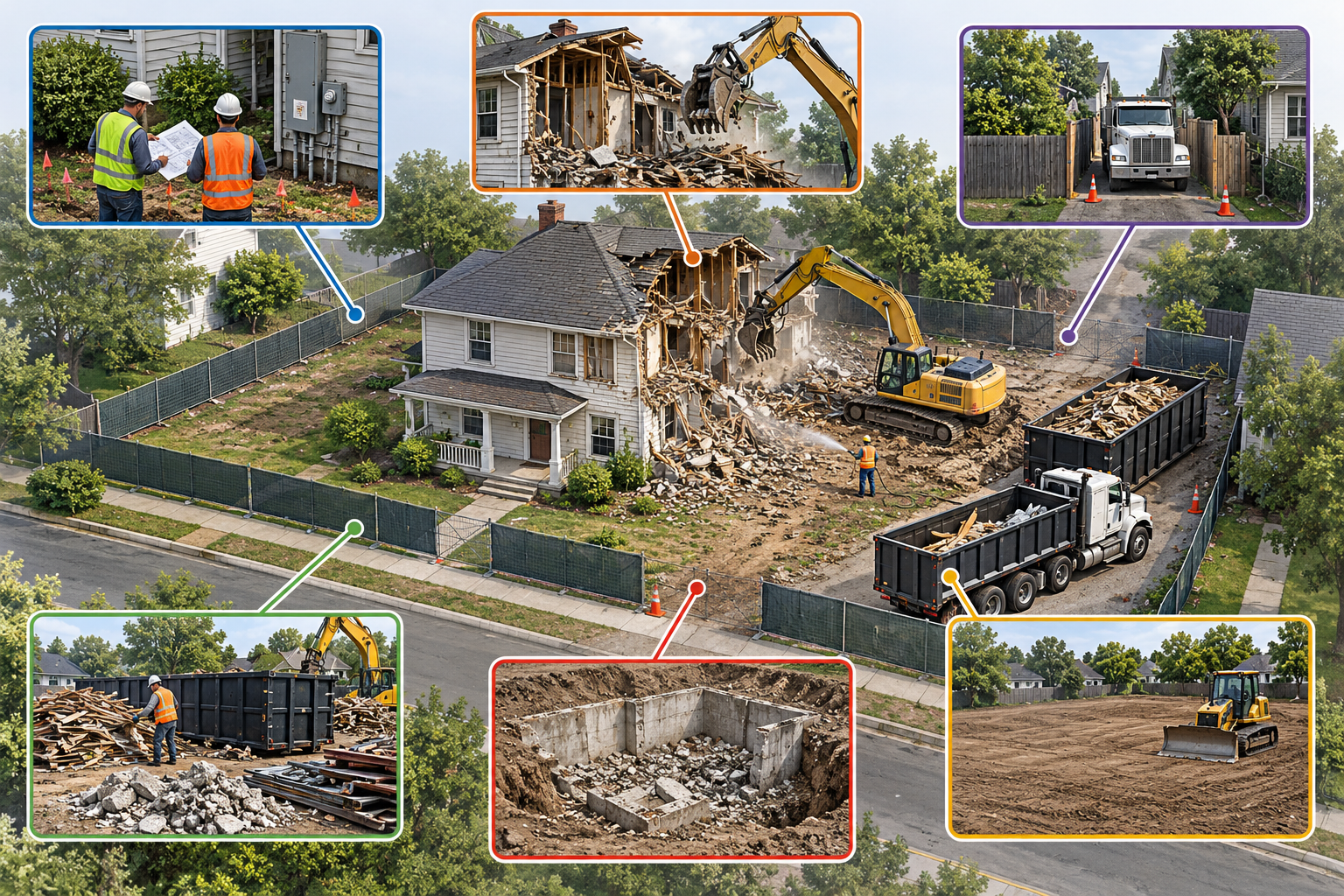
There is no dependable national teardown tariff. Consumer-market demolition figures are directional only; labor, disposal, access, and local requirements can make two houses with the same floor area produce very different bids. Compare the scope and assumptions behind any number rather than treating a per-square-foot figure as a quote.
Foundation removal is a separate decision
Some projects remove a slab, basement, or footings. Others leave eligible portions in place for a future plan or because complete removal would require substantially more breaking, excavation, hauling, and backfill. The choice can affect the next building design, soil conditions, utilities, and approvals.
Have the demolition contractor and the professional responsible for the future site work state what remains below grade. “House removed” is not precise enough if the lot will be reused. Foundation removal and site restoration should appear as identifiable scope items, not be hidden in a general cleanup allowance.
Moving an intact structure is a separate alternative to demolition or salvage. The City of Vancouver describes building relocation as a demolition alternative that a moving contractor should assess for the project. A Metro Vancouver case study separates the house move from destination foundation and utility work. Those scopes, plus any remaining work at the original site, need their own estimate; do not treat relocation as a demolition price adjustment.
Why hauling and disposal can dominate
Construction and demolition material is not one uniform waste stream. Concrete, masonry, wood, metal, drywall, roofing, and mixed debris can have different handling, weight, acceptance, and destination costs. Separating material may reduce disposal expense or support recycling, but it can add containers, labor, space, and coordination.
EPA identifies salvage, reuse, recycling, and deconstruction as options that can reduce waste. Those options do not guarantee savings: the work may take longer, recovered materials may have little local demand, and storage or transport can erase their value.
Local assistance is a separate eligibility question, not a lower demolition bid. Minnesota’s Residential Redevelopment program, for example, supports eligible demolition or full-home deconstruction projects through public and nonprofit applicants; individual owners cannot apply directly and are directed to their municipality. The program page does not promise that funding will reduce a particular homeowner’s bill. Deconstruction grants with property and reuse requirements are a separate comparison; see deconstruction vs. demolition.
Older homes and hazardous-material boundaries
Older construction can require additional investigation before work begins. In the United States, EPA distinguishes partial demolition or renovation from total demolition for purposes of its lead-safe Renovation, Repair and Painting framework, while still recommending lead-safe practices during total demolition. That is not a general hazardous-material clearance for a property. Asbestos, lead, PCBs, mold, silica, and other hazards belong to hazard-specific assessment and abatement professionals, with local rules checked for the site.
Questions to ask before accepting a bid
- What structures, contents, foundation elements, and buried materials are included?
- Who coordinates utility disconnection, and what happens if the site is not ready?
- What equipment and access assumptions does the price use?
- Is disposal included, and are weight, contamination, or prohibited-material charges separate?
- Is sorting, salvage, or recycling included, optional, or excluded?
- What site condition will exist after demolition?
- Which permits, approvals, engineering, testing, or hazardous-material services are outside this quote?
- What events cause remobilization, standby, weather, or change-order charges?
For a smaller renovation, compare this scope with selective and interior demolition. For a salvage-oriented project, see deconstruction vs. demolition.
Published cost guides are context, not a teardown bid
Current consumer guides illustrate how wide reported estimates can be. HomeGuide’s February 2026 U.S. page gives $4–$10 per square foot and a $6,000–$25,000 average teardown range. It says its per-square-foot figure includes cleanup and basic site grading; its $14,000 sample average is based on 32 member-reported project costs. HomeStars’ guide, updated August 21, 2026, reports a Canadian range of $5–$15 per square foot, including separate stated ranges for Ontario and Vancouver, but does not disclose a sample, estimate method, currency code, or normalized list of included work.
For illustration only, applying those per-area figures to a 1,500-square-foot house produces $6,000–$15,000 from HomeGuide’s U.S. range and $7,500–$22,500 from HomeStars’ Canadian range. The arithmetic does not make the sources comparable: their methods and scopes differ, the HomeStars currency code is unstated, and neither number is a quote for a particular property. HomeGuide’s reported project sample is limited; HomeStars’ local ranges are guide estimates, not verified city surveys. Use them to understand why broad online figures vary, then obtain local bids with the same foundation, disposal, and closeout assumptions.
A low-complexity and a constrained teardown are different projects
An uncomplicated example might be a detached house with clear equipment access, known utility status, no adjoining structure, and a defined endpoint that leaves the foundation in place. A contractor can estimate the building removal, loading, and ordinary cleanup against a relatively clear scope. Even then, the bid should say what happens to contents, appliances, sheds, and the driveway, and whether rough grading is included.
A constrained example may involve a shared wall or narrow urban lot, multiple stories, limited room for equipment, a basement to remove, heavy mixed debris, or a future building plan that requires a specific below-grade condition. The project may need more hand work, controlled sequencing, neighbor protection, extra loads, and coordination between demolition and excavation. Those are interacting costs: tight access can increase labor and haul handling at the same time that a foundation decision increases the volume and weight of material.
Do not ask a bidder to price only by finished floor area if these conditions remain unknown. Request a site visit, mark included structures, and identify what must be investigated before the price is firm. If a concealed condition is excluded, ask how it will be documented and priced before extra work proceeds.
Build the total around decisions you can verify
Before accepting a proposal, group the total into parts you can confirm: preparation and utility interfaces; structure removal; foundation and below-grade work; loading and hauling; facility charges; and site closeout. A contractor may reasonably bundle some items, but should explain the assumptions and exceptions. Check whether disposal charges are fixed, included up to a stated amount, or passed through from facility receipts. Confirm who pays for extra trips, rejected material, or a change in facility classification.
Then coordinate the endpoint with the next project. If new construction follows, the designer or site professional may specify what foundations, slabs, buried services, and soil conditions must remain or be removed. If a builder and demolition contractor both provide rough grading or debris removal, compare their boundaries to prevent duplicate allowances. A small apparent credit can be false economy if the lot is left short of the condition required for the next phase.
Deconstruction is another pathway, but it changes labor, schedule, sorting, and storage rather than guaranteeing resale value. Before counting a salvage credit, identify which materials are in usable condition, who will recover them, who owns them, and whether there is a real reuse outlet. Compare the deconstruction quote against a conventional demolition quote with matched debris and closeout scope; related trade-offs appear in deconstruction vs. demolition.
Treat exclusions as budget lines to resolve
Some estimates intentionally exclude approvals, surveys, utility-provider charges, hazardous-material assessment or abatement, environmental controls, backfill, engineered fill, and replacement site work. These exclusions do not prove that the contractor is underpricing the job, but they prevent the headline amount from representing the entire project. List each item as included, separately quoted, owner-arranged, or not yet determined. For each unresolved item, identify the responsible party and when it must be settled.
The most useful pre-award comparison is not the one with the most precise-looking per-square-foot number. It is the one that describes the same property, removal endpoint, disposal assumptions, local interfaces, and change process as the alternatives. Ask for a revised comparison whenever a bidder’s allowance silently moves a material cost outside the quoted total.