
Concrete removal is priced differently from ordinary light demolition because the material is dense, difficult to break, and expensive to move by weight. Surface area is only a starting point. Thickness, reinforcement, buried conditions, machine access, haul distance, and the destination facility can matter more.
Published prices offer context, not a comparable quote. Angi’s 2026 U.S.-oriented guide reports a $1,139 average based on 1,330 Angi Pro projects and a $2–$6 per-square-foot estimate for 3–6-inch slabs, with labor and dumping included; the same guide displays higher city and regional figures that it does not reconcile. A Southwestern Ontario contractor posts $3–$5 per square foot for standard residential removal and $5–$8 for reinforced concrete, while its FAQ gives a broader $3–$6 range. The pages do not state a currency code, and one provider’s offer is not a regional market rate. Confirm the current quote’s thickness, reinforcement, hauling, disposal, taxes, and site assumptions.
What a concrete-removal quote should separate
Look for distinct allowances for:
- locating and exposing the concrete;
- saw cutting or sectioning where needed;
- breaking with hand tools, a breaker, or larger equipment;
- loading and moving heavy pieces to the truck or container;
- hauling, container capacity, and weight limits;
- recycling or disposal fees;
- backfill, grading, patching, or replacement as a separate scope.
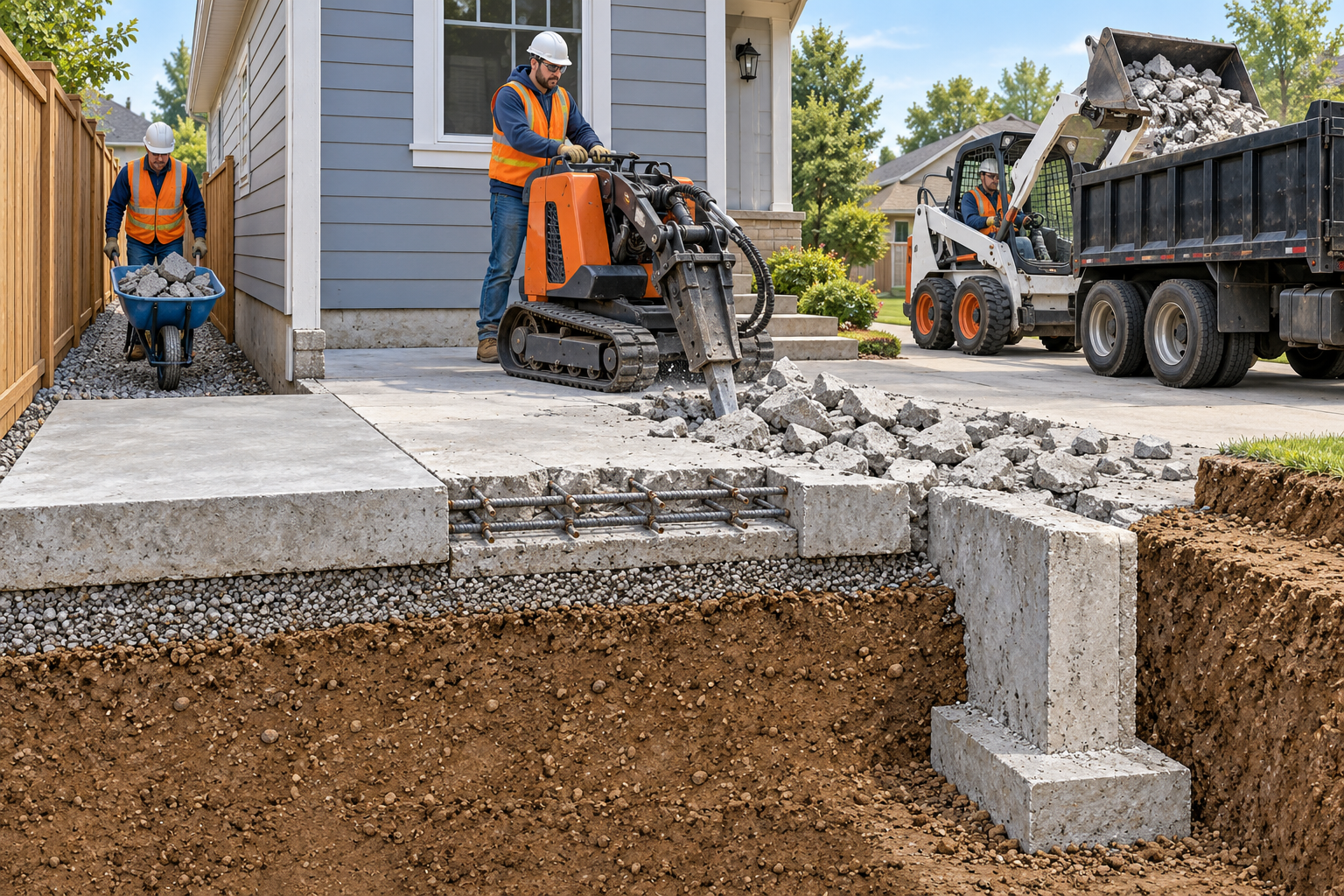
Concrete slabs, steps, footings, foundation walls, retaining elements, and reinforced pads do not have the same removal profile. A footing may be deeper than it appears. Reinforcing steel can slow breaking and require separate handling. Buried utilities or structural connections can change the method entirely.
Access changes the method
If a skid steer, excavator, or loader can reach the work, the crew may remove material faster than if every piece must travel through a gate, house, stair, or narrow side yard. But larger equipment needs width, turning room, ground support, and a safe path. Limited access can shift the cost toward saw cutting, smaller equipment, more crew time, more trips, or a different removal sequence.
Give bidders the access facts early: gate width, overhead clearance, route length, slopes, stairs, soft ground, nearby walls, and where a truck or container can stand. A site visit is more informative than a surface-area estimate alone.
Weight beats volume
Concrete can fill a container’s weight allowance before it fills its volume. Ask how the hauler handles:
- included weight and overage charges;
- maximum container loading for heavy material;
- mixed loads containing soil, masonry, wood, or metal;
- clean concrete accepted for recycling;
- reinforcement and contamination;
- separate loads or multiple hauls.
Government of Canada construction, renovation, and demolition reporting treats concrete and masonry as distinct material categories and shows why diversion results vary by material and jurisdiction. That context does not establish a local homeowner fee or guarantee that a nearby facility accepts your load.
Dust and silica boundary
Breaking, cutting, or grinding concrete can create hazardous dust. The removal plan should identify the controls and professional responsibilities before work starts. This article does not provide a concrete-cutting procedure, equipment instructions, or a substitute for applicable occupational-safety requirements.
If the material is contaminated or the project involves asbestos, lead, mold, PCBs, or another regulated hazard, ordinary concrete-removal pricing is no longer the whole question. Use hazard-specific assessment and abatement professionals.
Restoration is not removal
After concrete is removed, the remaining excavation or surface may need temporary stabilization, backfill, grading, drainage work, or a new slab, driveway, patio, or foundation. Those are separate scopes. Ask exactly whether the quoted price ends at removal, loading, disposal, rough grading, or a finished replacement.
Questions for a comparable quote
- What are the estimated thickness, depth, reinforcement, and total weight?
- What removal method and equipment-access assumptions are included?
- Is saw cutting, hand carrying, loading, and sorting included?
- Is the material going to a recycling facility, transfer station, or landfill?
- What weight, contamination, or extra-haul charges can occur?
- How will utilities and adjacent structures be protected?
- What dust controls are included, and what happens if hazardous material is found?
- What site condition will remain after removal?
For the downstream cost after the concrete leaves the site, read construction debris disposal cost.
Why two similar-looking slabs can produce different bids
Square footage helps identify the amount of surface, but it does not tell a contractor how much material must be broken, carried, and accepted. A thin patio with machine access is a different removal job from a thick reinforced slab behind the house. A small footing can also require deeper excavation and more difficult handling than its visible area suggests. If the bidder receives only a photo or surface measurement, the estimate may include assumptions that change after work begins.
The quote should say what is known and what remains provisional: measured thickness, approximate depth, reinforcement, embedded objects, access route, and whether the material is expected to be clean concrete or mixed with soil and other debris. If the contractor cannot confirm an item until opening the work, ask what observation triggers a change and how the added work will be priced. A clearly identified uncertainty is easier to manage than a low fixed number based on an unstated assumption.
Removal method and disposal are linked
The way the concrete is separated can change the size of pieces, labor required for loading, the need for a machine, and whether reinforcing steel or attached material must be sorted. The fastest breaking approach is not always the lowest total if equipment cannot reach the work or if the resulting load exceeds a container or truck limit. Conversely, a labor-intensive approach may be justified where a larger machine would threaten adjacent structures, finished surfaces, or access routes. The contractor should determine the appropriate method; the homeowner’s role is to compare the scope and site assumptions, not specify a tool or breaking procedure.
Ask whether material will be kept separate for a recycling destination or combined with other debris. A clean load may have a different receiving option from mixed rubble, but separating it can require space and handling. The quote should disclose whether a possible recycling credit is guaranteed, conditional on facility acceptance, or merely an assumption. Keep haul trips, container service, facility fees, and removal labor visible enough to determine who bears a heavier-than-expected load.
Think in project scenarios
A straightforward case might be an accessible, shallow exterior slab with known edges and a nearby place for a container. The core work can be easy to define, although hauling and the desired replacement surface still need separate scope. A constrained case might involve a slab inside a finished home, narrow access, hand carrying, dust-sensitive adjacent rooms, or several separate concrete elements. Setup, protection, small-piece handling, and multiple trips may be more important than area. A below-grade or structural case can add excavation, utility coordination, shoring or engineering decisions, uncertain depth, and substantial restoration; it should not be budgeted as an ordinary patio-removal job.
These are scope comparisons rather than price bands. When reviewing bids, match each contractor’s scenario to the same physical condition and final site outcome. One estimate may include loading and disposal but stop at the exposed base; another may include backfill and rough grading. A lower headline is not comparable if it ends earlier in the work.
Cost controls without false savings
You can improve quote accuracy by sharing available plans, photographs, approximate dimensions, access measurements, and the intended replacement project. Ask whether the contractor visited the site and which conditions were visually confirmed. If the new work will reuse the area, coordinate the required removal depth and finish condition with the designer or trade installing the replacement. Removing more concrete than necessary adds breaking, handling, and disposal without necessarily helping the next phase.
Do not try to reduce cost by mixing unknown materials into concrete loads or by asking an unqualified person to cut or break structural elements. The receiving facility’s rules and the project’s safety requirements govern. If a quote depends on a potential credit, estimate, or assumed acceptance, request the fallback charge if the material is rejected or classified differently.
Use safety scope as a bid-comparison item
Concrete cutting, sawing, grinding, drilling, and crushing can generate respirable crystalline silica dust. OSHA identifies those activities as potential exposure sources; the applicable controls depend on the work and workplace. This is a reason to ask who is responsible for the work plan, protection of occupants, cleanup, and any required professional controls. It is not a do-it-yourself dust-control recipe, and an ordinary removal quote does not establish that lead, asbestos, or other contamination has been assessed.
Compare proposals on the controls and cleanup they expressly include, while keeping specialized testing or abatement separate. If the work is near an occupied area, ask how the contractor will coordinate access and limit migration into finished rooms. If hazardous material is suspected, pause ordinary price comparison and obtain the appropriate assessment. For related debris weight and destination costs, use construction debris disposal cost alongside the removal quote.
Coordinate removal with the replacement work
The intended replacement can determine how much concrete actually needs to come out. A new patio, driveway, slab, or foundation may require a specific depth, edge, or substrate condition, while a landscaping project may need a different endpoint. Ask the designer or installing contractor to state the required removal boundary before the demolition bid is finalized. Coordinate whether the removal contractor leaves excavation, backfill, or grading for the next trade. If one contractor prices removal and another prices replacement, record the handoff condition and who reports unsuitable soil or an unexpected buried element. This avoids paying for unnecessary removal or discovering that the lowest bid stops before the next phase can begin.