
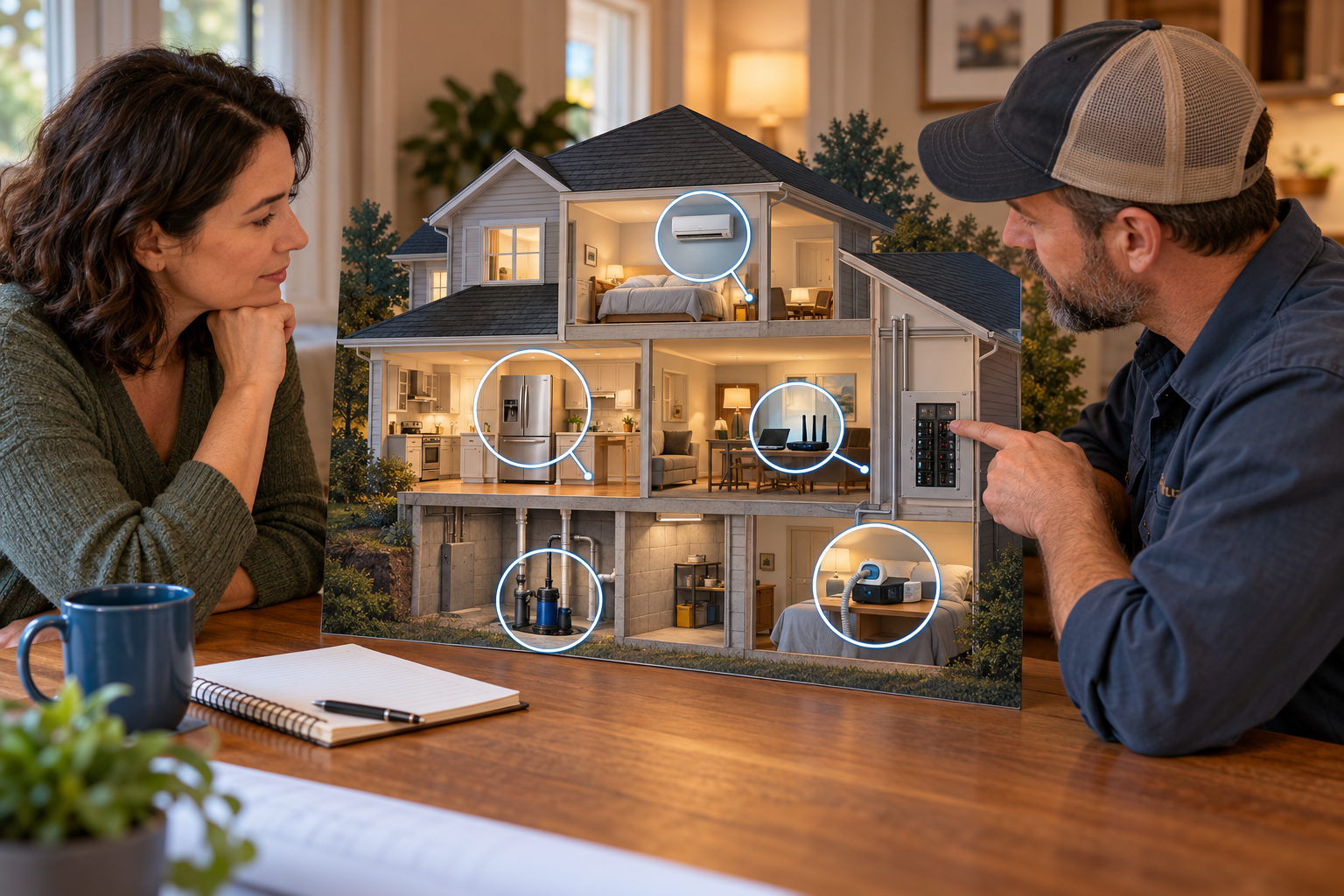
Outage resilience begins with the systems the household actually needs, not with the largest generator or battery available. Critical loads may include heating or cooling controls, a sump pump, well pump, refrigeration, medical equipment, communications, security, water treatment, or a small cool or warm room. The backup source and generation equipment belong to the power-system category; this article focuses on load selection and the enabling work around it.
Define critical loads
List what must operate, for how long, in summer and winter, and what can be turned off. A sump pump may need short high-power starts. A well pump may have a different starting load and water-storage consequence. Heating, cooling, refrigeration, medical equipment, and communications may need different duty cycles. A whole-home system can cost more than a targeted critical-load plan without adding useful protection for the household.
Include passive survivability. Insulation, air sealing, shading, thermal mass, water storage where appropriate, and a cool or warm room can lengthen the time before conditions become unsafe. NRCan research measures time to unsafe conditions in a monitored pilot, but it does not establish a universal outage duration or sizing formula for every home.
What enabling work costs
Budget for load calculation, electrical evaluation, transfer or interconnection equipment, circuits, panel or service changes, controls, fuel or battery placement, grounding, permits, inspection, testing, and restoration. A home with an old panel, limited capacity, a private well, electric heat, multiple pumps, or medical equipment may require more design work.
Ask the electrician or power-system designer to identify the source, loads, starting currents, operating assumptions, fuel or storage limits, and manual or automatic operation. Transfer equipment, interconnection, fuel, and electrical compatibility are high-consequence details; use current code, manufacturer, utility, and local authority guidance. Do not copy a generic wiring diagram.
Cost tiers
- Targeted continuity: a few critical loads, monitoring, and small enabling changes may be a manageable project.
- Critical-load panel or circuits: adding circuits, transfer equipment, or load controls creates a larger electrical scope.
- Whole-home continuity: service capacity, generator or battery, fuel, distribution, and testing can be a major project.
- Passive and multi-hazard package: envelope, heat, winter, water, and communications measures add separate work but may reduce required backup capacity.
Price U.S. and Canadian systems in their local markets. Fuel availability, utility rules, fire separation, noise, climate, labor, and permitting vary. Incentives and insurance treatment are not guaranteed.
Test and maintain the system
An outage plan fails when batteries are old, fuel is stale, a transfer device is not tested, a sump discharge is frozen, a filter is blocked, or the selected load exceeds the source. Include inspection, exercise, battery replacement, fuel, monitoring, and seasonal checks. Ask who will test the actual household loads rather than only starting the source.
The right decision may be a smaller source, load reduction, passive work, or a phased package. Make the protected loads and the unprotected loads explicit. A quote that only says “whole-home backup” does not show whether the system can safely support the property’s critical services.
Build the load list with the household
Ask each occupant what must work during a short outage and a multi-day outage. Include start-up loads, run time, seasonal differences, fuel or battery replenishment, water availability, communications, and access. A pump, compressor, heat pump, refrigerator, and medical device may behave differently even if their nameplate watts look similar. The designer should calculate the system rather than add appliance labels casually.
Ask for a normal-load scenario, a priority-load scenario, and a failure scenario. If the source cannot start a pump or compressor, the plan may need soft-start equipment, a different source, passive measures, or a reduced load. Those are design questions, not generic DIY instructions.
Price the ownership plan
Include exercise and testing, fuel, battery replacement, filters, maintenance contracts, noise or placement work, weather protection, and the cost of a person responding to alarms. Remote or seasonal homes may need monitoring and a local service arrangement. Confirm what happens when the source is unavailable or the outage exceeds the planned duration.
If the home may need both cooling and filtration during a smoke-related outage, put the selected room cleaner or HVAC fan on the actual critical-load list. Ask for the proposed device’s power use and operating schedule, the HVAC system’s compatible filter and airflow limits, and the replacement-filter type and expected service conditions. Smoke can load filters quickly, so include the replacement and operating cost rather than treating filtration as a one-time purchase. Compare the smaller occupied-room plan with broader whole-home continuity using the same outage duration and assumptions; neither option guarantees safe indoor air or temperature. Generators, batteries, and their installation still belong to the separate backup-power decision.
Keep critical-load work separate from a promise of whole-home independence. A narrower plan can be safer and more affordable when it is explicit about what remains unpowered.
Compare a smoke-and-heat load with other priorities
When a room cleaner, HVAC fan, and cooling equipment may operate together, have the electrician or system designer list each device, its starting and running load, operating schedule, and whether it must run continuously or intermittently. Include filter replacement access and the expected service conditions. A room purifier can be a smaller load than whole-home air handling, but it may not serve multiple closed rooms or provide cooling; central HVAC may cover a larger area but needs compatible filtration and enough backup capacity for its fan and cooling equipment.
Compare at least two operating scenarios: the smallest occupied room with selected essential loads, and the broader set of circuits the household would like to keep available. Use the same outage duration and weather assumptions in both. Include what gets shed first, who changes the settings, how the filter or equipment is checked, and what happens if outdoor conditions worsen. This turns “backup for smoke” into a priced operating plan rather than an untested appliance list.
The quote should keep the resilience measure separate from the source that powers it. This category covers the load decision and enabling work; generator, battery, transfer equipment, and installation prices belong to the dedicated backup-power scope. State the cross-category assumption so the household does not count the same electrical or equipment work twice.
For each load, ask the designer to record its purpose, starting and running demand, likely operating hours, seasonal importance, and whether the household can shed it. A small cool-room plan might prioritize one fan or cooling unit, a room cleaner, communications, and medication storage; another household may need a well pump or medical device first. The list should follow actual use and health needs rather than a generic appliance ranking. The household and qualified designer should confirm the electrical details.
Then compare the equipment schedule with the expected duration and maintenance plan. Include filter or battery replacement, fuel or charging, periodic testing, and the person responsible for checking that the load still operates. If a smoke event is likely to coincide with heat, test the plan against that combined condition rather than assuming a clean-air filter can be added later without changing backup capacity. Record which rooms and services remain unavailable if the source is undersized or a component fails. That residual gap is part of the cost decision and the household’s response plan.
Questions for the electrical and power-system quote
Ask whether the proposal includes a load calculation, transfer or interconnection equipment, panel changes, circuit labeling, grounding, permits, inspection, commissioning, and testing with the actual loads. Confirm who verifies compatibility with the utility, generator or battery, HVAC, well, sump, medical equipment, and fuel system. A source that starts without the expected load is not a reliable design.
Ask how the household will operate the system when nobody is home, the source is low, fuel is unavailable, or a critical load fails. Include alarm, monitoring, manual override, maintenance, and service response. Seasonal properties may need a local caretaker or remote system that is designed for unattended operation.
The final plan should show the protected circuits, the unprotected circuits, the expected duration, and the assumptions that would require a different source or an emergency relocation plan. Keep the latest load schedule with the panel directory and test record, and revise it when equipment or household needs change.