
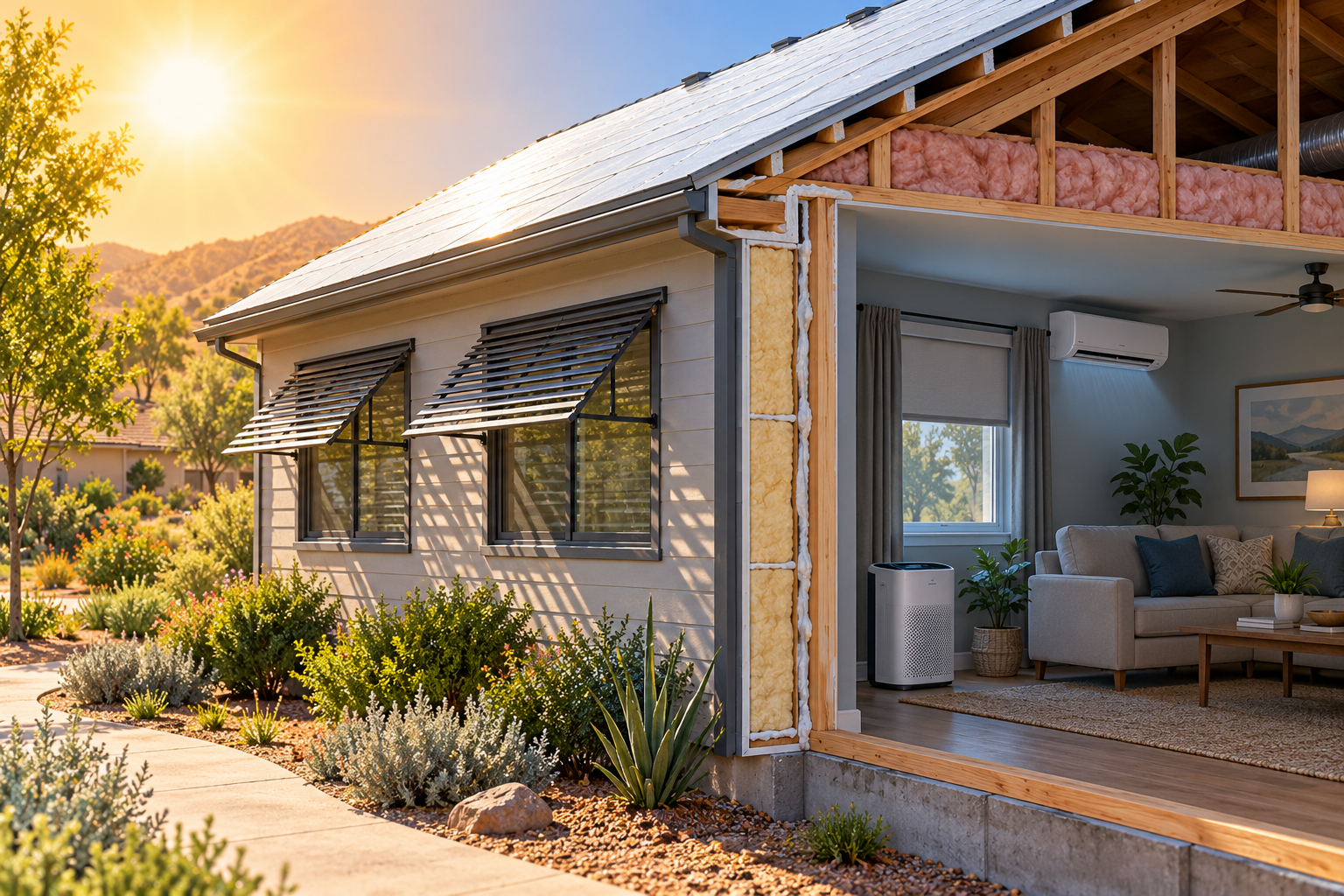
Heat resilience is a layered building decision. Shading, solar-control glazing, roof reflectance, insulation and air sealing, ventilation, thermal mass, mechanical cooling, and backup power interact. No passive measure guarantees safe indoor temperatures during every heat event or outage, and a fan is not an adequate cooling solution above 35°C according to Health Canada guidance.
Start with the heat pathway
Identify when rooms overheat, how quickly they cool overnight, which windows and roof areas receive sun, whether outdoor air is clean enough for ventilation, and who needs a cooler space. Air conditioning capacity, envelope performance, humidity, indoor air quality, and outage duration can change the correct priority. A home near wildfire smoke may need closed-window filtration or cooling rather than night ventilation.
Cost tiers
- Low-disruption measures: exterior or interior shading, curtains or blinds, maintenance of cooling equipment, and a designated cool room can be the first phase. Interior shading helps but does not block heat as effectively as an exterior strategy in every building.
- Envelope and solar-control work: films, glazing, air sealing, insulation, roof changes, and exterior shading can range from small installations to major renovation depending on access and existing assemblies.
- Cooling and continuity: equipment sizing, distribution, controls, filtration, and backup power can create a multi-trade project. The power source itself belongs to the backup-power category; this guide addresses the resilience decision and enabling work.
Use local bids. Climate, orientation, window area, roof, building age, electricity rates, equipment availability, and Canadian or U.S. labor markets make a converted currency estimate misleading.
Air quality and ventilation
Night ventilation can help when outdoor air is cooler and clean, but it may be inappropriate during smoke, high humidity, or poor outdoor air conditions. A resilient plan should state when windows remain closed and how cooling and filtration work. Do not assume that one research pilot or one product result applies to every home.
NRCan’s living-lab work illustrates why resilience can be measured across temperature, moisture, indoor air quality, weather, energy use, comfort, and power-loss conditions. It is a research example, not a universal homeowner package or performance guarantee.
Combine with planned work
Window replacement, reroofing, insulation, air sealing, shading, HVAC replacement, and solar or battery work can overlap. Ask for incremental and complete-project prices so the household can compare doing the work now, at replacement time, or in phases. Include controls, maintenance, filter replacement, roof or wall moisture risk, and restoration.
Health protection comes first during dangerous heat. Keep a reliable cool location and follow current public-health guidance. The retrofit budget should reduce the time and severity of overheating, but it cannot replace an emergency plan or guarantee safe conditions in an extreme event.
Compare measures by timing and interaction
Ask for a staged comparison: shading and controls now, envelope or glazing at the next replacement, cooling or filtration when equipment is due, and backup-power enabling work when the electrical system is changed. A measure can be worthwhile because it reduces peak load or makes a smaller cooling system adequate, but that conclusion needs a property-specific calculation. Do not assume a reflective roof solves rooms that overheat through unshaded glass.
Include humidity, condensation, air leakage, indoor air quality, and maintenance. Closing windows during smoke may increase cooling and filtration needs. Night ventilation may help only when outdoor air is cleaner and cooler. A film, shade, or window change may affect daylight, views, egress, warranty, or winter heating.
Design for the vulnerable room
Many households do not need every room to remain at the same temperature during an outage. A smaller, well-shaded, filtered, and cooled room may be a more realistic first phase. Ask the professional to identify the room, occupants, equipment, duration, and power required. Keep medical and health advice current and separate from the retrofit quote.
When smoke and heat overlap, price that room as a combined cooling and clean-air decision. Compare room-scale filtration and cooling with a broader HVAC or whole-home scope on the same assumptions about occupants, room size, outdoor conditions, and operating hours. Include the device or system work, any compatibility assessment, electricity, replacement filters, and the continuity work required to keep those loads available. Health Canada and EPA guidance distinguishes room cleaners from central HVAC filtration; both caution that a higher-efficiency HVAC filter must be compatible with the system. Ask an HVAC professional to check airflow and filter pressure effects before assuming an existing furnace or air handler can accept a different filter. The guidance does not provide an installed-price schedule or guarantee safe indoor conditions.
The final budget should state the weather and outage assumptions and the conditions under which the home still needs an emergency cooling location.
Price comfort and safety separately
A lower indoor temperature is not the only outcome. Humidity, air quality, vulnerable occupants, noise, glare, power demand, and the ability to sleep or access medication can matter. Ask the professional to identify the room and conditions that must remain safe, then compare a smaller targeted intervention with a whole-home upgrade.
Natural ventilation, shading, reflective roofs, glazing, insulation, and cooling have different maintenance and failure modes. A window film may reduce solar gain but not solve internal loads. Air sealing can improve comfort but requires moisture and combustion-safety review. Backup power can run a selected system but may not cover the entire home.
Include a contingency for concealed envelope conditions and controls. The project should state which evidence supports the expected result and what needs to be monitored after installation.
Compare a cool room with whole-home work
For a household that cannot upgrade every room at once, compare a targeted room plan with whole-home cooling and filtration on the same weather, smoke, occupancy, and outage assumptions. The targeted option still needs a real scope: shading and window exposure, cooling capacity, air leakage, filtration, controls, and the power needed for the intended operating hours. A portable room cleaner may be easier to isolate and replace, while central filtration depends on the HVAC fan, filter fit, airflow, and the rest of the ducted system. Neither scope should be selected by filter rating alone.
The cost comparison should separate installation from ownership. Include equipment or HVAC work, any electrical or controls change, electricity at expected operating time, replacement filters, cleaning or service, and the plan for maintaining cooling or filtration if the power fails. Ask how often a filter may need attention during smoky periods and who will check it. Do not assume the same filter life in clean-air and smoke conditions. For the central system, get confirmation that the selected filter does not create unacceptable airflow or equipment problems.
Also price the remaining gap. A room plan may protect the space used by a vulnerable occupant while leaving other rooms warm or smoky; a central system may serve more rooms but require a larger load and backup plan. Identify where occupants can go if outdoor conditions, heat, smoke, or outage duration exceed the design assumptions. The project can lower exposure and make an emergency plan more workable, but its budget is not proof that a space will be safe in every event.
Use the same assumptions in each estimate: which room is occupied, how many people use it, the expected outdoor temperature and air quality, how long the system runs, and whether power remains available. Then request separate lines for shading or envelope changes, cooling equipment, filtration, electrical work, controls, and recurring filters or service. If the room plan relies on existing central equipment, ask the HVAC contractor to identify the system’s capacity and compatible filter conditions rather than assume that an existing unit can serve a new use.
The comparison should also state what is deliberately left out. A room-scale plan does not price improvements to every bedroom; a whole-home proposal may still not include outage continuity, a cleaner-air response, or replacement filters. Keep the emergency relocation plan visible alongside the construction budget. If a project depends on a battery or generator, coordinate the expected loads with the backup-power designer instead of assuming that the heat or filtration quote includes that system. Record the room, operating assumptions, selected products, and filter schedule for the household members who will use the plan.