
Permafrost-related home adaptation is one of the hardest residential projects to price from a generic article. Thaw, fine-grained or wet soil, drainage, foundation type, building movement, remote access, a short construction season, and limited skilled labor can interact. A serious concern begins with site and structural investigation, not a standard foundation repair allowance.
Signs that change the decision
Government of Canada guidance identifies fine soils, wet ground, poor drainage, cracks, sticking doors and windows, settlement or heave, and out-of-level floors or roof lines as reasons to investigate. They are indicators, not a diagnosis. A professional familiar with northern ground and foundation conditions should interpret them.
The assessment may include monitoring, survey, geotechnical information, foundation and framing review, drainage, snow and vegetation conditions, and a plan for seasonal movement. Some designs use adjustable foundations or deep piles, but the appropriate system depends on local ground and building conditions. Do not prescribe a foundation change from a symptom alone.
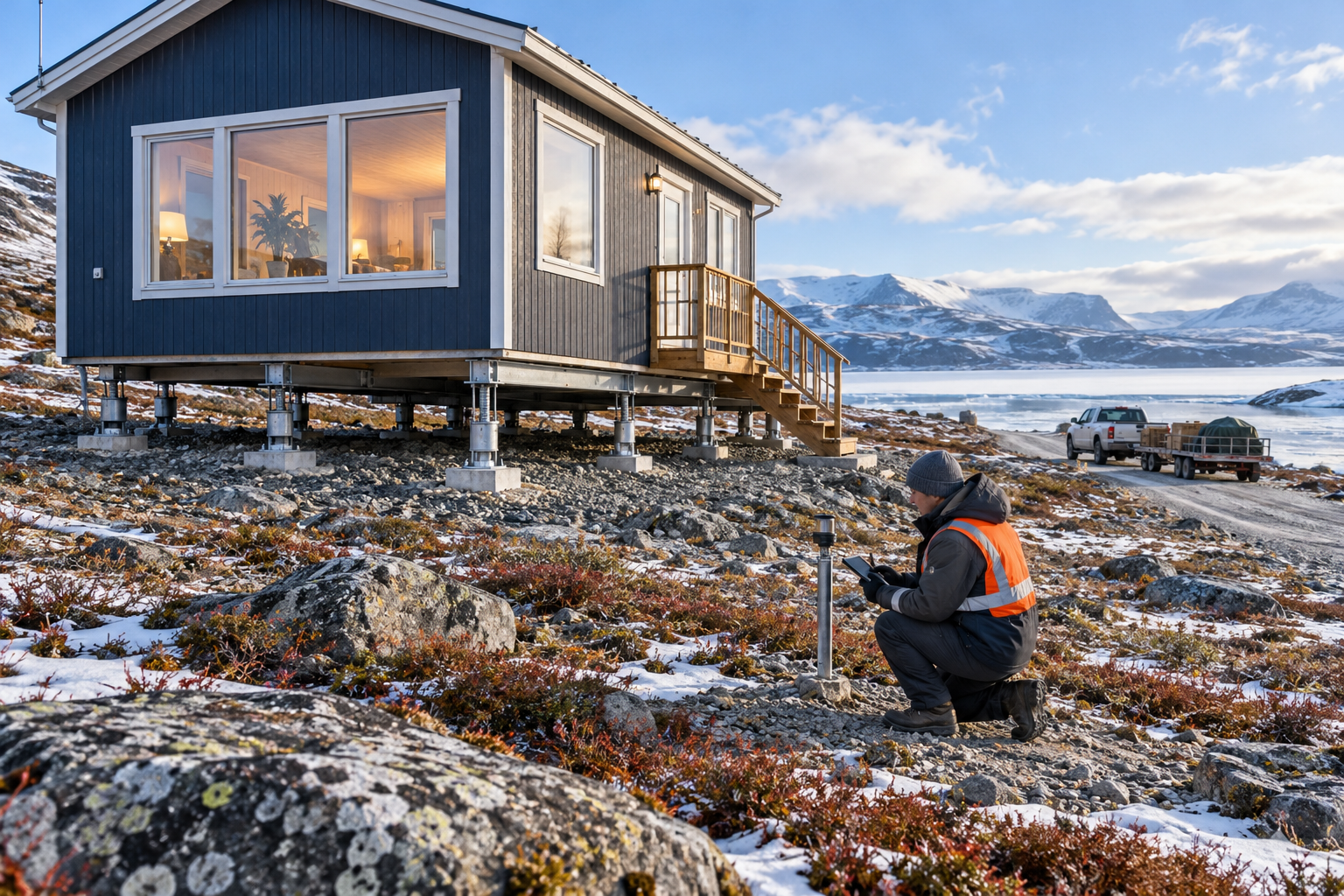
Why the budget is unusually uncertain
The cost may include travel, mobilization, remote equipment, material transport, winter-road or seasonal access, specialist engineering, foundation adjustment, jacking or support, piles, drainage, envelope work, mechanical coordination, temporary occupancy, and monitoring. A small-looking house may be expensive to reach or service. A construction season may require ordering and staging long before work starts.
Use case studies or specialist estimates as examples, not national market prices. Canadian and Alaskan conditions differ by community, soil, access, and regulation. Do not create a Canadian or U.S. range by converting a distant project or currency.
Monitor, adapt, or intervene
Monitoring may be appropriate when movement is slow, understood, and safe to observe. Adaptation can include drainage or ground-management work, foundation adjustment, insulation or ventilation changes, or coordination with envelope and mechanical projects. Major movement, loss of support, or worsening cracks may require urgent professional escalation.
Keep water moving away from the building only within an approved site plan; changing drainage can affect neighboring land or the ground below the home. Snow and vegetation management may influence ground temperature, but those actions are not a substitute for structural design.
Plan the project with local help
Ask the team to separate assessment, monitoring, temporary support, design, materials, transport, labor, access, permits, construction, and contingency. Clarify what happens if thaw or hidden foundation conditions are worse than expected. Coordinate with rural or remote infrastructure planning for private utilities, fuel, water, wastewater, and outage continuity.
This is a regional economic decision because the hazard and logistics are materially different, not because a generic article has been given a northern label. The responsible budget is a range with explicit assumptions and contingency, followed by local professional review.
Ask for a staged northern work plan
The first proposal should distinguish monitoring, seasonal inspection, drainage or snow management, temporary stabilization, foundation adjustment, and permanent redesign. Ask what observation would trigger the next phase and how movement will be measured. A monitoring plan without an owner, frequency, records, and response threshold is not a complete risk-management budget.
Separate travel and mobilization from professional services, materials, labor, equipment, accommodation, transport, permits, construction, and contingency. Ask what can be prefabricated or coordinated with another planned project and what must be completed before the next freeze or access closure. Remote logistics can make a small amount of work expensive, while a coordinated shipment can lower the incremental cost.
Do not overread a symptom
A sticking door, crack, or out-of-level floor may come from several causes. It may be a foundation, moisture, framing, settlement, or ordinary finish issue. Northern guidance supports expert help for serious concerns but does not establish a universal foundation remedy. The responsible decision is to buy the assessment that can distinguish those possibilities.
After intervention, budget for repeat inspection, drainage, ground conditions, adjustable components, and access. Future climate and permafrost conditions may change the maintenance burden.
Separate observed examples from a market price
Northern research and case studies can show why foundations, logistics, and construction seasons matter, but one project is not a national price. Label case-based figures as examples and ask local specialists for a current scope. Travel, mobilization, material transport, and seasonal access should be visible rather than folded into a misleading per-square-foot average.
Ask whether the project can be coordinated with envelope, heating, water, wastewater, or remote-power work. A shipment and crew mobilization may serve several needs, but the technical design for each system remains separate. Preserve access to adjustable foundations, monitoring points, drainage, and utilities after the work.
The best budget is explicit about what is known, what must be tested, what could change during thaw, and what contingency protects the household from a short construction window.