Basements, Crawl Spaces & Below-Grade Water

Project cost and decision guide

Compare battery, secondary-pump, generator-supported, and other sump-backup options by failure mode, installation scope, ongoing maintenance, and local applicability.

On this page

Backup Sump Pump Cost: Battery, Secondary Pump, and Other Options

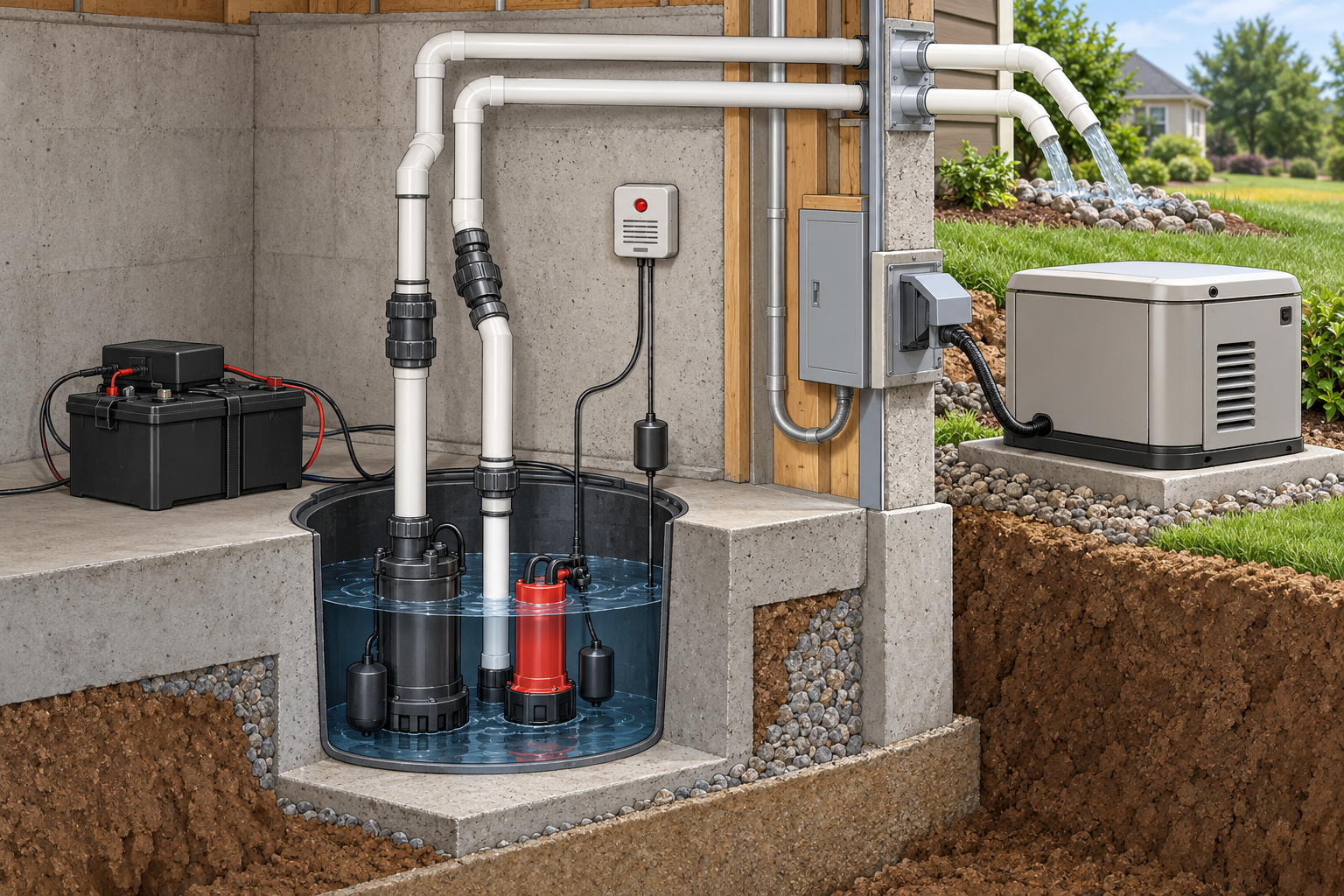
Backup sump protection addresses more than one failure mode. A secondary pump can help when the primary pump fails. Alternate power helps when the utility fails. An alarm helps you learn that water is rising. Compare the system and the risk rather than buying the first backup label in a quote.

Main configurations

  • Battery backup: a separate pump or control system with a battery and charger. Price the battery, installation, test, and eventual replacement.
  • Secondary pump: a second pump with an independent float or control. It may still need independent power to protect against an outage.
  • Generator-supported system: can support a primary or secondary pump during an outage but belongs in a wider backup-power decision when the generator serves other loads.
  • Water-powered backup: may be available only where water supply, pressure, plumbing, backflow protection, and local rules make it suitable. It is not a universal option.

Angi’s U.S. specialist observations place battery backup around $1,000–$2,000 as an add-on and water-powered systems around $1,200–$2,500. These are market signals, not guaranteed prices or evidence that either system fits a specific home.

Ongoing cost and fit

The battery has a service and replacement cost. A backup pump needs access, testing, a float that can operate, and a discharge path. NRC Canada guidance recommends considering backup pumps, alternate power, and a high-water alarm while leaving capacity and local applicability to project review.

The Government of Canada recommends alternate power and a backup pump, but local electrical, plumbing, water-use, and inspection rules control. Ask what happens if both pumps share a circuit, pit, discharge, or control.

Quote questions

Ask which failure each component covers, how long it can operate, what maintenance is required, whether the battery and alarm are included, and how the system is tested. A sump backup reduces a drainage-system vulnerability; it does not prevent floodwater from entering during an extreme flood.

Match the backup to the failure mode

Risk Component that may help Limitation to ask about
Primary pump motor or float fails Secondary pump or spare pump It may share the same pit, discharge, or power source
Utility power fails Battery system, generator-supported power, or another approved source Runtime, recharge, fuel, transfer equipment, and electrical requirements vary
High inflow exceeds one pump A properly designed second pump or drainage correction More pumping does not correct a blocked discharge or unsuitable system
Rising water goes unnoticed High-water alarm or remote notification An alarm needs power, testing, and a response plan
Discharge freezes or backs up Rerouted/protected discharge and a verified outlet Local site and connection rules still apply

The table is a decision aid, not an installation design. A backup pump is not the same as backup power, and an alarm does not remove the need to respond.

Cost layers beyond the equipment

Price the pump, battery or charger, control, float, alarm, installation, electrical work, discharge, lid, testing, and future maintenance separately. A battery can require periodic replacement. A generator may serve the sump but also belongs to a broader power-system decision. A water-powered system depends on water supply, pressure, backflow protection, and local acceptance, so its apparent simplicity can hide a technical or operating limitation.

NRC Canada guidance recommends considering a backup pump, backup power, and a high-water alarm, while leaving the actual capacity and application to site review. The Government of Canada also recommends alternate power and a backup pump in its Canadian homeowner guidance. These recommendations are not a universal design or a promise that every configuration is suitable.

Scenario-based buying decisions

  • Short, common outages: a battery system may be useful if its runtime covers the typical event and the discharge remains open.
  • Long or frequent outages: generator-supported power or a larger resilience plan may make more sense, with fuel, transfer, service, and electrical costs included.
  • High water and a failed primary pump: a separately controlled secondary pump may reduce single-equipment risk, but the pit and discharge must handle the flow.
  • Finished or encapsulated space: ensure the backup, battery, alarm, and service points remain accessible.

Ask which component covers which failure, how it is tested, what happens if both pumps share a discharge, and who replaces the battery. A backup quote is valuable when it makes those dependencies explicit instead of treating “backup” as a single feature.

Match the backup to the failure

Start by listing the event that worries you: utility outage, primary-pump failure, stuck float, blocked discharge, frozen line, unusually high inflow, or a flooded site. A battery backup can address some power and pump-failure conditions for a limited time. An alternate power source may address a longer outage. A high-water alarm provides warning but does not move water. A second pump may add capacity or redundancy, but only if the pit, controls, power, and discharge support it.

Do not describe every backup as a complete flood solution. Ask what happens after the battery is exhausted, if the discharge freezes, if both pumps run, and if water enters outside the collection system. These answers matter more than the feature name.

Price the operating commitment

The purchase and installation are only the first layers. Include battery replacement, testing, alarm batteries or communications, generator fuel or service, electricity, filters or controls where applicable, and future pump replacement. Ask whether the backup has its own float, whether it shares a check valve, and how the contractor prevents one pump from interfering with the other.

An accessible, clearly labeled installation makes testing more likely. Keep the lid, float, battery, alarm, disconnects, and discharge visible and reachable. Record a normal test and an outage or backup test only under safe conditions and according to the equipment instructions.

Compare three resilience levels

  • Warning: an alarm identifies high water, but the homeowner still needs a response.
  • Backup pumping: a secondary pump or battery-supported pump operates when the primary system or power fails.
  • Alternate power and pumping: a generator or other designed source supports one or more pumps for a longer outage, with additional installation and maintenance responsibilities.

The appropriate level depends on the property’s inflow, outage pattern, occupancy, finished contents, and ability to respond. A backup cannot replace correcting grading, a blocked discharge, a failed drain, or an active plumbing source.

What the quote should show

Request equipment, controls, battery or alternate power, alarm, installation, discharge, testing, warranty, maintenance, and exclusions as separate items. Ask which failure mode is covered and which is not. A good backup budget buys a defined response to a defined failure, with enough access and documentation that the homeowner can know whether it is ready when needed.

A decision record for the homeowner

Write down the primary pump’s normal test result, the failure mode the backup is meant to cover, the expected runtime or response, the discharge path, and the maintenance date. Ask whether the battery, alarm, float, and secondary pump can be tested without creating a flood risk. Keep the installation visible after finishing work and record every test.

The backup should be compared with the consequence of failure at this property: contents, finished areas, occupancy, response time, outage pattern, and inflow. It is a resilience purchase, not a substitute for correcting the source or maintaining the primary system. A quote that explains the failure boundary is more useful than one that simply lists a larger equipment package.

Questions for the handoff

Ask for the primary and backup test results, battery or generator assumptions, alarm operation, discharge route, maintenance schedule, and replacement parts. Confirm that the homeowner can reach the controls and tell whether the backup is active. If a power or pump failure occurs, the system should provide a defined response rather than an undefined promise of protection.

Keep the original water-management problem visible. If a source, pit, discharge, or collection route remains weak, the backup may only delay the same loss. The most complete resilience budget combines reliable normal operation with a backup matched to the failure that matters.

Record the test date, battery or alternate-power condition, alarm result, and discharge route. Ask when the backup should be retested and what event requires service. The homeowner should be able to tell whether the system is ready before an outage rather than discovering its limits during one.

Research notes

Sources used for this guide