
“Encapsulation” does not describe one consistently priced system. Compare what the contractor will diagnose, correct, seal, install, test, and maintain before comparing totals.
Confirm water-source assumptions
Ask whether standing water, groundwater, site drainage, plumbing, foundation entry, or condensation was assessed. A liner or dehumidifier should not hide active bulk water. Identify drainage, sump, discharge, and damaged-material work before comparing enclosure packages. If the source is uncertain, ask whether a diagnostic step should precede enclosure.
Compare the physical enclosure
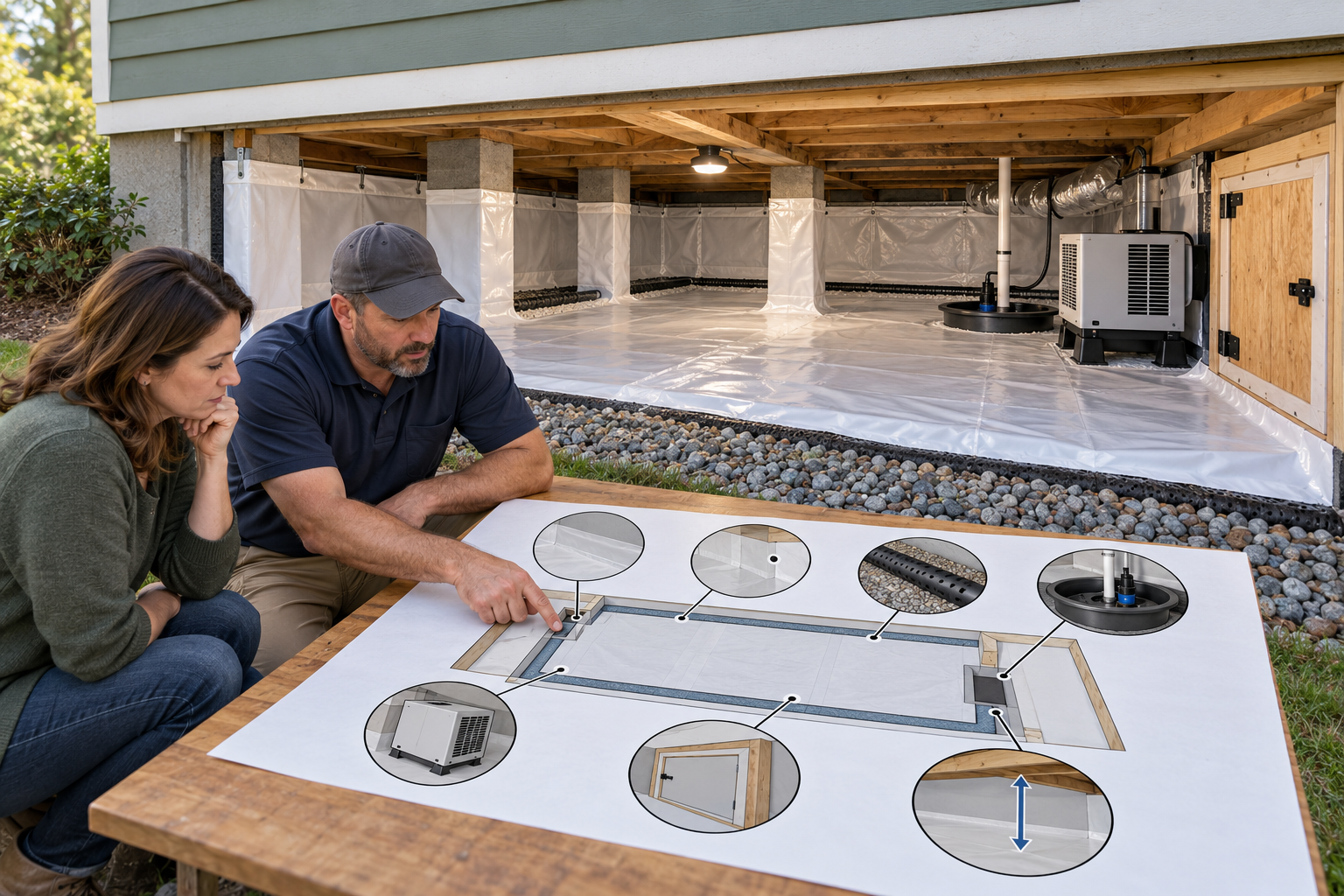
The quote should describe floor coverage, seams, wall and pier attachment, penetrations, vents, access doors, protection, and how service areas stay reachable. DOE guidance supports a continuous ground-vapor-control approach in its context; it is not a complete specification for every crawl space.
If the quote includes conditioning, insulation, or a dehumidifier, ask how the intended air and thermal boundary changes the assembly. A ground cover alone is not the same scope as a sealed or conditioned enclosure.
Separate drainage and equipment
List existing and new drains, sump, pit, pump, float, check valve, alarm, backup, discharge, power, dehumidifier, condensate, and testing as separate lines. Ask what is reused and require a test of any existing component. A shared power source does not by itself protect against an outage.
When an enclosure quote also includes a new sump or foundation-drain work, separate those components from the liner and conditioning price. Some municipal programs support only specific drain or sump work, not an entire crawl-space package. Toronto and Halton provide location-bounded examples; check the current address rules, pre-approval, contractor, permit, invoice, and inspection requirements in the basement quote guide. Do not count assistance until the program confirms the covered line items.
Draw the scope boundary before comparing totals
Ask for a sketch or measured description showing the floor area, perimeter, foundation walls, piers, posts, vents, access door, penetrations, drainage route, sump, and planned equipment. The drawing should distinguish surfaces receiving a liner from areas receiving wall attachment, seam treatment, insulation, or conditioning. If a floor, wall, or transition is excluded, mark it. This makes the physical package visible when contractors use the same word for different systems.
The quote should also explain the assumed condition of the crawl space. Is the soil level and accessible? Is there an existing barrier? Are the walls dry? Is the pump operating? Is the intended space vented or conditioned? A price built on assumptions can change once debris, hidden water, utility conflicts, damaged framing, or inaccessible corners are found. Record which observations are confirmed and which are allowances.
Compare each proposal by function
For every line, ask what it changes and how a homeowner can tell it worked. Floor coverage and seams limit soil-vapor entry in the intended assembly. Drainage and a sump address collected liquid water. Wall and pier attachment complete selected enclosure details. A dehumidifier manages air moisture when the planned configuration supports it. Insulation changes the thermal boundary. These elements can be combined, but they are not interchangeable and one does not prove another has been completed.
If two bids differ, request a side-by-side version with common quantities and separate options. A narrower quote may be the right choice if the water source and purpose are clear. A more comprehensive proposal may be justified when it closes a documented gap. Do not compare a ground-cover-only price to a conditioned-space package as if the difference were markup.
Resolve access, change orders, and future service
Low clearance, stored items, ducts, wiring, plumbing, posts, and narrow access can affect labor and maintenance. Ask who moves or protects contents, whether debris or damaged materials are removed, what site restoration is included, and whether access improvements are priced. Identify the stop-work point for hidden water, structural damage, pests, or utilities. Request measured unit prices or written allowances and require approval before an uncertain scope expands.
Before accepting a design, confirm where a technician can reach the pump, alarm, cleanouts, dehumidifier, condensate line, and electrical disconnect. A sealed enclosure that prevents ordinary service may increase future repair cost. The quote should state how a failed component can be inspected or replaced without unnecessarily destroying the liner or insulation.
Identify exclusions and concealed conditions
Wet insulation, debris, pests, wood deterioration, plumbing, electrical work, radon, structural concerns, and restoration may need separate scope. Ask how the contractor will price hidden conditions, what triggers a stop, and whether the space will be left open until an unresolved issue has an owner. Warranty and consumer-protection terms vary by contractor and jurisdiction.
Compare proposals with a worksheet
For each proposal, record floor area, perimeter, wall and pier treatment, seams, penetrations, vents, access, drainage, sump, discharge, dehumidifier, power, insulation coordination, cleanup, and restoration. Mark each item included, optional, reused, allowance, or excluded. Then record assumptions such as no standing water, accessible surfaces, working existing drainage, dry framing, and no pest or structural work.
Compare the function of each option: what it controls, what remains open, what it costs to operate, and whether future inspection is possible. The lowest total may be appropriate when its narrower boundary is deliberate. A broader package is not automatically better if it encloses an unresolved source.
Handle assistance and combined project scopes
If a quote adds a sump, foundation-drain work, or backwater protection, request separate line items for those components and the enclosure. Program eligibility may attach to only one part of a package, and rules can require pre-approval, a specific contractor, inspection, or paid invoices. The gross installed price remains the proper basis for comparing bids until a municipality confirms what it will cover. Program caps should not be used as installed-cost estimates.
Preserve the record for future repairs
Keep the signed scope, marked-up drawing, before-and-after photographs, equipment models, tests, warranty terms, maintenance dates, and unresolved conditions together. Record where the liner ends, where a drain discharges, which seams or equipment were excluded, and how to access the space. This lets a later contractor inspect a local failure without treating the entire enclosure as an unknown system.
The completion walk-through should compare the installed work with the drawing and quote. Resolve missing items while the crew is present, document approved changes, and make sure the homeowner knows which conditions require service rather than routine maintenance.
Compare operating and warranty obligations
Ask for the model, warranty term, maintenance schedule, and replacement assumptions for each pump, alarm, dehumidifier, condensate pump, or control. Confirm whether the warranty covers material, labor, water entry, or only a defined component, and which maintenance tasks are the homeowner’s responsibility. Terms differ by provider and jurisdiction, so compare the actual documents rather than relying on a verbal lifetime claim.
The operating budget can include electricity, filter or coil service, battery replacement, alarm checks, discharge maintenance, seam repair, and inspection after a water event. A proposal should say who is expected to perform each task and whether the service is included. The lowest installation price may leave these continuing costs entirely to the homeowner.
Use a clear approval process for changes
Ask the contractor to stop and contact the homeowner when concealed water, damaged framing, a utility conflict, or a different foundation condition changes the work. The change request should identify the observation, photographs or measurements, added scope, price basis, schedule effect, and any alternative. This preserves the chance to compare options while the space is open.
A staged enclosure may be appropriate, but each stage needs a written boundary: what is complete, what remains exposed, whether temporary protection is included, and what condition allows work to continue. That keeps an unfinished crawl space from being treated as a failed project or an unresolved water source from being priced as an ordinary change order.
Define completion and maintenance
Before work starts, state the condition expected at handoff, who checks it, and what evidence will be provided. This may include photographs of floor and wall coverage, sealed penetrations, drainage or pump tests, equipment models, humidity observations, and service access. It is not a universal moisture-acceptance test; preserve the limits and remaining conditions in the record.
Price ongoing electricity, filters, condensate maintenance, battery replacement, pump and alarm testing, seam repairs, inspections, and future equipment replacement. Ask what maintenance affects the contractor’s warranty and who services each component. Keep controls, cleanouts, pumps, and the access door reachable.
Pause the quote comparison for qualified assessment if standing water, sewage, energized equipment, unstable soil, structural deterioration, mold-like growth, radon questions, pests, or wet materials require another scope. The completed quote should show the enclosure boundary, the evidence used, the work excluded, the test and maintenance tasks, and the trigger for reopening or reassessing the project.