
Waterproofing quotes are hard to compare when each contractor uses the same label for a different system. Normalize the water source, measured area, collection path, pump, excavation, demolition, restoration, and exclusions before comparing totals.
Confirm the problem being priced
Ask what evidence supports the assumed mechanism: surface runoff, groundwater, foundation-drain failure, condensation, a crack, plumbing, or flood exposure. A quote that assumes a crack is not equivalent to one that includes perimeter drainage. Ask what remains unknown and what event would change the recommendation.
Compare the physical system
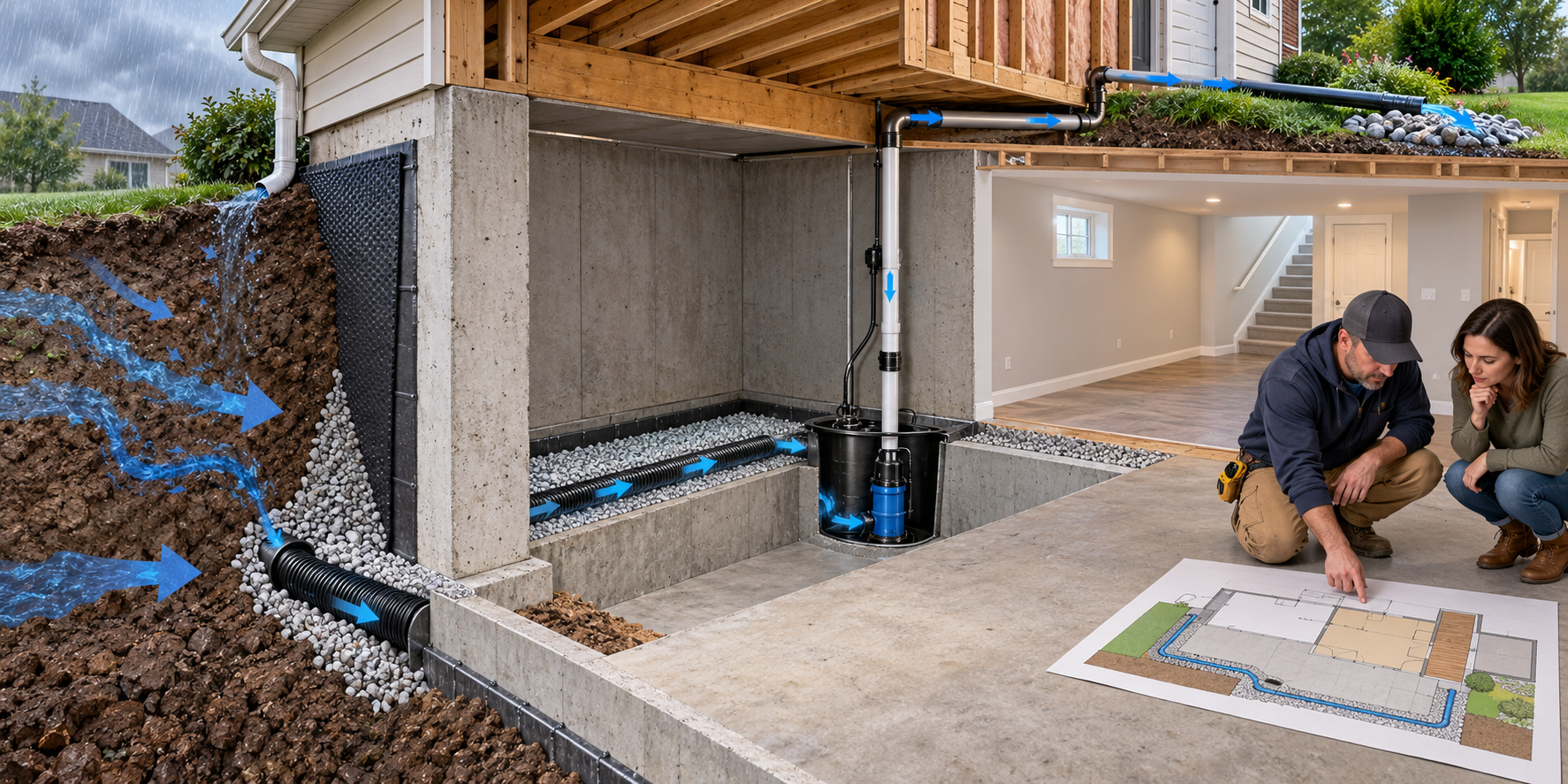
Record whether the work is interior or exterior, partial or full perimeter, and how many linear feet or square feet are included. List the drain or channel, stone, membrane, foundation preparation, footing-drain replacement, sump pit, pump, check valve, discharge, alarm, backup, and electrical work. “French drain,” “drain tile,” and “weeping tile” can describe different systems in different markets.
Compare access and restoration
Exterior quotes should identify excavation depth, equipment access, utility assumptions, backfill, compaction, and landscape or hardscape restoration. Interior quotes should identify concrete cutting, floor and wall demolition, contents protection, disposal, drying, and finish reconstruction. A finished basement may need a separate allowance for rebuilding.
Check exclusions and local items
Ask about permits, inspections, discharge destinations, property-line drainage, structural work, plumbing, mold, flood recovery, radon, landscaping, warranties, allowances, and change-order triggers. Local requirements vary; do not infer that a connection or warranty is legal or sufficient from a generic article.
Check local assistance before comparing the net cost
Compare contractor bids using the gross installed scope. Treat a subsidy, rebate, loan, or public-works project as a separate possibility until the municipality confirms the address and work. Before authorizing anything, check the property boundary, eligible components, pre-approval, contractor rules, permit and inspection steps, application window, funding, and required paid or itemized invoices. Keep each potentially covered component on its own quote line.
Examples checked against municipal and federal pages in September 2026 show why the rules cannot be generalized:
| Location | What the homeowner should verify |
|---|---|
| Toronto | The City lists eligible sump-pump and battery-backup work and foundation-drain severance or capping, with a maximum subsidy of CAD $6,650 per property under current program terms. The cap is assistance, not an installed-price estimate. |
| Halton Region | The subsidy is tied to qualifying weeping-tile disconnection and sump-pump installation. Check connection proof, contractor and permit/inspection requirements, paid itemized invoice rules, application timing, and the exclusion for water-powered backup. |
| Hamilton | Sump work appears in a Protective Plumbing Program that can pair it with backwater-valve work; check property eligibility and whether the current grant or loan route fits the quote. It is not a general sump-installation price. |
| Windsor | Confirm address and work eligibility, required pre-approval, licensed contractor, inspection, paid invoice, and application steps before construction. |
| Milwaukee | Private Property Infiltration & Inflow Reduction is targeted to defined neighborhoods, including the current Grasslyn Manor pilot area. Check the address and public-works scope; it is not a citywide homeowner rebate. |
| Ottawa | The published schedule distinguishes an existing pit from work that builds a new pit, but the City’s flooding FAQ says the program is currently under review. City pages conflict on application timing and the schedule does not label its currency. Confirm status and terms directly before counting any assistance. |
Natural Resources Canada’s current Greener Homes Affordability Program describes partner application routes but does not establish eligibility for basement waterproofing, drainage, sump, or crawl-space work. Do not infer below-grade eligibility from a national energy program. Program pages and funding can change; retain the written terms used for the bid.
Questions before signing
- What does this price solve, and what does it not solve?
- What is the measured scope and what components are included?
- How will water be routed during a heavy storm or power outage?
- Who performs and documents final testing?
- Which costs are allowances rather than fixed prices?
- What restoration is included before the space is returned?
The lowest total is not necessarily the smallest complete project. Compare the system, assumptions, serviceability, and exclusions along with the number.
Read the quote in the same order as the water
Start at the source, then follow collection, discharge, and restoration. Ask what observation supports the proposed cause and which alternative causes were considered. A quote that begins with a product name can obscure whether it addresses groundwater, a wall crack, a joint, surface runoff, plumbing, condensation, or a failed pump.
The price should identify the measured work area or perimeter, access, preparation, materials, equipment, testing, restoration, permits, warranty, maintenance, and change-order rules. “Waterproofing” can mean a membrane, coating, interior collection system, crack repair, sump project, or package of several components. Request a drawing or plain-language description when the label is broad.
Separate the core project from optional work
Mark each line as source correction, water collection, pumping and discharge, damage control, restoration, comfort improvement, or finish upgrade. This separation lets the homeowner stage work without accidentally omitting the component that makes the system function. It also makes two different methods comparable.
Examples of core questions include whether water is collected at the footing or wall-floor joint, where a pump discharges, how a membrane connects to drainage, and how service access remains available. Restoration questions include demolition, drying, disposal, concrete, drywall, flooring, cabinets, paint, and landscaping. A warranty may apply to one layer but not the others.
Allowances and hidden conditions
Below-grade work can reveal buried footings, utilities, damaged drains, groundwater, concealed cracks, contaminated materials, or unexpected restoration. Ask for unit prices or defined allowances and a written change-order process. Require photographs or measurements when the scope changes. A fixed total that excludes every difficult condition is not more reliable than a transparent allowance.
If the quote depends on a pump or discharge, ask about outage, freezing, blockage, alarm, backup, and maintenance. If it depends on exterior access, ask about excavation, shoring, soil handling, restoration, and property constraints. If it depends on a finished room, ask what must be opened before the water source can be confirmed.
Before approving the work
Compare at least the diagnosis, mechanism, measured quantities, destination for water, restoration, exclusions, schedule, maintenance, and expected result. Do not convert a U.S. market signal into a Canadian rate or treat a specialist range as a local bid. Ask what the contractor will document at completion and what event or observation would require another assessment.
A good quote does not promise that every below-grade condition is eliminated. It states what the work is designed to control, what remains outside scope, how the system will be serviced, and why the price corresponds to that decision.
A practical comparison sheet
For each proposal, record the suspected source, measured area or length, method, collection route, discharge, power, restoration, access, test, warranty, operating cost, and exclusions. Then write one sentence answering, “If water appears at a different point, what happens next?” This exposes whether the quote is local repair, source-side correction, interior collection, restoration, or a broader system.
Do not choose by the number of components. Choose the smallest complete scope that fits the evidence and leaves a serviceable system. A quote that is narrower may be the better choice when the mechanism is clear; a wider quote may be warranted when several pathways or recurring groundwater are documented. The decision should be explainable after the work is concealed.
Questions for the final walk-through
Ask who will photograph the completed work, test the pump or drain, document the discharge, and explain maintenance. Confirm that cleanouts, lids, alarms, shutoffs, and service areas remain accessible. If finishes return, record what is behind the wall or floor. Ask whether the warranty covers materials, labor, water entry at the treated area, or the full system.
If a change order is proposed, ask which observation caused it, what measured quantity changed, and whether another option exists. A professional may need to change scope when concealed conditions are found, but the decision should remain evidence-based. A transparent change-order process is part of the quality of the original quote.
The handoff should preserve uncertainty
Not every below-grade condition can be proven during a dry visit. The quote should state what remains unknown and how recurrence will be evaluated. That may be a wet-event observation, a test of the collection system, a follow-up inspection, or a separate specialist assessment. A price that acknowledges uncertainty is more useful than one that hides it in a warranty.
A homeowner’s final checklist
Before signing, confirm the work area, water mechanism, collection route, discharge destination, power and backup, restoration, permits, testing, schedule, warranty, maintenance, and change-order process. Ask what the contractor will photograph before concealment and what the homeowner will receive at handoff. Keep the quote and record with the home documents.
If two quotes remain far apart, do not average them. Identify which assumption differs: access, perimeter length, excavation, drain condition, pump, finishes, or source. The better decision may be an additional diagnostic step. The goal is a complete scope that can be explained to the next professional if water returns.
Write down whether the goal is to stop a local leak, manage recurring groundwater, protect a finished room, correct exterior water, or improve comfort. A contractor can price work accurately only after that goal is connected to the observed mechanism. If the proposal changes the goal by adding a broader package, ask for the evidence and incremental benefit.
The completion record should state what was corrected, what was tested, what remains outside scope, and what maintenance protects the result. That makes the price useful beyond the installation day.
Ask for a marked-up plan, photographs of the problem, and a written explanation of the proposed water path. Request separate options for a targeted repair and a broader system when both are plausible. Ask what observation would make the contractor stop, change scope, or refer the work to a structural, plumbing, environmental, restoration, or site-drainage professional.
Do not let urgency erase the comparison. Immediate pumping, drying, and electrical safety can proceed while the permanent scope is investigated. If a temporary measure is offered, record its expected duration and the trigger for returning. This keeps emergency response, waterproofing, and finishing work from being priced as one indistinguishable total.
The final quote should help the homeowner explain the decision months later: why this water path was selected, what was corrected, what remains possible, and how the system will be maintained. That explanatory value is part of a complete project scope.