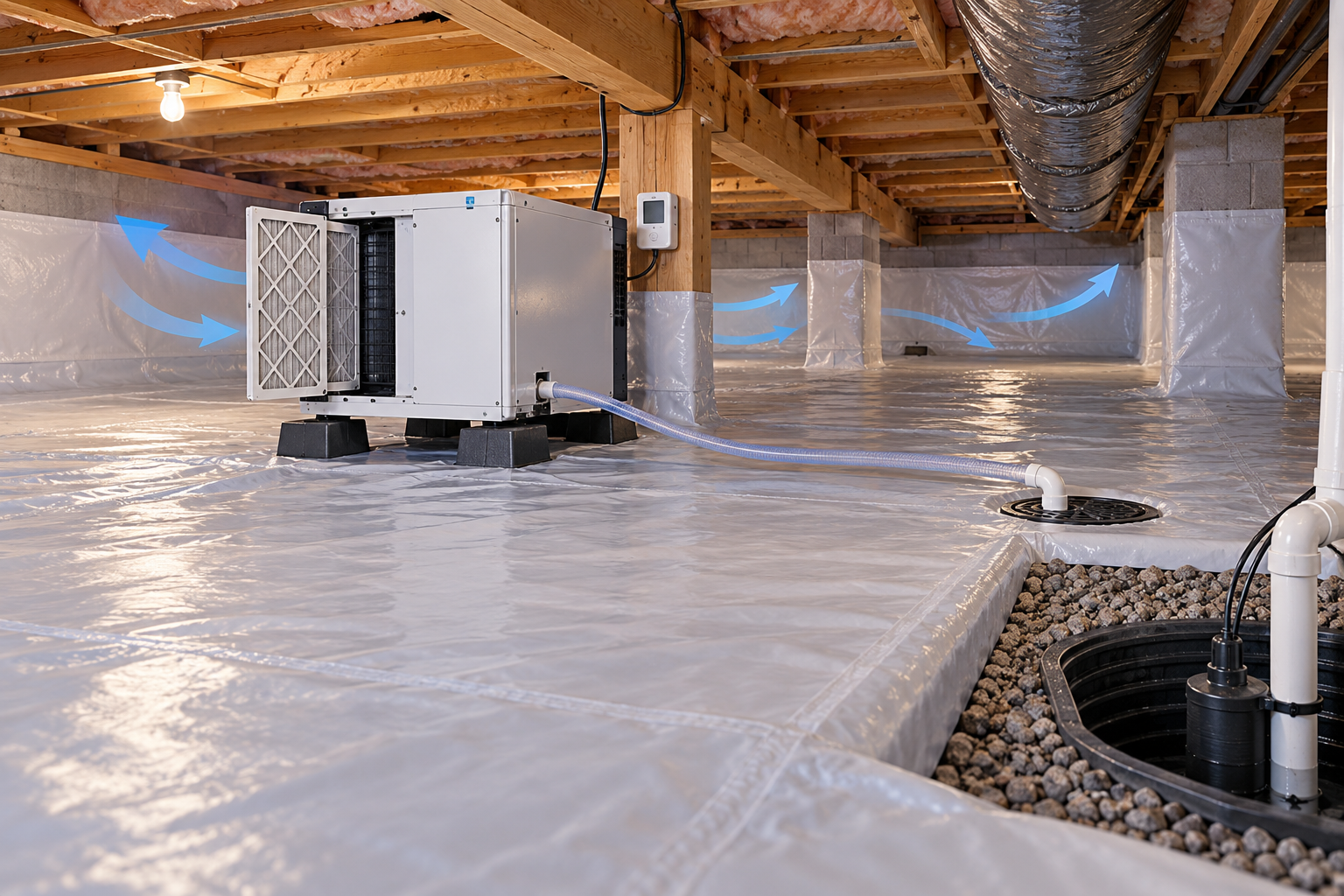
Crawl Space Dehumidifier Installation and Operating Cost
A crawl-space dehumidifier can control residual humidity in an enclosure or moisture-prone space, but it is not a substitute for correcting standing water, foundation leakage, or a failed drainage system. Price the equipment, its condensate path, power, monitoring, service, and future replacement separately.
Published U.S. signal and its limitation
Angi’s 2026 U.S. specialist page reports crawl-space dehumidifier projects of roughly $1,500–$14,000, but its headline often assumes encapsulation. It reports an approximately $3,000 installation observation where usable encapsulation already exists. These are scope-sensitive U.S. signals, not standalone equipment prices or Canadian rates.
Installation and operating layers
- equipment and controls;
- condensate drain or pump;
- electrical supply and access;
- ducting or conditioning where specifically designed;
- humidity monitoring and filter/service;
- electricity based on runtime, efficiency, climate, and local rates.
DOE says soil can introduce liquid water or vapor, so a ground barrier and drainage assessment remain relevant. A dehumidifier addresses air moisture; it does not remove pooled water or prove that framing and insulation are dry.
Confirm the moisture load first
A dehumidifier removes moisture from air. It does not pump standing water, correct a plumbing leak, repair a foundation, or replace damaged insulation. Before pricing one, document humidity, condensation, staining, odor, standing water, recent rain, and the condition of the ground and walls. DOE guidance identifies soil as a possible source of liquid water or vapor, so a ground barrier and drainage assessment may be more important than equipment.
If the crawl space is being enclosed, ask whether the proposed unit assumes a particular enclosure. A unit sized for a sealed space may not perform the same way in a vented or leaky space. Ask what relative humidity or operating condition is being targeted, how it will be measured, and what happens if the source remains active.
Installation layers
Separate equipment and controls from condensate, pump, drain, power, placement, access, monitoring, filters, ducting, and service. A condensate pump adds another component that can fail. A drain line can kink, clog, freeze, or discharge into an unsuitable place. Ask where condensate goes during a power outage and how the unit can be removed without damaging the liner or insulation.
Operating cost depends on runtime, efficiency, climate, temperature, electricity price, and enclosure. Ask for an estimate with its assumptions rather than a guaranteed annual saving. Include filter and coil service, replacement, alarm or monitoring, and access in the longer-term budget.
Compare system choices
- Monitor first: appropriate when the cause is uncertain and no active damage or safety condition requires immediate control.
- Ground and source correction: address soil contact, standing water, grading, foundation entry, plumbing, or drainage before relying on equipment.
- Enclosure plus dehumidification: evaluate when the planned crawl-space configuration requires air-moisture control and the installation leaves service access.
- Damage or specialist work: wet insulation, wood deterioration, pests, mold-like growth, radon, plumbing, and structural concerns need their own assessment.
The Angi U.S. signal referenced for this scope is broad and often tied to encapsulation; it is not a standalone equipment price or Canadian rate. Local quotes should identify the enclosure, electrical, condensate, and service assumptions.
What a complete quote should state
Ask for equipment model and capacity, target condition, placement, clearance, drain or pump, power, controls, monitoring, filters, warranty, maintenance, operating assumptions, and exclusions. Do not cover the unit, drain, wiring, sump, or alarm behind an enclosure. Record the test result and humidity conditions at handoff. A dehumidifier budget is reliable when it explains whether the unit is the remedy, one layer of a moisture plan, or a temporary control while the source is investigated.
Ask what relative humidity or operating condition the installer is targeting, where condensate goes, how the unit is serviced, what power is required, and whether the quote includes encapsulation, drainage, sump, or damaged-material removal. DOE research on conditioned crawl spaces reports lower humidity in its research context, but it is not a universal savings guarantee or current code rule.
Make the operating assumption explicit
Ask how much of the crawl space is included in the air volume, whether the proposed enclosure is complete enough for the equipment, and what happens if outside air or soil moisture remains uncontrolled. A target relative humidity is a control objective, not proof that wood, insulation, or finishes are ready to close. The installer should explain how the reading will be taken and where the sensor remains accessible.
Compare the equipment cost with installation, condensate, power, filters, service, electricity, noise, access, and replacement. A unit that is inexpensive to purchase may be costly to operate or difficult to maintain. A condensate pump or shared circuit adds another failure mode. Keep the discharge and electrical components visible after the enclosure is complete.
If the space has standing water or an active foundation or plumbing source, route that work first. A dehumidifier can be one layer of the solution after source correction, but it should not be used to turn a wet crawl space into an apparently finished one. The useful quote says what air condition is being controlled and what water condition remains outside the equipment.
The moisture load can change when a vent is sealed, insulation is moved, a liner is installed, a drain begins to flow, or a foundation repair alters the air path. Ask whether the quoted equipment and operating estimate assume those changes. If the crawl space remains open or receives seasonal water, the installer should state what the unit can and cannot control.
Keep the target and the limitations in the handoff. If humidity remains high, if condensate backs up, or if standing water appears, the next step is source and system assessment rather than simply buying a larger unit. This keeps the operating budget tied to evidence.
Record the target condition, sensor location, runtime expectation, condensate destination, filter or coil service, power, and the warning signs that require a professional visit. The homeowner should know whether a high reading means a clogged filter, a failed pump, a changed enclosure, a new water source, or normal seasonal variation. Without that interpretation, an equipment purchase can become a recurring expense with no diagnostic value.
Ask whether the unit can be removed, cleaned, or replaced without damaging the liner, insulation, wiring, or access door. If a sump, alarm, or backup power is nearby, keep the components separately identifiable. A serviceable installation costs less to diagnose later and makes the quote’s exclusions easier to honor.
The final decision should distinguish air comfort from material protection. If the crawl space is being prepared for insulation or an enclosure, use the moisture-control handoff required for that assembly rather than treating a lower humidity reading as the only readiness test.
Size the decision, not just the equipment
Ask whether the proposed capacity assumes a continuous ground barrier, sealed walls and piers, treated vents, or a particular amount of air leakage. A unit installed in a leaky or unfinished space may run differently from one serving a completed enclosure. Ask where the sensor will be located and how the target condition will be verified.
If the crawl space is cold, low, or difficult to enter, ask how the equipment will be protected and serviced. Condensate lines and pumps need a destination that will not back up into the enclosure. Electrical work, extension arrangements, controls, and service clearances should be part of the quote, not an afterthought.
Do not confuse a reading with readiness
A lower humidity reading can be useful evidence about air conditions, but it does not confirm that framing, insulation, soil, or foundation surfaces are dry. If water returns after a storm, if the sump runs continuously, or if wood deterioration is present, the source and damage scopes remain open. Ask the contractor what observation would require stopping or expanding the work.
Compare the continuing cost
Price filters, cleaning, condensate maintenance, electricity, monitoring, noise, replacement, and access over the expected service period. A broad U.S. encapsulation-linked market signal does not establish a Canadian rate or a standalone equipment price. A local quote should state whether installation assumes an enclosure, drainage, sump, damaged-material removal, or future insulation.
The right unit is part of a documented moisture plan. It should have a defined target, reliable condensate path, service access, and a clear boundary around the water conditions it does not solve.