Basements, Crawl Spaces & Below-Grade Water

Project cost and decision guide

Plan for crawl-space liner, seam, vent, sump, dehumidifier, and water-under-liner repairs, and compare partial repair with re-encapsulation.

On this page

Crawl Space Encapsulation Repair and Maintenance Cost

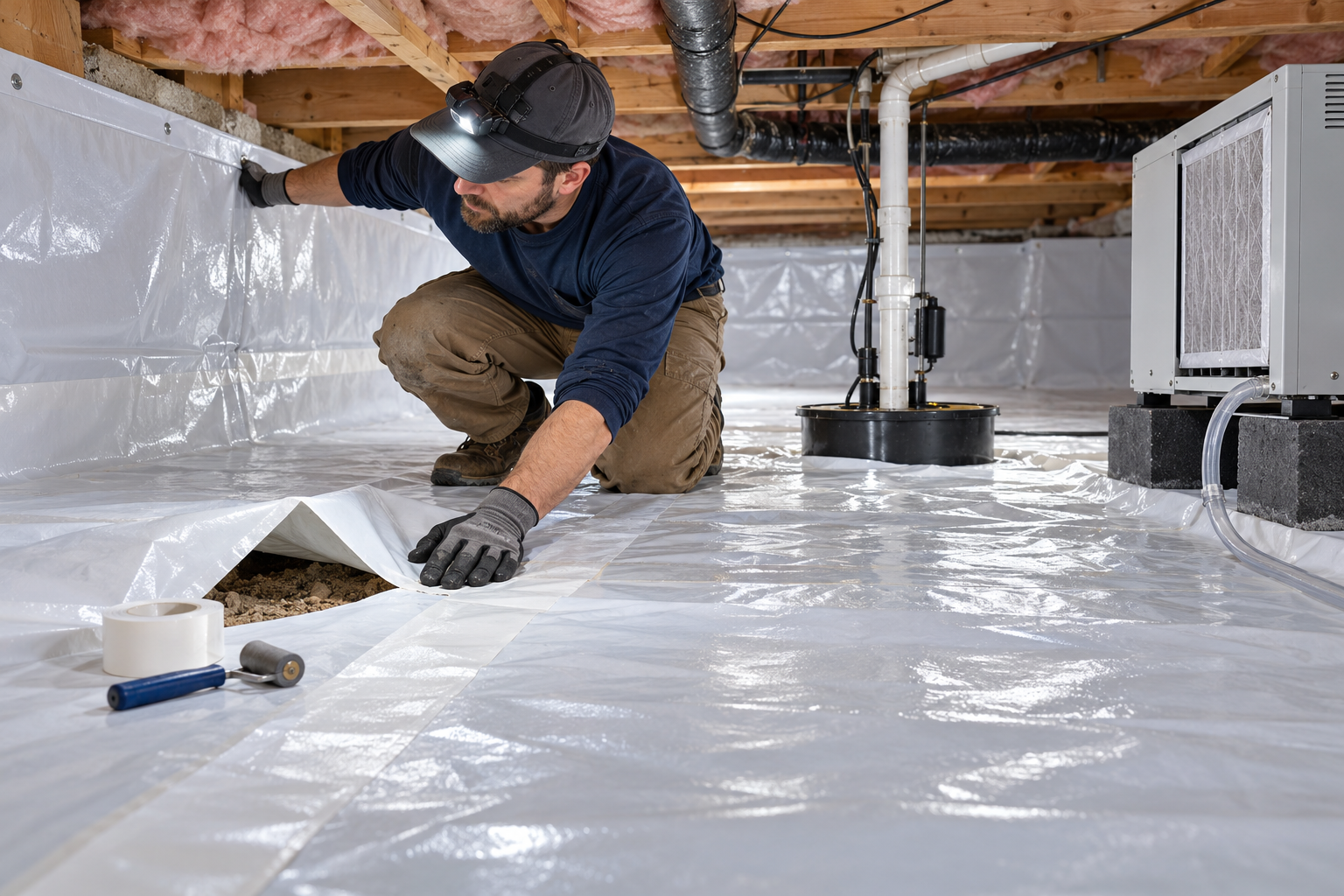
An encapsulated crawl space is a system that needs inspection. Loose seams, damaged liner, failed wall attachment, open penetrations, water below the liner, a blocked discharge, or a failed dehumidifier can each require a different repair.

Common maintenance scopes

  • inspect liner, seams, walls, piers, penetrations, vents, and access;
  • patch or re-seal a localized tear or seam;
  • correct water below or above the liner and verify drainage;
  • test the sump, alarm, discharge, and backup;
  • clean or service the dehumidifier and condensate path;
  • repair insulation, access doors, or protection damaged by later work.

No reliable comparable national repair or maintenance price was established. A service call plus a small liner repair is not comparable with removing an enclosure because the source water remains unresolved. Ask for the affected area, access assumptions, parts, equipment, cleanup, and warranty boundary.

When partial repair may be enough

Localized damage with a dry underlying condition can often be evaluated as a component repair. Re-encapsulation becomes more plausible when failures are widespread, wall and pier attachment is open, the material is incompatible with the intended enclosure, or water and humidity problems continue throughout the system.

DOE ground-cover guidance addresses soil vapor but does not make an enclosure floodproof. Natural Resources Canada advises correcting leaks before insulation. Keep drainage and humidity causes visible rather than covering them with a new liner.

Find the failed layer before repairing it

An enclosure can fail at the ground cover, seam, wall or pier attachment, access door, penetration, drainage system, sump, dehumidifier, condensate route, or the underlying building condition. A tear may be a local material repair. A wet liner may indicate water below it. Repeated humidity may indicate a missing enclosure detail, equipment failure, or a source that the enclosure never addressed.

Ask the service provider to document the location and size of damage, the condition beneath it, the water and humidity history, and the repair method. Request photographs before the liner is closed. If the cause is standing water, groundwater, plumbing, pests, or structural deterioration, keep that work separate from a patch price.

Maintenance tasks to budget

Maintenance can include visual inspection, seam and edge checks, cleaning or protecting the ground cover, pump and alarm testing, discharge inspection, dehumidifier filters and coils, condensate checks, battery replacement, access-door review, and monitoring of humidity or standing water. The exact schedule depends on equipment and configuration. Ask the installer to state what the homeowner can do and what requires service.

Do not cover the pump, float, alarm, cleanout, discharge, wiring, shutoff, or structural observation with a later repair. A maintenance visit that cannot reach the equipment is not a complete service. Keep a record of dates, readings, repairs, and unresolved conditions.

Repair scenarios

  • Local liner or seam damage: the surrounding substrate is dry and the enclosure boundary remains suitable.
  • Attachment or transition failure: walls, piers, posts, vents, doors, or penetrations need renewed detailing.
  • Equipment or drainage repair: pump, discharge, dehumidifier, condensate, power, or alarm is the failed layer.
  • Re-encapsulation: damage is widespread, the configuration is changing, or the underlying source has been corrected and the enclosure must be rebuilt.

The correct scope can be smaller than redoing the whole space, but only if the cause and boundary are understood. A large patch may be poor value if water continues to enter below the liner. A full re-encapsulation may be unnecessary when one accessible seam has failed.

What a repair quote should show

Ask for access, preparation, materials, seam or attachment method, removal and disposal, drying, equipment service, testing, cleanup, warranty, and exclusions. If a dehumidifier or sump is involved, list the model, test, power, discharge, maintenance, and replacement assumptions. Ask how the repaired condition will be verified and what event would trigger further work.

The long-term budget is the cost of keeping the enclosure inspectable and functional. A repair that restores appearance but hides the pump or leaves the source unresolved is not a durable maintenance decision.

Do not permanently block the pump, alarm, discharge, electrical equipment, or inspection points. Request service records and photographs, and have the contractor state what condition was tested after repair.

A maintenance visit should produce evidence

Ask for the date, accessible area inspected, humidity or water observations, liner and attachment condition, equipment test, discharge condition, and unresolved limitations. If a seam is patched, photograph the surrounding area and identify whether the material underneath was dry. If a pump or dehumidifier is serviced, record the test and any part replaced.

Budget for maintenance before the enclosure is installed. A system that requires electricity, filters, condensate management, batteries, alarms, or pump testing has an operating commitment. Keep service clearances open and store equipment information where the next technician can find it.

Decide between repair and redesign

Repair the component when the underlying moisture condition is understood and the enclosure boundary remains suitable. Redesign or re-encapsulate when the configuration is changing, water continues below the liner, humidity remains uncontrolled, or the original installation omitted walls, piers, penetrations, drainage, or service access. A lower repair invoice is not a saving when the same source causes repeated damage.

Ask whether the repair warranty covers the patched material or the water-management result. Keep source correction, environmental assessment, structural work, and restoration separate. The goal is a durable, inspectable assembly rather than a clean-looking surface that postpones the same diagnosis.

Build a repair history

Record the original installation, the affected location, the water or humidity condition, the repair, the test, and the next inspection date. Photograph seams, attachments, transitions, equipment, and damage before closing them. A history helps show whether a repair was isolated or whether the same area repeatedly fails under the same condition.

Ask what maintenance can be done safely by the homeowner and what needs a technician. Do not enter unsafe standing water or operate equipment in a hazardous area to perform a routine check. If access is difficult, price access improvement as part of the maintenance decision rather than accepting inaccessible equipment as normal.

When the repair is a broader project

Repeated liner damage may point to movement, water below the enclosure, poor attachment, pests, or a changed moisture load. Repeated equipment failures may point to inflow, discharge, power, or sizing. Repeated humidity may point to enclosure leakage or source water. These patterns justify a new assessment before another patch is approved.

The most economical long-term scope is the one that corrects the failed layer, records the result, and keeps the next inspection possible. It may be a small repair, a drainage correction, or a redesigned enclosure, but the decision should follow evidence rather than the appearance of the liner.

Ask whether the repair requires moving stored material, removing part of the liner, drying the substrate, or opening a wall or pier detail. Include photographs, cleanup, disposal, testing, and restoration. If the contractor cannot see beneath the liner, the quote should state that limitation and explain what would change the scope.

Keep a calendar for pump, alarm, discharge, dehumidifier, condensate, battery, and seam checks. The schedule belongs to the installed system and manufacturer instructions; it is not a universal promise. A small maintenance cost can protect against a larger concealed failure when the homeowner can reach and document the components.

If the same seam opens after repair, ask whether the liner is moving, water is accumulating below it, an attachment is failing, or work by another trade is damaging the material. If humidity remains high, ask whether the enclosure is incomplete, the equipment is undersized for its assumed configuration, condensate is failing, or liquid water remains. If the pump cycles unexpectedly, review inflow, pit, discharge, power, and alarm before blaming the enclosure.

These observations can justify a broader review, but they do not automatically justify replacing every component. A good service provider states the evidence, the failed layer, the smallest correction, and the condition that would trigger redesign. At completion, keep photographs and a written limitation for any inaccessible or untested area.

The maintenance record should also identify the next inspection date and the person responsible for checking the system. That simple ownership prevents an enclosure from becoming invisible after the installation invoice is paid.

Research notes

Sources used for this guide