
Temporary accessibility work can be sensible after an injury, surgery, a short-term mobility change, a rental move, or an uncertain diagnosis. It can avoid unnecessary demolition while the household learns what it actually needs. Temporary does not mean universally safe, stable, or cheap. Compare fit, installation, weather, damage, removal, and the possibility that a temporary solution will last longer than expected.
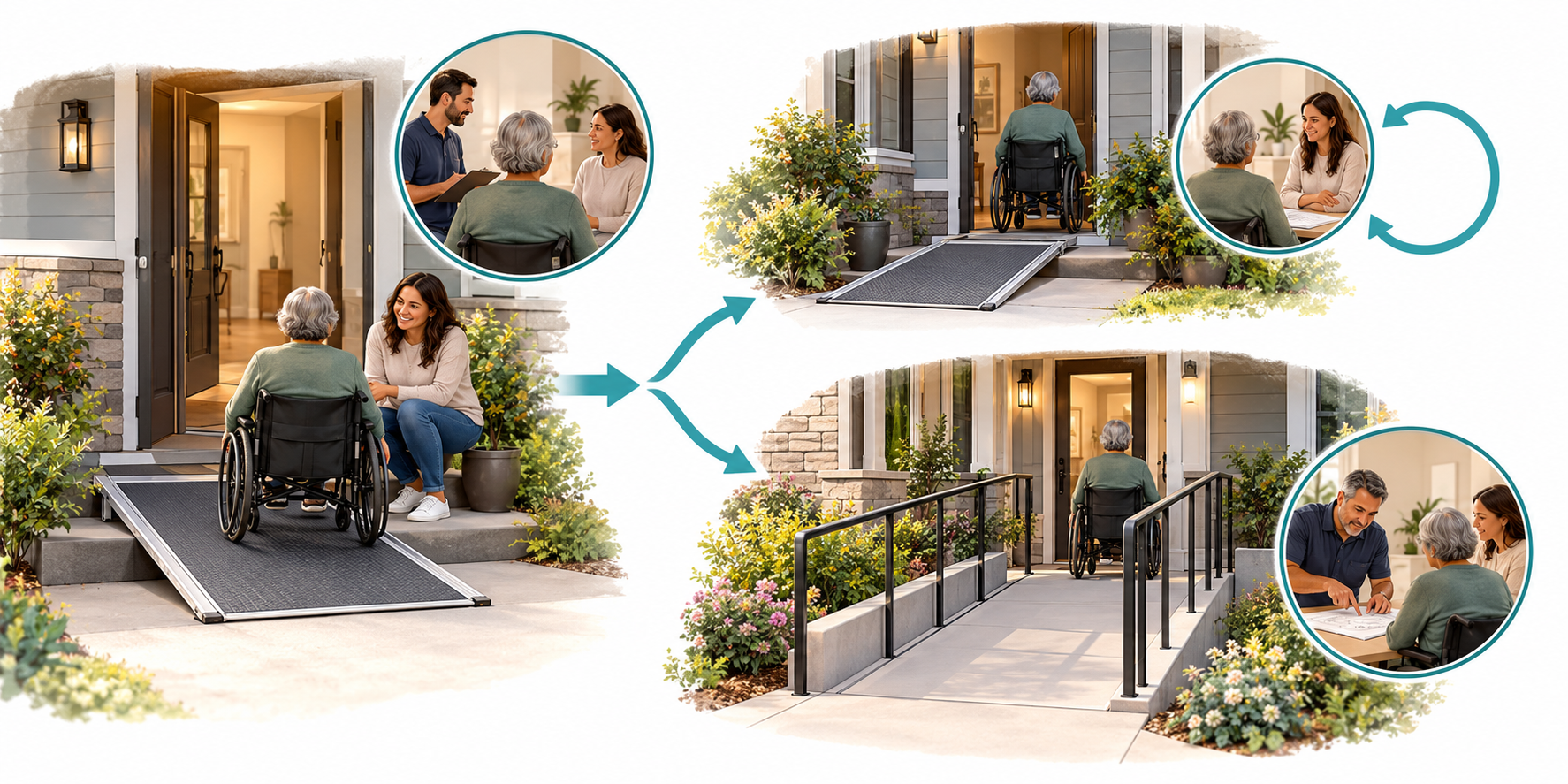
Start with duration and uncertainty
Ask how long the barrier is expected to last, how predictable the user’s needs are, and whether the home will be occupied throughout. Do not make a clinical recovery prediction. Instead, define a review date and the event that would trigger a permanent plan.
A short-duration need may justify a rental, movable device, hardware change, or limited route correction. A recurring or indefinite need may justify permanent construction even if the first response is temporary. The right answer can also be a phased plan: stabilize access now, assess the user and home, then build only the durable work that remains necessary.
Temporary entry options
Possible measures include a modular or rented ramp, a portable threshold solution, a temporary handrail, or a different route through a garage or side entry. Check rise, slope, landing, surface, anchoring, drainage, weather, door operation, and the route beyond the threshold.
A temporary ramp still needs stable support and a user-fit review. A portable threshold can be unsuitable when the door, water protection, device, or floor level conflicts. A garage route can create a new pinch point or weather and safety issue. Do not place a movable product over a condition it cannot safely address.
Temporary bathroom aids
Temporary changes might include movable storage, a shower seat, an appropriate bath aid, better lighting, a support product, or relocating daily supplies. The surface, user, transfer, and product instructions matter. A suction or tension support is not automatically equivalent to a permanently anchored bar.
If a person depends on a support device for a transfer, obtain appropriate professional guidance. This article does not give fastening, transfer, or medical-use instructions. A temporary product that shifts, has the wrong height, or obstructs the route can create more risk than the original condition.
Rental equipment
Rental may reduce upfront cost or avoid ownership of a device that will soon be removed. Compare delivery, measurement, installation, minimum rental term, service, damage, removal, and fit. A used or rented stair lift, ramp, or lift is not automatically compatible with the home or user.
Ask who tests the equipment, who responds to a fault, what parts are available, and what happens if the rental period extends. A product’s short-term price is not its full cost if the household pays for repeated installation, service, or finish repair.
Permanent construction
Permanent work may include a rebuilt entry, fixed ramp, widened route, support blocking, a bathroom remodel, lighting and control relocation, or a first-floor living conversion. It usually provides better integration and can reduce repeated mobilization, but it commits the household to a layout, material, and future maintenance plan.
Coordinate permanent work with planned renovation when possible. The project should solve the route and activity, not install a generic feature because it might be useful later. Include demolition, structure, plumbing, electrical, waterproofing, surfaces, permits, professional review, and restoration.
Cost comparison
Temporary options often trade lower demolition for rental, delivery, installation, removal, and fit risk. Permanent construction trades a larger upfront budget for integration, durability, and sometimes lower repeated service cost. A temporary solution can be economical when the need is genuinely short or uncertain; it can become expensive when it is extended, replaced, or supplemented by emergency work.
Keep U.S. and Canadian costs separate. Ask for a simple temporary scenario, a durable partial scenario, and a permanent scenario where appropriate. Identify what each option leaves unresolved.
When temporary becomes inadequate
Reassess if the device no longer fits, the user’s assistance needs change, the route is used more often, weather makes the entry unreliable, the product shifts or requires repeated repair, or the household is paying for multiple extensions. Reassess after a new bathroom or renovation changes the route.
The transition to permanent work does not need to be all-or-nothing. Keep a safe current route while a qualified professional evaluates the durable scope. Do not delay an urgent hazard because a larger project is planned.
Decision checklist
Before choosing, record duration, user and caregiver needs, route, weather, product limits, installation and removal, property permission, finish damage, rental terms, maintenance, and the review date. For lifts and other powered systems, use qualified providers and verify installation, testing, and service requirements.
Temporary access is a planning strategy, not a lower standard of care. Price the full period of use and choose the smallest solution that safely supports the actual activity while preserving a path to better long-term work.