
A passive whole-home leak-detection system may cost about $150–$800 in U.S. examples for sensors, a hub or bridge, setup, and basic alerts. A larger property with many sensors, professional placement, remote connectivity, automation integration, or recurring service can reach $800–$2,500. These are broad U.S. planning examples.
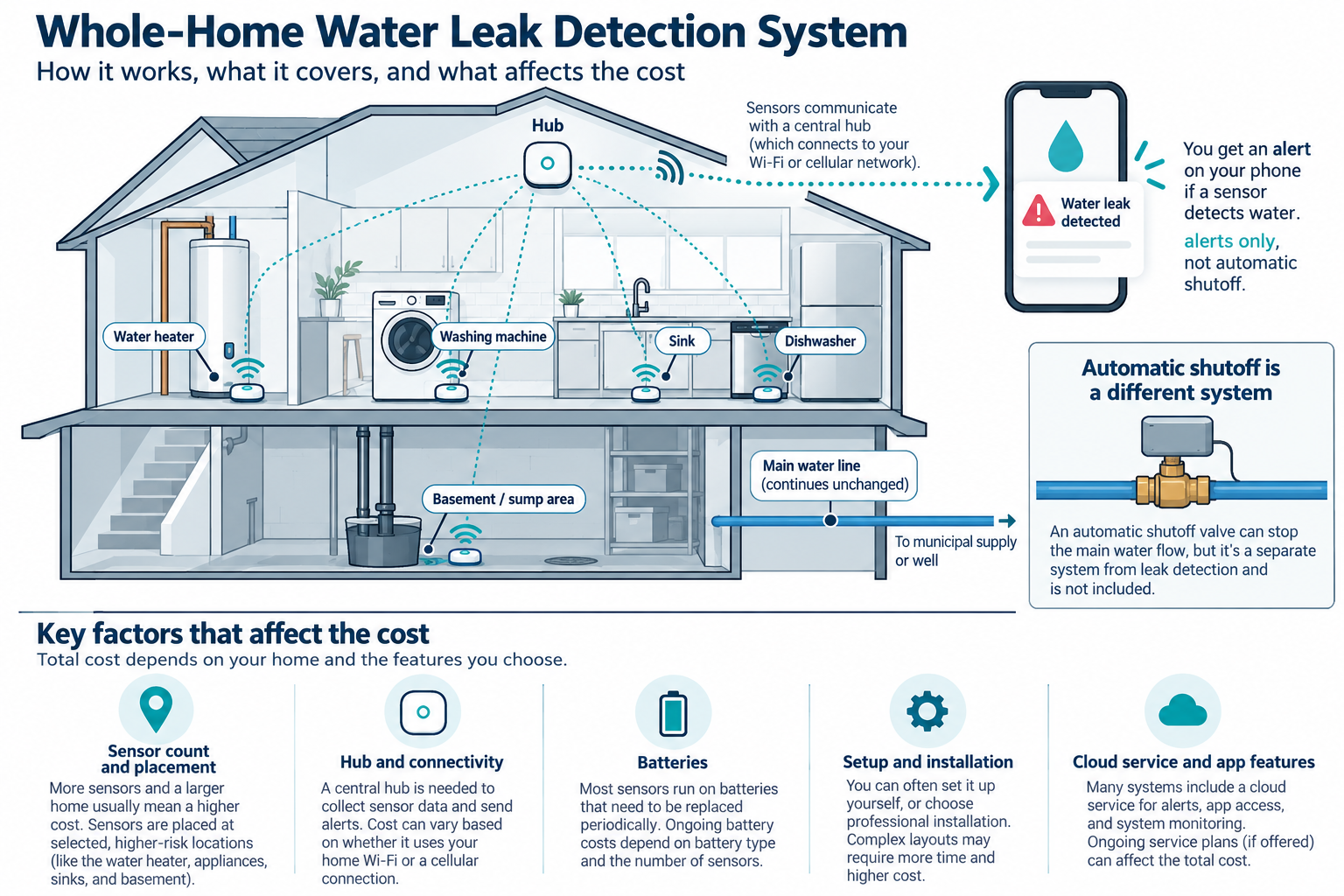
Passive detection means the system senses water and sends an alert. It does not automatically close the main water line. An automatic shutoff is a different project involving a valve, plumbing labor, pipe compatibility, power, commissioning, and maintenance.
What the system includes
A distributed leak-detection system commonly contains:
- point sensors under or near appliances and fixtures;
- a hub, gateway, or connected controller;
- batteries or local power;
- Wi-Fi, Thread, Zigbee, Matter, cellular, or another supported connection;
- an app, notification service, or automation platform;
- optional professional placement and setup;
- account configuration, testing, and handoff.
The purpose is to detect water at selected risk points before a small problem becomes a larger loss. The system only protects the locations where sensors are installed and the communication path that can deliver the alert.
Sensor count and placement
Sensor count is the most visible cost driver. A small installation might cover a water heater, washing machine, dishwasher, refrigerator supply, and mechanical room. A larger system may add bathrooms, basement perimeter locations, sump area, boiler, crawlspace, vacant rooms, or other points identified by the homeowner and installer.
More sensors add equipment, batteries, labels, testing, and future service. The cheapest system may leave a high-consequence location uncovered. The most expensive system is not necessarily better if sensors are placed where they cannot be reached, heard, or maintained.
Ask the installer to provide a location schedule and explain what is not covered. Water can originate in walls, ceilings, roofs, pipes, or fixtures that do not have a point sensor. Passive monitoring is a layer of risk reduction, not a guarantee that every leak will be detected.
Hubs and connectivity
Some sensors connect directly to a home network; others need a bridge or hub. A hub may add equipment and setup cost but can provide a more coordinated system. Connectivity affects alerts, remote access, battery behavior, and integration.
The selected product’s requirements control. The Connectivity Standards Alliance describes Matter as using Bluetooth Low Energy for setup and Wi-Fi, Thread, or Ethernet for network connectivity, but implementation depends on the device and ecosystem. Do not assume that a sensor marked with a common protocol works with every hub or exposes every feature.
Ask what happens if the internet, hub, power, or cloud account is unavailable. Confirm whether the sensor gives a local audible alert, stores events, retries notifications, or simply becomes unreachable. These behaviors are product-specific.
Professional setup and integration
DIY placement may be suitable for a small number of accessible sensors. Professional installation can add a site review, risk-point mapping, hub placement, network testing, battery installation, notification setup, and documentation. Integration with a smart-home controller, automatic shutoff, alarm, or monitoring service adds programming and testing.
Keep passive sensors separate from plumbing intervention. A sensor can report water without changing a pipe. If the homeowner wants an automatic valve, review the separate shutoff installation scope and have a qualified plumber assess the main line.
An insurance discount should not be assumed. The available evidence does not establish a universal saving, eligibility rule, or insurer requirement. Confirm any benefit directly with the actual insurer and policy.
Cost drivers beyond the devices
The most important variables include:
- number and type of sensors;
- hub, bridge, cellular, or other gateway requirements;
- access to mechanical rooms, crawlspaces, or remote locations;
- battery and power arrangements;
- Wi-Fi or network coverage;
- integration with alarms, shutoff valves, or automation;
- account, cloud, and notification service;
- documentation and ongoing testing;
- travel and seasonal-property conditions.
If a sensor must be placed below an inaccessible appliance or in a difficult crawlspace, future replacement labor may be more significant than the initial installation. Ask how the owner will test, replace, and relocate it.
Passive detection versus automatic shutoff
Passive detection tells the homeowner or service provider that water is present. It does not stop the source. An automatic shutoff can reduce flow after an event or abnormal pattern, but it needs compatible valve installation and creates a more consequential plumbing and control decision.
Choose passive sensing when the main objective is awareness at several locations, when plumbing changes are not desired, or when the homeowner can respond quickly. Consider a shutoff when the property is vacant, the potential loss is substantial, or the main line can be modified appropriately. These are not mutually exclusive; a shutoff can use sensors and alerts as additional layers.
Do not describe leak detection as prevention, and do not describe a shutoff as protection against every source of water damage. Roof, wall, sewer, storm, condensation, and concealed-pipe events may require different detection and mitigation.
Batteries, alerts, and ownership
Battery service is part of the total cost. Ask how often batteries are expected to be checked, how low battery is reported, whether a local alert remains available, and whether the homeowner can safely reach every sensor. Remote or seasonal properties need a plan for missed alerts and power outages.
Record the homeowner’s account, notification recipients, device inventory, and recovery method. Canadian consumer guidance recommends secure networks, updates, unique strong passwords, privacy consideration, expected service life, and factory reset before disposal or transfer. These are ownership practices, not a guarantee of any product’s security or support life.
U.S. and Canadian budgeting
For a Canadian project, request a quote from an installer serving the property’s area using the same scope: sensor count and placement, hub, notification path, valve integration, setup, and recurring service. Ask the quote to separate equipment and labor, applicable site or restoration work, configuration or testing, recurring terms, taxes, and exclusions. Do not derive a Canadian amount by converting a U.S. band.
The available cost evidence is made up of specialist market observations and product-level examples. Use a local quote for professional installation and ask what sensor count, access, service plan, and integration assumptions it includes.
Questions before buying
Ask:
- Which locations will be covered and which remain outside the system?
- How many sensors, hubs, bridges, and batteries are included?
- Does the system require a cloud or subscription plan?
- What happens when power, internet, or the hub fails?
- Is professional placement, notification setup, and testing included?
- Does the system only alert, or is an automatic shutoff separately included?
- Who owns the account and can transfer it?
- What maintenance, battery, and replacement work should be budgeted?
- Is any claimed insurance benefit confirmed by the actual insurer?
Building a sensible coverage plan
Rank locations by consequence, likelihood, and how quickly a person could respond. A sensor beneath a water heater or washing machine may be easy to justify; a sensor in an inaccessible cavity may be difficult to maintain; a vacant basement may justify remote alerts even when the sensor count is small. Document what is covered and what is not.
Ask the installer to demonstrate an alert and explain the failure path. The homeowner should know how a low battery, offline hub, missing notification, or false alert appears. If the system is paired with a shutoff, confirm whether the valve acts automatically, requires confirmation, or is only controlled manually. That behavior should be tested and documented rather than assumed from an app label.
What the homeowner should receive
The handoff should name each sensor location, battery type, hub, notification account, test result, and uncovered risk area. Ask the installer to demonstrate an event and an offline condition. If a sensor is moved during a remodel or an appliance replacement, update the map. Good documentation keeps a distributed system useful instead of turning it into a collection of forgotten batteries.
Before approving coverage
Ask for a sensor map and a list of excluded areas. Confirm that a battery, network, or cloud failure creates a visible status and that the homeowner can update the account after an appliance moves. These small handoff details determine whether the system remains useful after the installer leaves.
Key points
- Passive leak detection typically costs less than an automatic shutoff because it does not alter the main water line.
- Sensor count, risk-point coverage, hub requirements, network, and service drive the total.
- Alerts do not guarantee detection of every leak or prevent damage.
- Product protocols and cloud behavior are model-specific.
- Price monitoring, batteries, account ownership, and future testing alongside the devices.
Final quote checkpoint
Before approving coverage, rank water-loss points by consequence and response time, then mark every included and excluded area on a plan. Ask how sensors report low battery, loss of hub, loss of internet, and a normal event; who receives each alert; and what person can respond. Confirm whether the installation includes batteries, mounting, account setup, testing, a shutoff valve, or only passive detection. The homeowner should keep an accessible main shutoff and understand that sensors cannot detect every concealed leak or prevent damage after water has spread. Document sensor locations, appliance changes, test dates, account ownership, and any claimed insurer requirement separately. A smaller documented system can be more useful than a larger unmaintained one.