
In U.S. planning examples, adding access control and communications to an existing or separately planned driveway gate may cost roughly $1,000–$4,000 for a keypad, reader, intercom, camera, controller, and short accessible connection. A long driveway, trench, new conduit, fiber or wireless bridge, difficult power or network path, multiple entry devices, or substantial integration can push the technology scope above $5,000–$15,000.
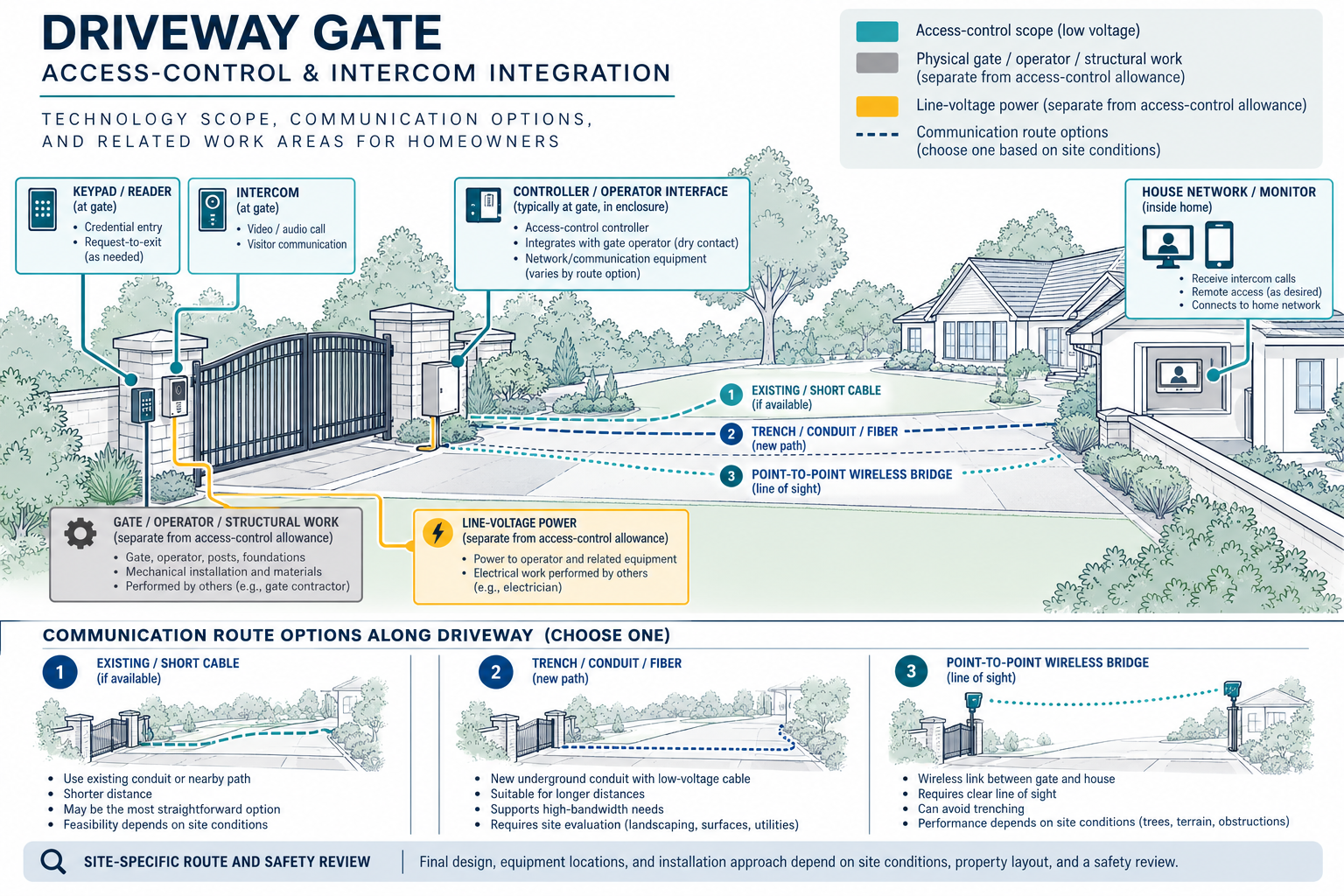
These figures cover the low-voltage control and communications layer. They do not include the physical gate, posts, hinges, operator, structural repairs, driveway work, or all line-voltage supply work. Keeping those scopes separate is the best way to understand a gate quote.
What this article prices
The category’s gate-control scope can include:
- keypad, card reader, fob, mobile credential, or remote receiver;
- gate-side intercom or video station;
- camera and local or cloud video connection;
- controller, relay, power supply, and enclosure;
- cable, conduit, fiber, or wireless bridge;
- house-side monitor, app, network equipment, or access-control integration;
- programming, testing, credentials, documentation, and handoff.
Physical gate construction and structural work are separate. The gate must already be suitable for the control equipment, and the opener or operator must expose a compatible control interface. A new keypad cannot compensate for a gate that is sagging, unsafe, or mechanically unreliable.
Main cost components
| Component | What changes its cost |
|---|---|
| Gate-side device | Weather exposure, mounting, camera view, keypad or reader type |
| Communication path | Distance, trenching, conduit, fiber, copper, wireless bridge, and line of sight |
| Controller and power | Existing compatible interface, enclosure, backup, and service access |
| House-side equipment | Intercom monitor, app, gateway, switch, access point, or recorder |
| Programming | Credentials, call routing, schedules, remote release, and integrations |
| Commissioning | Range, video, audio, release, outage, and handoff tests |
The price should identify whether the gate system is being added to an existing operator or installed alongside a new operator. The operator is not automatically part of a low-voltage quote.
Cabling versus wireless connectivity
A short accessible cable route may be economical when the home and gate are close and pathways already exist. A long driveway can make trenching, conduit, weather exposure, restoration, and site coordination the dominant cost. Fiber can be considered for a backbone where distance, bandwidth, or electrical isolation makes it suitable; it adds termination, transceiver, testing, and specialist labor.
A point-to-point wireless bridge may avoid trenching when there is a clear line of sight and suitable mounting and power. It still requires two endpoints, configuration, weather protection, and a stable network path. Trees, terrain, metal, buildings, and seasonal conditions can affect the decision. Do not treat wireless as a guaranteed low-cost substitute without a site assessment.
The network connection to the gate may be separate from the control interface to the operator. Ask which path carries video, which carries credentials or release commands, and what the system does when the network is unavailable.
Intercom, camera, and access-control integration
A gate station may only show a visitor and allow conversation, or it may also request a release through the operator. A camera may record without controlling the gate. A keypad may open the gate without providing video. Price each function separately.
If the home already has an intercom, alarm, camera recorder, smart lock, or automation controller, integration adds product compatibility and programming work. The installer should identify which system owns the access rule, where credentials are managed, and how a new user is added or removed.
Cloud service can add remote calls, notifications, video history, or remote release. Price the recurring plan and confirm its behavior during internet or account failure. A local control path may still need a network or power supply.
Gate operator and power boundary
The low-voltage system may need a compatible dry contact, relay, input, or other interface from the gate operator. The operator, motor, safety sensors, vehicle loops, hinges, and mechanical stops are separate technical systems. Do not assume that an access-control installer has assessed operator safety or that a gate contractor has designed the network.
New line-voltage supply, disconnects, receptacles, or underground electrical work should be priced and performed under the appropriate qualified electrical scope. Trenching may also include site, drainage, paving, or restoration work outside this category.
Access and egress safety
UL Solutions explains that access-control systems can include certified access-control units, electric locking mechanisms, request-to-exit arrangements, power supplies, and door hardware, and that the application must preserve free and unobstructed egress. Its source does not establish gate-specific construction, operator, vehicle-detection, or residential driveway requirements.
This article therefore does not generalize a safety-device or gate-operator compliance result. Require the installer to identify the product listing, power-loss behavior, emergency release, pedestrian access, and applicable local requirements for the actual gate. A vehicle gate and a pedestrian gate may have different risk and access questions.
Long-driveway scenarios
Distance changes the balance between cabling, wireless links, trenching, equipment protection, and service access. Treat the communication route as a separate cost decision from the gate hardware.
Gate close to the house
Existing conduit or an accessible low-voltage route may keep the project relatively simple. The budget is driven by the device, mounting, controller, programming, and compatibility with the operator.
Gate across a landscaped property
Trenching, conduit, landscape restoration, weather exposure, and long-distance communication can exceed the keypad or intercom price. Request a site-work allowance and identify which contractor owns it.
Remote gate or outbuilding
A fiber or wireless bridge may be evaluated alongside the gate controls. The project may need a network enclosure, switch, access point, backup power, and a separate property-infrastructure decision.
Gate and operator replacement together
The physical gate and operator can dominate the total. Keep access control, network, operator, structural, and electrical line items separate so the homeowner can compare bids.
U.S. and Canadian budgeting
For a Canadian project, request a quote from an installer serving the property’s area using the same scope: gate and controller assumptions, distance, trench or conduit, power, network link, weather protection, and commissioning. Ask the quote to separate equipment and labor, applicable site or restoration work, configuration or testing, recurring terms, taxes, and exclusions. Do not derive a Canadian amount by converting a U.S. band.
Privacy and recording requirements also depend on where cameras point and who uses the property. Shared drives, tenants, neighbors, service staff, and public approaches may require additional consideration. No universal privacy or permit rule is established here.
What the quote should clarify
Ask for:
- exact gate-side and house-side devices;
- the operator interface and physical-gate assumptions;
- cable, conduit, fiber, wireless bridge, and line-of-sight path;
- trenching, landscape, paving, and restoration boundaries;
- power supply, battery, enclosure, and network assumptions;
- intercom, camera, credential, and remote-release functions;
- programming, testing, documentation, owner accounts, and warranty;
- cloud, support, cellular, and future service charges;
- safety, emergency release, and local-verification responsibilities.
How to separate the gate quote
Ask the contractor to divide the proposal into physical gate condition, gate operator, power, access-control device, communications link, intercom or camera, and programming. This makes it possible to approve the technology while postponing a gate replacement, or to compare a wired link with a wireless bridge without mixing in excavation.
The most important site question is often where the gate’s control point is relative to the house. A short, accessible route may favor cable. A long landscaped approach may favor a bridge or fiber, but each adds its own alignment, power, weather, and service requirements. If a vehicle gate and pedestrian entry are both involved, ask that their access behavior and safety responsibilities be described separately.
The owner should also decide which functions are essential during an outage. Local keypad access, a manual release, intercom calling, remote opening, and camera recording may use different power or network paths. Ask the contractor to demonstrate the intended behavior and to document who can restore the system after a power or network interruption.
The value of a site-specific allowance
A gate quote should state what is known about the route and what remains conditional. Ask for measured distance, trench or bridge assumptions, endpoint power, weather protection, and expected service access. If the gate operator or physical structure has not been assessed, keep those costs outside the technology allowance. This prevents a low access-control number from disguising a large later change order.
Key points
- Gate access-control cost is separate from the physical gate and operator.
- Long runs can make trenching, conduit, fiber, or wireless bridges the main cost.
- Intercom, camera, credential, and release functions should be priced separately.
- New line-voltage supply and site work need explicit boundaries.
- Gate-specific safety and compliance claims require qualified, local, product-specific verification.
Final quote checkpoint
Before approving the technology package, require a site sketch showing the house, gate, operator, pedestrian entry, power source, communications route, and any trench or bridge. Confirm which contractor owns the gate structure, hinges, operator, safety edges, loop detectors, access credentials, and release behavior. Ask how the system behaves during a power, internet, cellular, or controller failure and how emergency access is preserved. A remote app may be convenient but should not be treated as the only safe means of entry. Have the installer separate one-time construction from recurring connectivity or support. The final handoff should include user permissions, manual-release instructions, tested safety behavior, route photos, and service contacts.