
In U.S. planning examples, installing an automatic main water shutoff may cost roughly $800–$2,500 when the main line is accessible and the selected valve fits the pipe. A difficult mechanical-room location, large pipe, obsolete valve, new power or network path, leak sensors, integration, or substantial plumbing changes can bring the project to $2,500–$5,000.
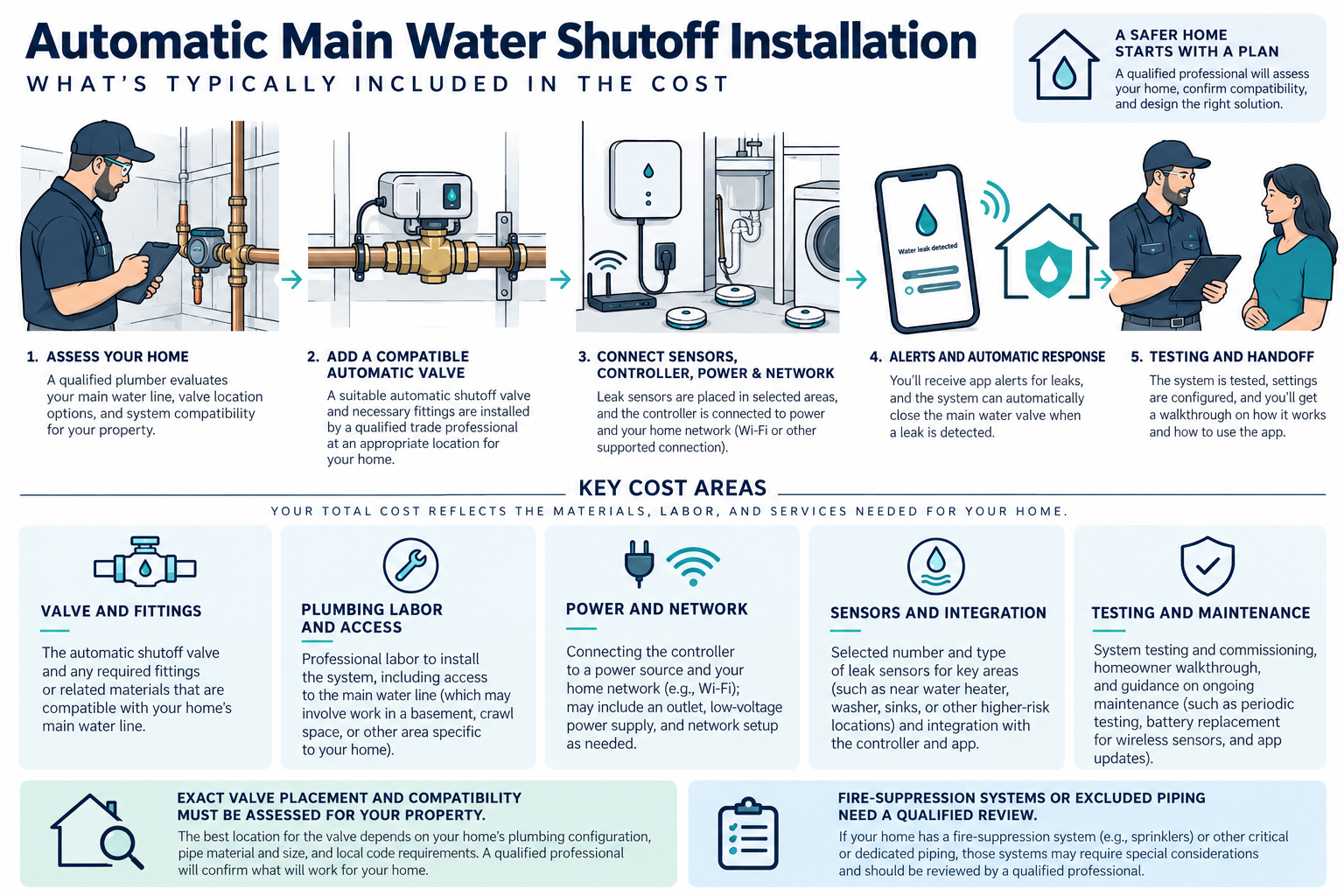
This is a plumbing-and-controls project, not just a connected sensor purchase. The valve must be installed in the correct part of the water system, remain serviceable, and work with the property’s pipe, pressure, power, network, and any connected monitoring.
How it differs from leak sensors
Passive leak sensors detect water at selected points and send alerts. An automatic shutoff adds a valve or actuator to the main supply so the system can close water after a defined trigger or manual command. It may use point sensors, abnormal-flow analysis, schedules, or another product-specific rule.
The two systems can complement each other. Sensors can detect a local leak, while the valve provides a way to stop or limit incoming water. Neither prevents every water-loss event: leaks beyond the monitored locations, sewer or storm water, roof leaks, and plumbing conditions outside the system may require other mitigation.
Installed components
A complete project may include:
- the automatic valve or actuator;
- pipe fittings, adapters, supports, and isolation arrangements;
- plumbing labor and water shutdown;
- a hub, gateway, Wi-Fi, cellular, or automation connection;
- local power or battery equipment;
- point leak sensors;
- app, alert, or professional monitoring setup;
- commissioning, manual-operation testing, documentation, and owner training.
The hardware and labor should be separate in the quote. A low device price does not describe the cost of cutting into a main line, adapting the pipe, restoring access, or testing the system.
Main-line placement and access
The valve’s location is a technical product and plumbing decision. In the Moen Flo example, the manufacturer places the device on the main supply after the shutoff and pressure-reducing valve and before branches, while excluding fire suppression and hot-water distribution from that installation relationship. That is an example for a specific product, not a universal placement instruction.
The plumber must assess the actual main shutoff, pressure-reducing valve, branch layout, pipe material, pipe size, clearance, drainage, and future service access. A cramped crawlspace, buried or inaccessible main, corroded valve, finished wall, or unusual material can make labor dominate.
This article is a planning guide, not an installation procedure. Do not shut off, cut, or modify the main water line based solely on a general article.
Pipe and valve compatibility
Compatibility can depend on nominal pipe size, actual material, fittings, pressure, flow, direction, valve dimensions, installation environment, and manufacturer limitations. Ask the plumber to verify the selected model against the actual property before purchase.
A system may also interact with a pressure-reducing valve, backflow device, water softener, well system, booster pump, or separate fire-suppression piping. The evidence available here does not establish a universal arrangement. The quote should identify what the valve will control and what it will not control.
If the home has a fire-suppression system, the exclusion or protection boundary must be clear. Do not install or configure an automatic shutoff in a way that compromises another system. Use qualified plumbing and safety professionals for the actual design.
Power and network requirements
The controller may need a receptacle, low-voltage adapter, battery, Wi-Fi, Ethernet, cellular, or a hub. New line-voltage work belongs in a separate qualified electrical scope. Network changes, access-point installation, and automation programming may be separate low-voltage scopes.
Ask what happens during a power outage, internet outage, or cloud-service interruption. Confirm whether the valve can be operated locally, how it reports its state, and how the homeowner receives a failure alert. These are model-specific behaviors, not conclusions that follow from the word “smart.”
Sensors and integration
Point sensors under appliances, near mechanical equipment, or in vulnerable rooms can provide the trigger for a shutoff. Each sensor adds equipment, battery, placement, testing, and future service. Integration with a security alarm, home automation hub, freeze monitor, or professional service adds setup and compatibility work.
Do not assume that every leak sensor communicates with every valve. The manufacturer’s current compatibility information should identify supported devices and functions. A common protocol can help with ecosystem connection without guaranteeing a specific automation or safety behavior.
Commissioning and maintenance
Commissioning should include valve operation, sensor events, alerts, account ownership, local operation, and a documented recovery process. Ask who tests the system after a firmware or network change and who is called when the valve reports an error.
Maintenance may include exercising the valve under the manufacturer’s instructions, replacing batteries, checking sensors, updating the app or controller, and inspecting for plumbing leaks. The system is not a substitute for ordinary plumbing maintenance, and an alert is not proof that the valve closed or that all downstream water stopped.
Cost scenarios
The same valve can produce very different installed costs depending on where the main line is accessible and whether the project includes sensors, communications, or response support. Use these scenarios to identify which scope matches the property.
Accessible mechanical room
A close, visible main line with compatible pipe, available power, and a straightforward Wi-Fi path may keep labor and restoration relatively low. The device, fittings, setup, and commissioning still need to be included.
Finished or cramped location
Wall access, crawlspace work, relocation of the valve, corroded fittings, and finish restoration can push the project toward the high end. Ask for an access allowance and a change-order rule.
Integrated water-loss protection
A valve plus multiple leak sensors, professional monitoring, freeze sensors, and automation can be a larger system. Price sensors, network, cloud, monitoring, and ongoing maintenance separately.
U.S. and Canadian budgeting
For a Canadian project, request a quote from an installer serving the property’s area using the same scope: pipe and valve compatibility, access, plumbing changes, power or network, sensors, and a shutoff test. Ask the quote to separate equipment and labor, applicable site or restoration work, configuration or testing, recurring terms, taxes, and exclusions. Do not derive a Canadian amount by converting a U.S. band.
The available evidence does not establish a national code, permit, or fire-suppression rule. Ask the plumber which local requirements apply and seek authoritative confirmation for consequential questions.
Questions for the plumber and integrator
Ask:
- What exact valve model fits the property’s pipe and pressure conditions?
- Where will it be placed, and what parts of the system will it control?
- Is the existing shutoff, pressure-reducing valve, or fitting reusable?
- Are fire suppression, hot-water, well, or booster systems affected?
- What power, network, hub, and cloud services are required?
- Which sensors are compatible, and how are they tested?
- What happens during power, internet, or cloud failure?
- Does the price include commissioning, owner training, and documentation?
- What routine testing, battery, and service costs should be expected?
Evaluating the total water-loss decision
Start with the plumbing layout and the type of loss the homeowner is trying to limit. A main-line shutoff can address incoming supply but cannot stop every leak, such as a roof leak, drain backup, concealed branch leak, or water already inside the home. Point sensors and ordinary plumbing maintenance remain important.
The quote should explain manual operation, alert behavior, power and network failure, sensor compatibility, and testing. Ask whether the homeowner can see the valve’s current state and whether a qualified professional will verify the system after installation. A device that can close water is valuable only when the owner understands its limits and can restore service safely.
The homeowner should also ask how ordinary plumbing remains usable during service. Identify the main shutoff, any pressure-reducing or backflow equipment, the portion of the system excluded from automatic control, and who responds if the valve closes unexpectedly. A low-cost installation that leaves no accessible manual control or documentation can create future service expense. Include the cost of a return visit or replacement actuator in the ownership reserve.
A complete commissioning handoff
The homeowner should receive the valve model, placement record, controlled and excluded piping, sensor list, account access, manual-operation information, test result, and failure response. Ask who is responsible for plumbing repair versus network or app support. This distinction matters when the valve closes unexpectedly or a cloud service stops reporting. Documentation is part of the safety and ownership value of the installation.
Key points
- Automatic shutoff installation includes plumbing labor and compatibility assessment, not only valve hardware.
- Main-line access, pipe size and material, fittings, power, network, and integration drive cost.
- A manufacturer’s placement example applies to that product and is not a universal plumbing rule.
- Fire-suppression, local code, and safety questions require qualified, authoritative review.
- Treat automatic shutoff as one layer of water-loss protection, not a guarantee against all damage.
Final quote checkpoint
Before comparing prices, ask the plumber to identify the valve location, pipe size and material, normal flow direction, accessible manual controls, and any branch or fixture that will remain outside the shutoff. Confirm how the installation affects a well pump, hot-water equipment, fire-protection piping, or a pressure-reducing assembly. The proposal should state whether the valve is fail-open or fail-closed, how it behaves when its batteries or network are unavailable, and who will test that behavior. Include an owner walk-through, a dated test record, replacement-part assumptions, and a clear division between plumbing service and app support. These details make a lower hardware price comparable with a fully commissioned installation.