
A U.S. planning example for a video-doorbell installation is about $150–$500 when the existing low-voltage circuit, chime, mounting location, and Wi-Fi connection are suitable. A wired installation with transformer or chime work, masonry, new cable, or troubleshooting poor Wi-Fi can reach $500–$1,200. The device subscription and future service are separate.
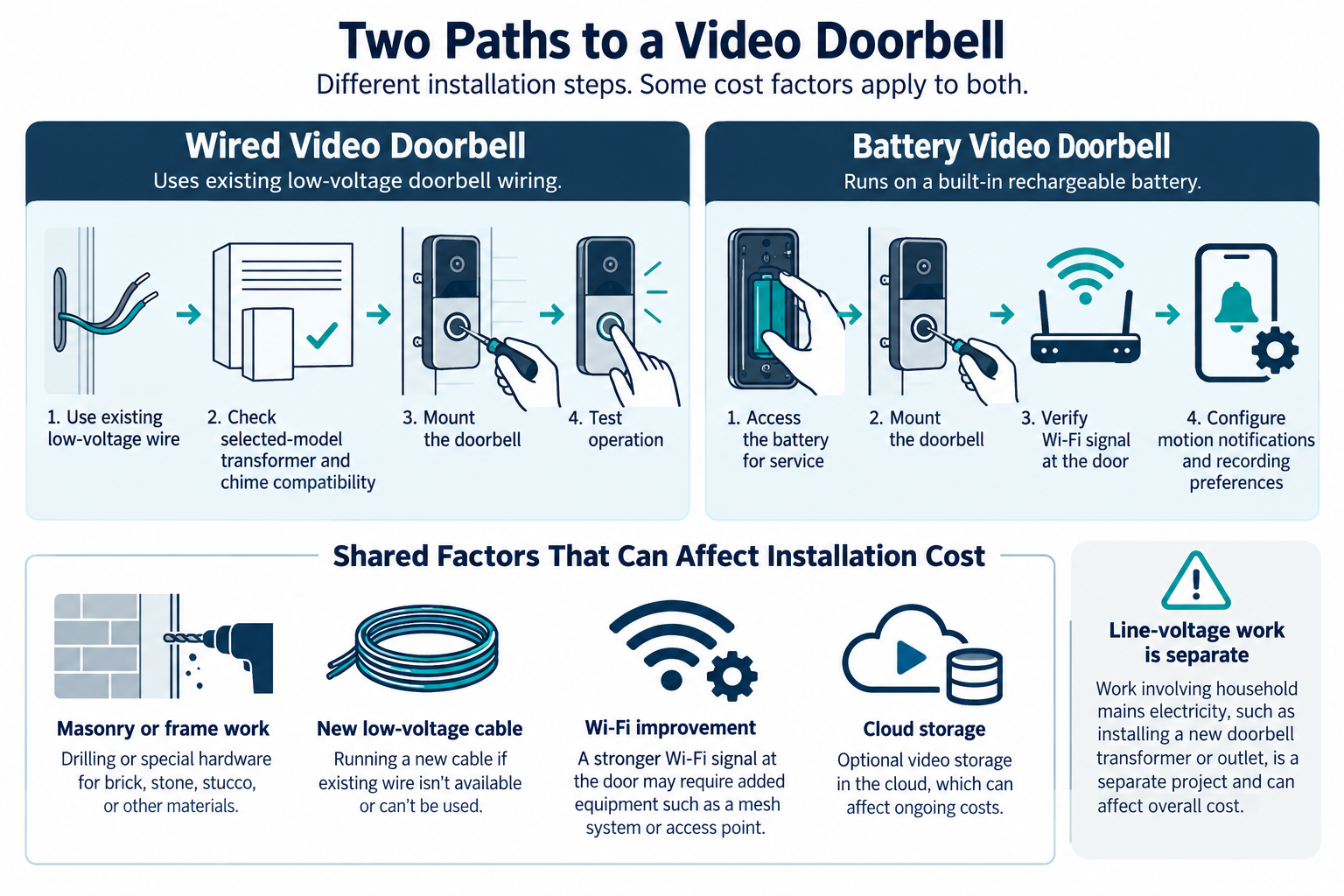
The key question is not simply which doorbell costs less. It is whether the property already has compatible power and a usable network path, and whether the selected device’s installation assumptions match the door.
What the installation includes
A complete quote may contain:
- the doorbell device and mounting hardware;
- battery, wired, or hybrid power arrangement;
- existing wire and chime assessment;
- transformer or low-voltage power compatibility check;
- mounting and door-frame preparation;
- Wi-Fi coverage testing;
- app, account, notification, and visitor-response setup;
- cloud recording or local-storage configuration;
- testing, handoff, and future service instructions.
Some homeowners install the device themselves. A professional visit can be useful when the wiring is old or undocumented, the entry is masonry, the chime behaves unexpectedly, the device must be integrated with a larger security system, or the owner wants a documented handoff.
Wired versus battery models
A wired doorbell can avoid routine charging when the existing low-voltage supply meets the selected manufacturer’s requirements. It still depends on compatibility among the device, transformer, chime, wiring, and mounting arrangement. A battery doorbell can reduce the need to reuse or alter existing wiring, but the battery must be charged or replaced and the device must remain reachable.
Neither label automatically determines reliability. A wired device can lose power or have an incompatible transformer. A battery device can be affected by cold, activity level, Wi-Fi, or a mount that is difficult to access. The manufacturer’s current installation instructions should control the product-specific requirements.
If the entry is vacant for part of the year, include a battery and connectivity plan. A doorbell that cannot be serviced or connected while the property is unoccupied may not deliver the intended value.
Existing doorbell wiring and chime compatibility
The most economical wired installation often reuses a sound existing route. That assumption needs to be verified. The technician may inspect the wire, identify the transformer and chime, check the device’s compatibility, and determine whether a bypass, adapter, or replacement is required.
Do not infer a specific voltage or transformer requirement from another model. Doorbell products vary. The quote should name the product or use a clearly defined manufacturer-compatible assumption. If a transformer or power supply does not meet the selected device’s requirements, the correction may be a separate electrical or low-voltage task.
A digital or mechanical chime may need a product-specific adapter or configuration. A silent or unreliable chime may also be a user-experience issue rather than a camera issue. Ask whether the price includes testing the chime from the final installed position.
Mounting and difficult entries
Doorbell cost rises when the mount requires masonry drilling, a nonstandard bracket, a long setback, a narrow frame, a gate post, a high or exposed location, or finish repair. Angle wedges or replacement plates may improve the view but add hardware and installation time.
Ask the installer to confirm the field of view, lighting, weather exposure, and service access. A camera that points at a bright sky, a wall, or an obstructed porch may produce a poor result even when the device works. The goal is a usable entry view, not just a powered device.
If the desired view is at a driveway or detached gate, the job may no longer be a single doorbell installation. Long cable paths, wireless bridges, access control, or an intercom can become a separate low-voltage project.
Wi-Fi and account setup
The doorbell location may be at the edge of the home’s radio coverage. Brick, metal, concrete, distance, and a crowded network can affect connection. Test coverage at the final mounting position rather than beside the router. A new access point or wired network path can be more expensive than the device.
App setup should include account ownership, notification recipients, recovery methods, shared users, and the process for transferring the device when the property changes hands. Record the model number and current service plan. If a cloud account is required for video history or remote access, include that recurring cost.
Keep device credentials under the homeowner’s control and remove old users at transfer. Connected-device guidance from Canadian consumer authorities and U.S. consumer guidance both emphasize secure network settings, updates, strong unique credentials, and careful handling of obsolete devices. Those recommendations are not a substitute for the selected manufacturer’s instructions or local privacy requirements.
Cloud and recording costs
Many video doorbells offer live view and notifications at no recurring cost but charge for event history, extended retention, advanced detection, or sharing. Others may use local storage, a hub, or a larger camera system. A subscription price can change, so use the current plan and note its camera, retention, and export limits.
Cloud recording is not the same as professional intrusion monitoring. A doorbell plan may save video without an operator receiving or verifying an alarm. If the owner wants a broader alarm response service, compare it separately with the monitoring decision.
For a multi-year budget, add the device, installation, any transformer or chime work, a replacement battery or mount, network changes, and the cloud plan over the chosen horizon. The lowest retail doorbell may not have the lowest ownership cost if it requires a more expensive power or subscription arrangement.
When electrical work becomes separate
A low-voltage doorbell installation can expose a need for line-voltage work, such as a new receptacle, a transformer supply, or a branch-circuit change. Such work belongs in a separate qualified electrical scope. Do not assume that a doorbell installer is authorized to alter the property’s line-voltage system.
If the existing wire is inaccessible, damaged, or not compatible, a professional may price a new low-voltage route, a battery model, a surface pathway, or an alternative entry device. Ask for each alternative rather than accepting an unspecified change order.
U.S. and Canadian budgeting
For a Canadian project, request a quote from an installer serving the property’s area using the same scope: the doorbell and chime, transformer or new wiring, masonry or access work, Wi-Fi troubleshooting, and subscription. Ask the quote to separate equipment and labor, applicable site or restoration work, configuration or testing, recurring terms, taxes, and exclusions. Do not derive a Canadian amount by converting a U.S. band.
Privacy and recording rules also depend on the location and people captured by the camera. Confirm the applicable requirements before recording shared areas, tenants, employees, neighbors, or public space. This guide does not establish a universal surveillance-law rule.
What to ask the installer
Ask:
- Is the existing wire and transformer compatible with the selected model?
- Is the existing chime supported, and is an adapter included?
- What happens if wiring or Wi-Fi fails the final test?
- Does the price include mounting, aiming, account setup, notifications, and handoff?
- Is cloud recording optional, and what are the current retention and export terms?
- Who owns the administrator account and recovery method?
- Is any transformer, receptacle, or branch-circuit work separate?
- What battery access and cold-weather assumptions apply?
- Will a gate, intercom, or driveway view require a different project scope?
Choosing the least disruptive path
Have the installer inspect the existing doorbell before choosing a device. A working chime and accessible wire may make a wired installation simple. A battery unit may be more economical when the wire is damaged, the transformer is unsuitable, or the entry is difficult to open. If the owner wants a wired result but the existing path is poor, compare a new low-voltage route with a battery model instead of assuming the transformer must be changed.
The final decision should also account for the homeowner’s response habits. A doorbell with inexpensive live view but no useful retained history may not meet the need for package or visitor review. A subscription can be worthwhile for that purpose, but its renewal, export, account-transfer, and cancellation terms should be written down. Keep the doorbell account under the homeowner’s control.
Key points
- A straightforward installation often costs far less than one involving transformer, chime, masonry, Wi-Fi, or new cable work.
- Wired and battery devices have different maintenance and compatibility costs.
- Existing wiring must be checked against the selected manufacturer’s requirements.
- Cloud storage and professional alarm monitoring are separate services.
- Keep account ownership, power assumptions, and any line-voltage work visible in the quote.
Final quote checkpoint
Before comparing a wired and battery doorbell, verify the existing transformer, chime, wire path, mounting surface, Wi-Fi signal, and expected cold-weather conditions. Ask whether the quote includes a new low-voltage route, chime adapter, masonry work, account setup, notification testing, recording settings, and owner training. Confirm who owns the administrator account and how video is exported or transferred. A doorbell may share a visitor view with a gate, camera, or intercom, but those integrations can create a separate design and subscription scope. Keep line-voltage work outside the low-voltage allowance unless a qualified trade includes it. The final handoff should state the power mode, device model, account recovery method, and tested visitor-notification behavior.