
A U.S. planning example for a residential video intercom is about $800–$3,000 for a door station, one indoor monitor or app endpoint, wiring or network setup, and commissioning. A multi-station or gate-connected system with new cable, door-release hardware, difficult access, or several interior endpoints can reach $3,000–$10,000.
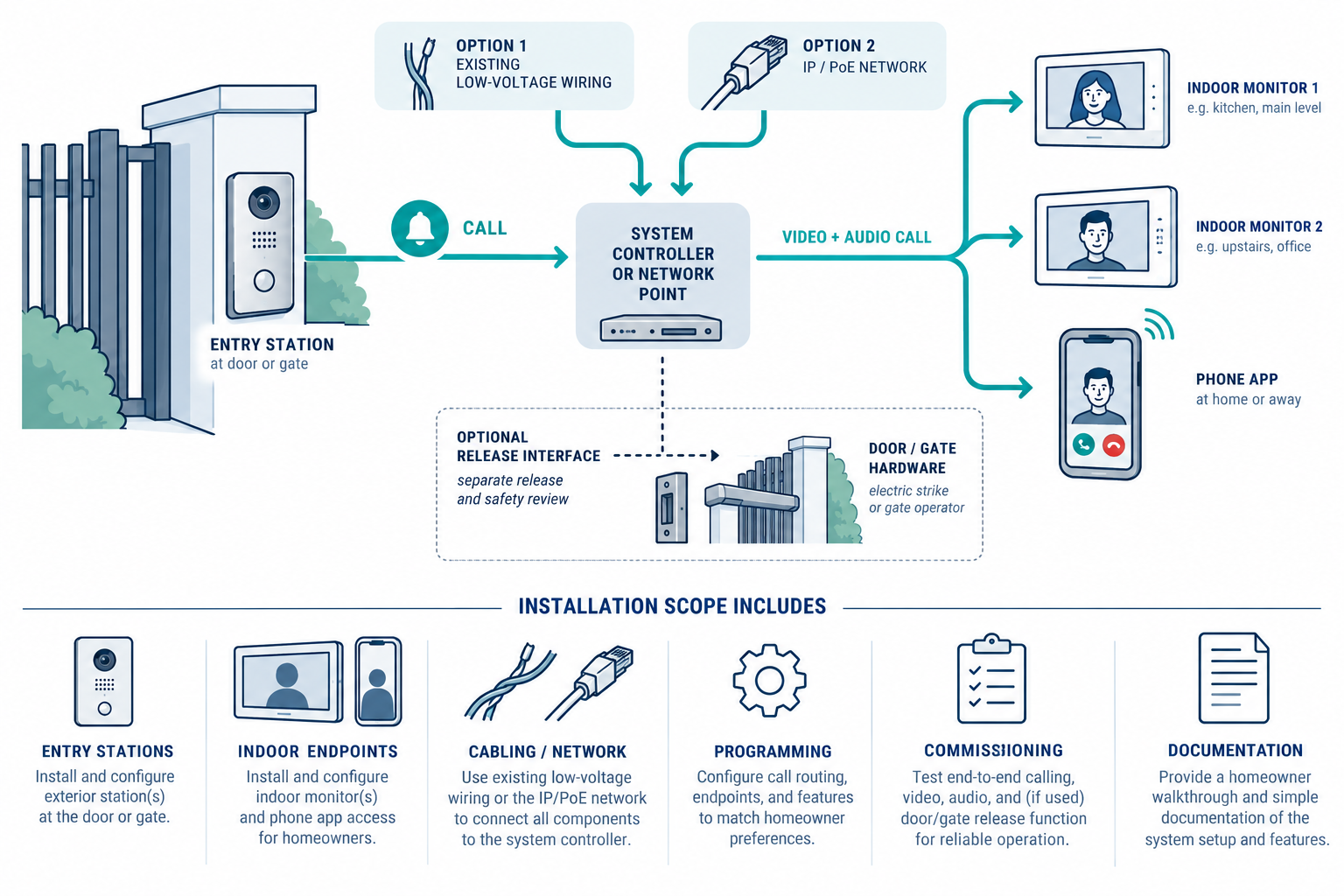
An intercom is more than a single video doorbell. Its purpose is two-way communication between an entry and one or more indoor or mobile endpoints, sometimes with a controlled release. The number of stations, cable topology, door hardware, and integration path determine the real project scope.
What distinguishes an intercom
A video doorbell normally serves one entry and a homeowner’s phone or a simple chime. An intercom may include:
- an exterior door or gate station;
- one or more indoor monitors, handsets, or mobile endpoints;
- a controller, hub, or network switch;
- Ethernet, PoE, legacy low-voltage, or proprietary wiring;
- a door or gate release interface;
- cameras, access credentials, or an alarm connection;
- programming, user setup, testing, and documentation.
The distinction is about the reader’s project, not marketing terminology. A premium doorbell may have many features, but a multi-station entry system still has different cabling, endpoint, and service economics.
System components and cost structure
| Scope | Cost questions |
|---|---|
| Entry station | Door or gate location, camera view, weather exposure, mounting, and power |
| Indoor endpoints | Number of monitors, rooms, users, app accounts, and notification behavior |
| Network or wiring | Ethernet, PoE, legacy wire, hub, switch, bridge, and cable access |
| Release interface | Whether the system only communicates or also operates a compatible release |
| Programming | User setup, call routing, schedules, mobile access, and integrations |
| Commissioning | Audio/video testing, network tests, release tests, documentation, and training |
Some products are consumer-oriented and some require an integrator. Do not compare a self-installed app doorbell with a fully commissioned multi-station system without normalizing the scope.
New installation versus legacy replacement
An open-wall installation can make a wired or PoE intercom economical because cable pathways, central equipment, and power can be coordinated before finishes close. A finished-home retrofit may require cable fishing, attic or crawlspace access, surface raceway, masonry work, patching, or a wireless bridge.
Legacy intercom replacement adds a compatibility question. Existing wires may be usable, but the new station, power supply, indoor monitors, controller, and release interface must support the old topology. A cable that reaches the right room may still be unsuitable for the new product. Ask for a test or a clearly stated compatibility assumption.
If the old system includes a controlled door release, do not replace only the screen without understanding the release and safety behavior. The communication unit and access-control layer may need separate evaluation.
Network and PoE considerations
IP intercoms may use an Ethernet network and, in some product families, PoE. A manufacturer-specific product may require a compatible console, switch, controller, or application. The Connectivity Standards Alliance describes Bluetooth Low Energy for Matter setup and Wi-Fi, Thread, or Ethernet as possible network transports, but product implementation remains decisive. A protocol label does not prove that a selected intercom supports every desired feature.
Network costs include a switch, power budget, cable runs, router or gateway capacity, access point, VLAN or configuration work, and documentation. Do not assume internet speed is the same as internal network readiness. A gate station may also need a long-distance link or outdoor-rated path.
Door and gate release integration
Some intercoms only notify and communicate. Others connect to a compatible electric strike, lock, gate controller, or release relay. The quote must state who controls the release, what happens when power or network service fails, and whether the selected station is approved for that application.
Access-control work can have egress and life-safety implications. UL Solutions describes access control as an integrated system involving certified units, electric locking mechanisms, request-to-exit systems, power supplies, and door hardware, with free and unobstructed egress preserved. This is not a universal code determination for every home. A qualified installer and applicable local authority should evaluate the actual opening when a release is involved.
Physical gate construction, posts, hinges, operators, and structural repair are separate from the intercom technology. If the gate does not move or latch correctly, a working intercom cannot solve that problem.
Cost drivers
The biggest price changes usually come from:
- number of indoor stations and mobile users;
- new cable versus usable existing wiring;
- open-wall versus finished-home access;
- exterior, gate, or long-distance locations;
- release hardware and door or gate compatibility;
- PoE switch, controller, hub, and network readiness;
- programming, account setup, and integration;
- difficult masonry, weather sealing, or finish restoration;
- recurring cloud, support, or software charges.
A quote that lists only the entry station may exclude the interior endpoint, power, network, or release scope. Ask the provider to show every part of the call path.
Subscriptions and owner control
Some intercoms use a local network and local endpoints; others rely on an account or cloud service for mobile calls, remote unlock, history, or support. Price the recurring plan over the intended ownership period. Record what still works if the service is cancelled or the internet is unavailable.
The homeowner should retain administrator access, the endpoint inventory, wiring map, device models, and recovery method. At property transfer, remove old users and follow the manufacturer’s instructions for account and data cleanup. Shared buildings may require permission before a station or release is changed.
U.S. and Canadian budgeting
For a Canadian project, request a quote from an installer serving the property’s area using the same scope: door or gate stations, indoor endpoints, cabling or network work, release hardware, and commissioning. Ask the quote to separate equipment and labor, applicable site or restoration work, configuration or testing, recurring terms, taxes, and exclusions. Do not derive a Canadian amount by converting a U.S. band.
Privacy and recording questions are also jurisdiction-specific, particularly when a station views a shared hall, sidewalk, neighbor, tenant, or staff area. Verify applicable requirements before deployment rather than using a general installation article as legal advice.
Questions for installers
Ask:
- Is this a single doorbell, multi-station intercom, or access-control system?
- How many indoor and mobile endpoints are included?
- What wiring, PoE, power, hub, and network equipment is required?
- Can the existing wire be tested and reused?
- Does the system only communicate, or does it release a door or gate?
- Which manufacturer compatibility and egress assumptions apply?
- What are the cloud, account, support, and cancellation terms?
- Is physical gate, door, or line-voltage work separate?
- What documentation and owner training are included?
Planning the call path
Map the desired call sequence before selecting hardware. Decide whether a visitor should call one monitor, several rooms, a phone app, or all of them; whether the homeowner only needs conversation or also wants a release control; and what should happen when nobody answers. This turns “video intercom” into a measurable scope.
Then identify the physical path from entry to interior endpoints. Open-wall wiring, existing conduit, a network rack, or a short route may keep the project manageable. A gate or remote entry may need a separate bridge, fiber, or trench. If the system includes release hardware, ask for a separate door or gate assessment and a documented power-loss and egress review.
What makes commissioning valuable
Commissioning should test every call path from the entry station to the intended indoor or mobile endpoints. If a release is included, the installer should document what was tested and what remains subject to the door or gate contractor. The homeowner should receive account access, station labels, wiring or network records, and instructions for adding or removing users.
Before comparing proposals
Make sure each proposal uses the same number of entry stations, indoor endpoints, call destinations, release functions, network path, and support assumptions. Ask which parts are local and which depend on an account or cloud service. That makes a simple doorbell, a local intercom, and a fully integrated entry system easier to distinguish.
Key points
- Multi-station intercoms cost more than single-entry video doorbells because they add endpoints, topology, and commissioning.
- Legacy-wire reuse can save access labor but must be verified for the actual product.
- Gate and door release integration introduces separate hardware and safety responsibilities.
- Network, PoE, power, cloud, and account costs should be listed explicitly.
- Separate the intercom from physical gate construction and line-voltage work.
Final quote checkpoint
Before choosing an intercom, define the number of entry stations, indoor stations, mobile destinations, release functions, users, and expected behavior when a call is unanswered. Ask for a measured wiring or network path and identify any gate, door, strike, operator, power, or trench work outside the intercom package. Confirm whether the system is local, cloud-dependent, or mixed, and who owns the accounts and configuration. If a release button affects a door or gate, obtain the relevant safety and egress review from the responsible professional. The commissioning record should show each call path, release test, network dependency, user setup, and recovery instruction. A simple endpoint map makes future service much less costly.