
In U.S. planning examples, a small multi-door residential access-control system may cost roughly $1,500–$5,000 for readers or keypads, a controller, power, cabling, and professional commissioning. Larger properties, multiple openings, specialized locks, intercoms, gates, difficult cable routes, and safety-related design can exceed $10,000. Opening count and release hardware strongly affect scope.
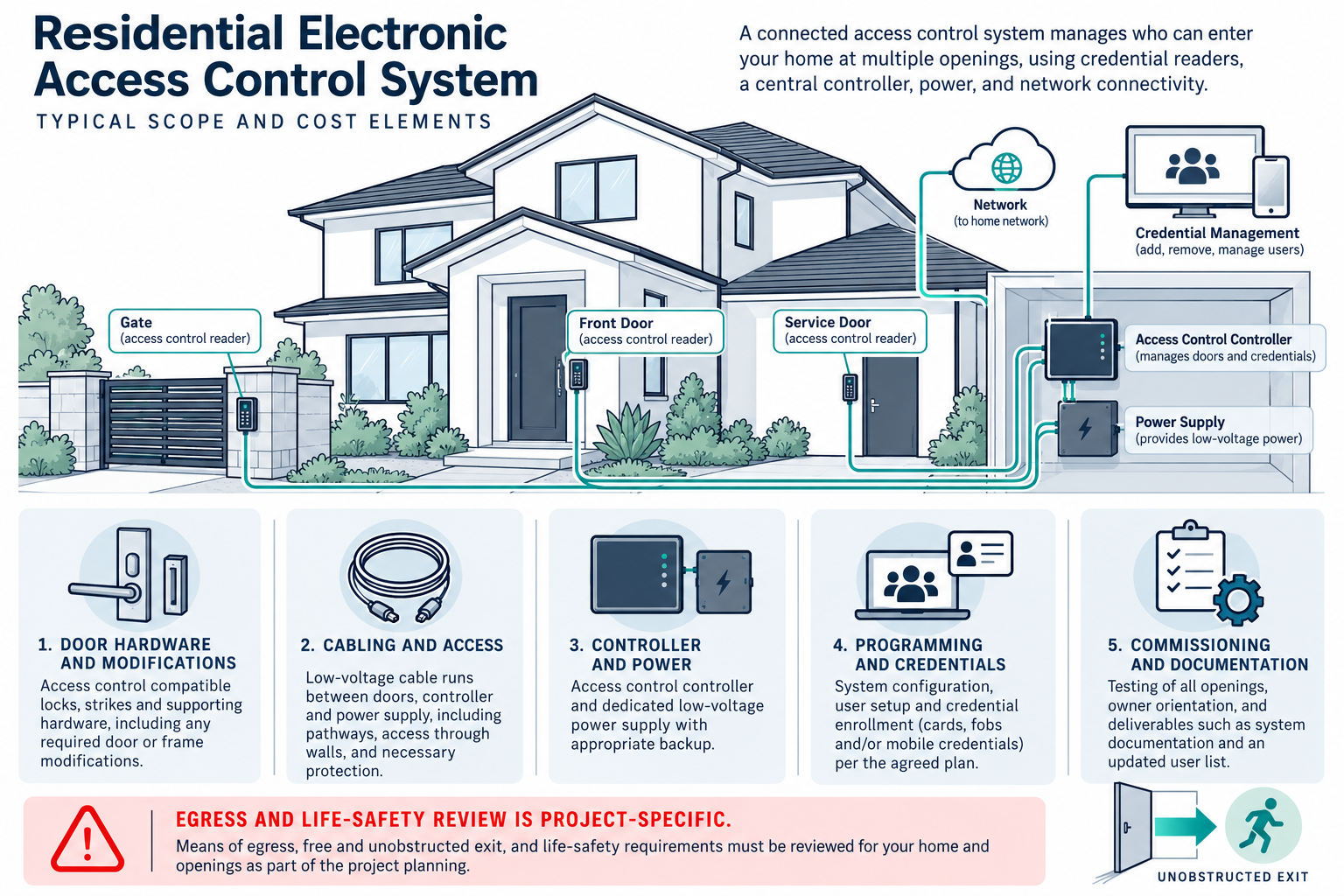
This is not the same decision as replacing one deadbolt with a smart lock. Centralized access control manages multiple openings, credentials, schedules, event records, and integrations. The hardware and installation are only part of the cost; door compatibility and safe release behavior can determine whether the proposed system is suitable.
How it differs from a smart lock
A single smart lock usually serves one door and is selected around that door’s mechanical hardware, battery, and app. A centralized access-control system may include several readers or keypads, a controller, credentials, power supplies, electric locking hardware, request-to-exit devices, low-voltage cable, network connectivity, and software.
The larger system may be justified for a large residence, staff or service access, multiple buildings, a gate and house combination, or a homeowner who needs centrally managed credentials. It is usually excessive when the need is one ordinary entry with a compatible retrofit lock.
Main system components
| Component | Economic role |
|---|---|
| Reader or keypad | Accepts a card, fob, code, mobile credential, or other authorized input |
| Controller | Applies access rules and communicates with the readers and locking hardware |
| Electric lock or strike | Changes the door’s locking or release mechanism |
| Power supply and backup | Powers the low-voltage system and may require a defined backup arrangement |
| Cable and network | Connects readers, locks, sensors, controller, and remote management |
| Credentials | Cards, fobs, mobile enrollment, codes, or other user records |
| Software and commissioning | Configures schedules, users, events, integrations, testing, and handoff |
Each opening may need a different hardware arrangement. A standard interior door is not economically equivalent to a weather-exposed gate, a fire-rated door, a multipoint entry, or a door with unusual hardware.
Cost by controlled opening
The first opening carries shared controller, design, and programming cost. Additional doors add readers, locking hardware, cable, power, installation, and credential configuration. A rough planning model is:
- small single-opening specialty installation in U.S. examples: $700–$2,000;
- two- to four-door residential system in U.S. examples: $1,500–$5,000;
- larger or integrated system in U.S. examples: $5,000–$15,000 or more.
These bands overlap because access, door hardware, product choice, and integration matter more than a fixed per-door formula. Ask for a door-by-door schedule rather than a single “access control package.”
Cabling and controller costs
Readers, locks, request-to-exit devices, door contacts, intercoms, and controllers may need different paths and power arrangements. A central controller location may need a rack, panel, network connection, cable management, labels, and service access. Long or concealed routes can require attic, crawlspace, masonry, or finished-wall work.
Centralized equipment can make future service easier when it is labeled and accessible. It can also concentrate risk if power, network, or controller capacity is undersized. Ask about spare ports, power budget, backup, ventilation, and documentation.
If the project needs a new receptacle, branch circuit, or line-voltage power supply, keep that work separate and have the appropriate qualified trade price it. Low-voltage access-control equipment does not automatically authorize line-voltage changes.
Door-hardware modifications
The lock, strike, closer, latch, frame, hinges, and door material all affect the installation. Electric strikes or other controlled locking hardware may require precise fit and a compatible latch. A door that does not close or align correctly can make the electronic system unreliable and unsafe.
The homeowner should request a physical-door assessment before approving a system. Replacement hardware, reinforcement, frame work, weather protection, or finish repair can exceed the reader cost. Ask whether the system is intended for a particular door class and whether the product listing or manufacturer application limits apply.
Safety and egress
Access control is a higher-consequence project than ordinary connected-device installation. UL Solutions describes access-control systems as integrated equipment that may include certified access-control units, electric locking mechanisms, request-to-exit systems, power supplies, and door hardware. It emphasizes that access control must preserve free and unobstructed egress and that the product certification and application must be considered together.
That guidance does not establish a universal local code result. The actual door, occupancy, fire-rating, exit path, power-loss behavior, life-safety interface, product listing, and authority requirements must be assessed for the property. This article does not provide instructions for wiring, bypassing, delaying, or disabling an exit or lock.
If a proposal discusses delayed egress, fire alarm release, emergency release, or a fire-rated opening, require appropriately qualified design and local verification. Do not choose equipment solely because a reader or lock is marketed for residential use.
Integrating intercom, alarm, and automation
A reader may be paired with an intercom, camera, alarm, smart lock, or whole-home automation controller. Integration adds design, network, programming, account, and future-support cost. A gate may also require a wireless bridge, long cable route, physical operator interface, and separate power work.
Ask which system owns the access decision and which system merely displays or reports it. A camera or intercom can show a visitor without controlling the lock. An alarm panel may report a door event without being suitable as the access controller. Clear ownership of the control path makes service and troubleshooting easier.
When this level is justified
Centralized access control may make sense when the homeowner needs multiple controlled openings, different user privileges, scheduled service access, event history, credential revocation, or coordination across a residence and outbuilding. It may also be appropriate when the property already has a compatible low-voltage infrastructure and professional support.
A set of individual smart locks may be more economical when each door has a separate, simple need and centralized rules are unnecessary. Compare the hardware, battery, cloud, credential, service, and future migration costs of both approaches.
U.S. and Canadian budgeting
For a Canadian project, request a quote from an installer serving the property’s area using the same scope: the number and type of openings, release hardware, power and cabling, commissioning, egress review, and maintenance. Ask the quote to separate equipment and labor, applicable site or restoration work, configuration or testing, recurring terms, taxes, and exclusions. Do not derive a Canadian amount by converting a U.S. band.
Local licensing, permits, inspection, egress, and shared-property responsibility can materially change the work. No national blanket rule is established here. Verify with the relevant authority and qualified contractor when the project affects an exit, fire-rated opening, rental, condo, or common area.
What the quote should include
Ask for:
- a door-by-door hardware and credential schedule;
- controller, power-supply, backup, network, and enclosure assumptions;
- cable routes, access, terminations, labels, and testing;
- physical door modifications and restoration;
- integration with alarm, intercom, camera, gate, and automation systems;
- egress, fire-rating, power-loss, and local-verification responsibilities;
- programming, user enrollment, documentation, training, warranty, and service;
- software, cloud, credential, and recurring support charges;
- the process for adding, revoking, and transferring users.
Decision framework for a residence
Start by listing the openings and the behavior the homeowner actually needs. A front door with a few trusted users may need a smart lock. Several exterior doors with scheduled service access may justify a controller and credentials. A house-and-gate arrangement may need an intercom and a separate long-distance network path. Each additional function should have a reason in the scope.
Then ask what happens when power, network service, a credential, or the controller fails. A system that is easy to use but difficult to release, service, or transfer can have a higher practical cost. Include a physical-door inspection, final testing, and an owner handoff. If another provider cannot service the equipment later, that dependence is part of the economic decision even when it is not shown as a monthly fee.
A useful access-control handoff
The owner should receive the opening schedule, credential process, controller and power details, door hardware records, test results, and emergency or service contacts. Ask who can add or revoke a user and what happens if the controller or network fails. That documentation supports the economic case for centralized access while keeping future service and safety responsibilities visible.
Key points
- Centralized access control is a multi-door system decision, not a larger smart-lock purchase.
- Readers, controllers, electric locking hardware, power, cabling, credentials, and programming each add cost.
- Door condition and access route can dominate the budget.
- Egress and life-safety behavior require product-specific and jurisdiction-specific verification.
- Separate access-control technology from physical gate, door, and line-voltage work.
Final quote checkpoint
Before accepting a credential-system quote, identify every controlled opening, credential type, user group, power source, communication path, and fallback method. Confirm whether the work includes the lock, reader, controller, request-to-exit device, door position contact, cabling, programming, batteries, and door alignment. Ask how users are added and removed, who owns the administrator account, and what happens when the network or cloud service is unavailable. Separate physical door, frame, egress, fire, and line-voltage work from low-voltage access control. The handoff should include a device map, credential procedure, tested release behavior, and recovery instructions. A lower device price is not comparable if it omits the door or the service model that makes access safe and usable.