
When a property is far from existing electric service, the choice is not simply a utility connection versus a panel of solar modules. Grid extension has a connection cost and an ongoing tariff. An off-grid system has generation, storage, backup, fuel, maintenance, replacement, and load-management costs. A hybrid or delayed-connection strategy may also be reasonable.
Start with two complete proposals
The grid side should identify the service point, extension route, transformer or equipment contributions, trenching or poles, easements, meter, capacity, customer-owned work, and restoration. The off-grid side should identify expected loads, generation, batteries or other storage, inverter and controls, backup generation, fuel, monitoring, installation, commissioning, maintenance, and replacement assumptions.
If either side is only a headline number, the comparison is not ready.
Compare the cost classes
| Question | Grid extension | Off-grid or hybrid |
|---|---|---|
| Initial work | Extension, service equipment, trenching, fees, site wiring | Generation, storage, controls, backup, fuel system, design, installation |
| Ongoing cost | Utility charges, outage response, service upgrades | Fuel, service visits, monitoring, maintenance, replacement reserve |
| Load flexibility | Usually supports ordinary expansion subject to capacity | High loads can require a larger system and more storage or backup |
| Reliability | Depends on the local network and connection route | Depends on system design, weather, fuel, storage, and operator discipline |
| Future value | Conventional service may help serviceability and resale | A well-documented system can be useful, but buyer acceptance is site-specific |
Use evidence without false break-even points
The current U.S. Department of Energy Small Wind Guidebook gives an illustrative remote line-extension benchmark of $15,000 to more than $50,000 per mile depending on terrain. It is distributed-wind guidance, not a current utility quote, not a Canadian estimate, and not evidence that a wind system suits a particular site. DOE also lists wind resource, available space, tower rules, electricity needs, interconnection, and economics as feasibility conditions.
The useful comparison is therefore a scenario model, not a universal payback claim. Change one assumption at a time: route length, terrain, occupancy, heating fuel, pump load, winter demand, battery replacement, generator use, fuel delivery, and the cost of a future service upgrade.
Account for high-load and seasonal use
Well pumps, electric resistance heat, water heating, refrigeration, workshop tools, and vehicle charging can dominate system sizing. A seasonal home may have a different peak and annual load from a full-time home, but vacancy can increase monitoring and freeze-protection requirements. If the system cannot support the loads when needed, the apparent capital saving may simply transfer cost to fuel, manual management, or reduced comfort.
When to obtain engineered proposals
Obtain site-specific professional proposals when the choice affects structural tower work, electrical service, generator integration, fuel storage, water pumping, critical medical loads, or a major property-development decision. Compare the serviceability of each option: who can reach the property, how quickly parts arrive, what happens during a long outage, and which components have a defined replacement path.
The lower first cost is not automatically the lower ownership cost. The defensible decision is the one whose assumptions, exclusions, operating duties, and replacement exposure are visible.
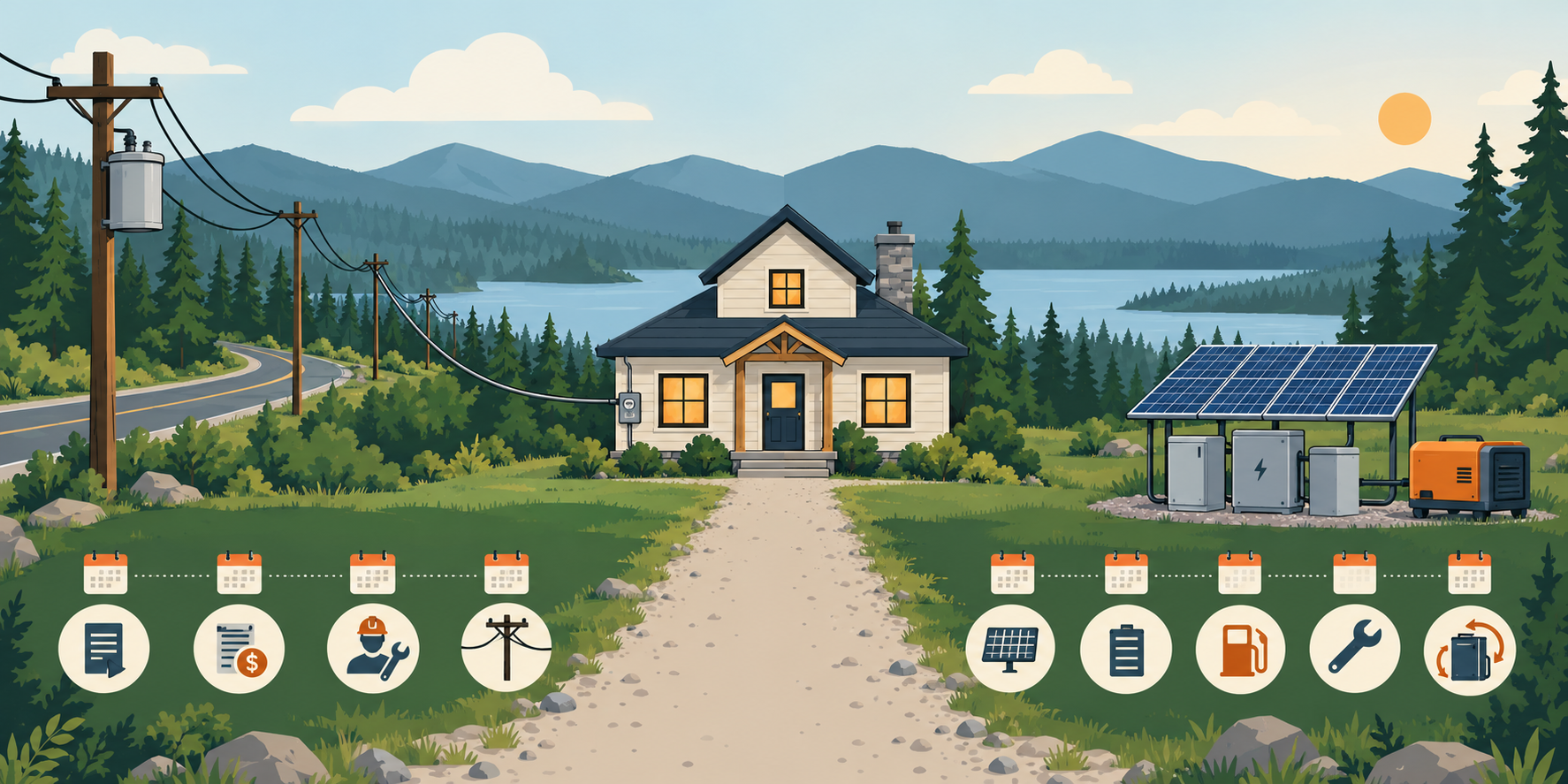
Put both options on the same time line
Choose a comparison period that matches the property decision, then list each expected payment in the year it would occur. The grid option may have a large connection cost at the start, followed by bills, service charges, and possible capacity work. The stand-alone option may have design and installation costs, periodic service, fuel, and replacement of equipment during the comparison period. A single “payback” number hides the timing and can make a fragile estimate look certain.
Use a worksheet with separate rows for:
- design, permitting, engineering, and application costs;
- utility extension, customer work, easements, trenching, and restoration;
- generation equipment, storage, inverter, controls, and commissioning;
- fuel or utility charges under the expected occupancy and load;
- maintenance travel, monitoring, and emergency service;
- replacement of batteries, generators, controls, or service equipment;
- backup arrangements during failure or planned maintenance;
- future capacity for pumps, heating, appliances, or electric vehicles.
Do not count an expense twice. If a quoted off-grid package includes the battery, generator, and commissioning, separate those items only to compare their assumptions, not to add them again. Likewise, a utility allowance is a credit against eligible work, not a cash payment that can be subtracted from every connection cost.
Test scenarios that change the answer
Build at least three cases from the property’s expected use. A low-demand seasonal case might use the home for a limited portion of the year, rely on another heating fuel, and have flexible loads. A full-time case may require continuous water pumping, refrigeration, heating, communications, and reliable winter operation. A high-demand or difficult-service case might add electric heat, workshop loads, vehicle charging, long outages, limited fuel delivery, or a service route that is expensive to maintain.
For each case, change one assumption at a time. Ask how the choice changes if the utility route is longer or rockier than expected, the home becomes year-round, a well pump must run during low generation, fuel delivery is interrupted, or a major battery replacement occurs earlier than planned. If one change reverses the preferred option, treat that variable as a decision-critical unknown and obtain a better estimate before choosing.
| Driver | Why it matters to the comparison | Evidence to obtain |
|---|---|---|
| Route and terrain | Changes extension, excavation, access, and restoration | Utility design and site-specific construction quote |
| Peak and seasonal loads | Determines capacity and the amount of storage or backup needed | Load inventory and qualified design |
| Occupancy pattern | Changes utility allowance classification, fuel use, and system cycling | Provider confirmation and actual schedule |
| Service response | Affects repair delays, emergency travel, and spare equipment | Local service availability and access terms |
| Replacement timing | Can create a large mid-life payment for private equipment | Manufacturer warranty, design assumptions, and reserve plan |
| Expansion plans | May make a small initial system or connection obsolete | Future load and building plan |
Treat provider examples as rules, not project prices
Utility policies illustrate why the connection side needs a written offer. BC Hydro currently lists a maximum residential contribution of $2,798 per single-family dwelling for April 2026 through March 2027; that contribution does not establish the full extension cost. PG&E’s California tariff lists a $3,255 allowance for permanent residential service, while seasonal or intermittent loads follow a different formula. Both pages display dollar signs without an ISO currency code, so the examples remain within their stated utility markets and are not converted or combined. Neither figure supplies the route cost, the customer’s eligibility, or a break-even result. A seasonal home should not be assigned a permanent-service allowance without the provider’s classification.
For a detailed extension breakdown, see cost to bring utilities to a rural property. The practical comparison begins with the provider’s current written terms and a designed project estimate, then considers whether the private system can meet the same load and reliability requirement. Do not combine a historic remote-line benchmark with a contribution allowance to produce an apparent quote.
Include any documented contribution-refund terms in a separate future-cash-flow scenario. Nova Scotia Power, for example, describes a possible refund if qualifying permanent customers later connect to an eligible contributed overhead extension. Timing, eligibility, line segment, and the calculation are provider-specific; it is not a guaranteed rebate or a reduction to the amount due when service is first built. Keep the written utility terms with the comparison and see the utility-extension guide for the bounded example.
Include serviceability and ownership effort
The lowest projected dollar total may not be the best choice if it depends on tasks the owner cannot reliably perform. An off-grid design may need regular checks, fuel storage, planned maintenance, and a response when alarms indicate a fault. A grid connection can still leave the owner responsible for private lines, trenching, trees, easements, or an extension agreement. Record who owns and repairs each component, who can reach it, and how long the household could function while it is unavailable.
Also consider how a future buyer or lender may view the system. Keep plans, permits, warranties, service records, load assumptions, and replacement dates. A well-documented private system may be easier to evaluate than an undocumented one, but buyer acceptance, utility access, and resale value are property-specific. Do not assume either grid service or independence adds a fixed amount to the property’s value.
The decision is ready when the alternatives serve the same intended use, the large cost assumptions are supported by current estimates, and the household understands the operating work and failure response attached to each choice. If neither proposal is complete, identify the missing design or provider answer rather than ranking two unlike totals.
Compare operating assumptions over the same years
Use the household’s expected load and occupancy to compare options. Record which appliances, heating loads, pumps, workshops, vehicles, or seasonal uses are included and how demand might change later. For grid service, ask the provider about ongoing charges, service capacity, outage history available for the area, and any customer work beyond the connection contribution. For an off-grid system, include storage, backup generation, replacement, fuel access, service travel, and the time needed to manage the equipment. A hybrid option can combine grid service with backup, but it still needs a defined design. Compare several years using current local quotes and clearly labeled assumptions rather than projecting one fixed price or claiming a universal break-even point.