
“Utilities are nearby” is not the same as “the property can be connected for a known price.” Bringing service to a rural or remote site can involve provider extensions, customer contributions, poles or transformers, trenching, road crossings, easements, meters, site wiring, communications, restoration, and private alternatives. Ask every provider and contractor to identify where its responsibility ends.
Define what “utilities” includes
Make separate scopes for:
- electric service and any capacity upgrade;
- communications or internet service;
- water source, storage, treatment, and pumping;
- wastewater or septic;
- fuel delivery and storage;
- access needed to construct and maintain each system.
Water and wastewater may not be extendable public services at all. A remote property may need a well, cistern, septic system, or delivered fuel even when electric service can be extended.
Why distance is only one driver
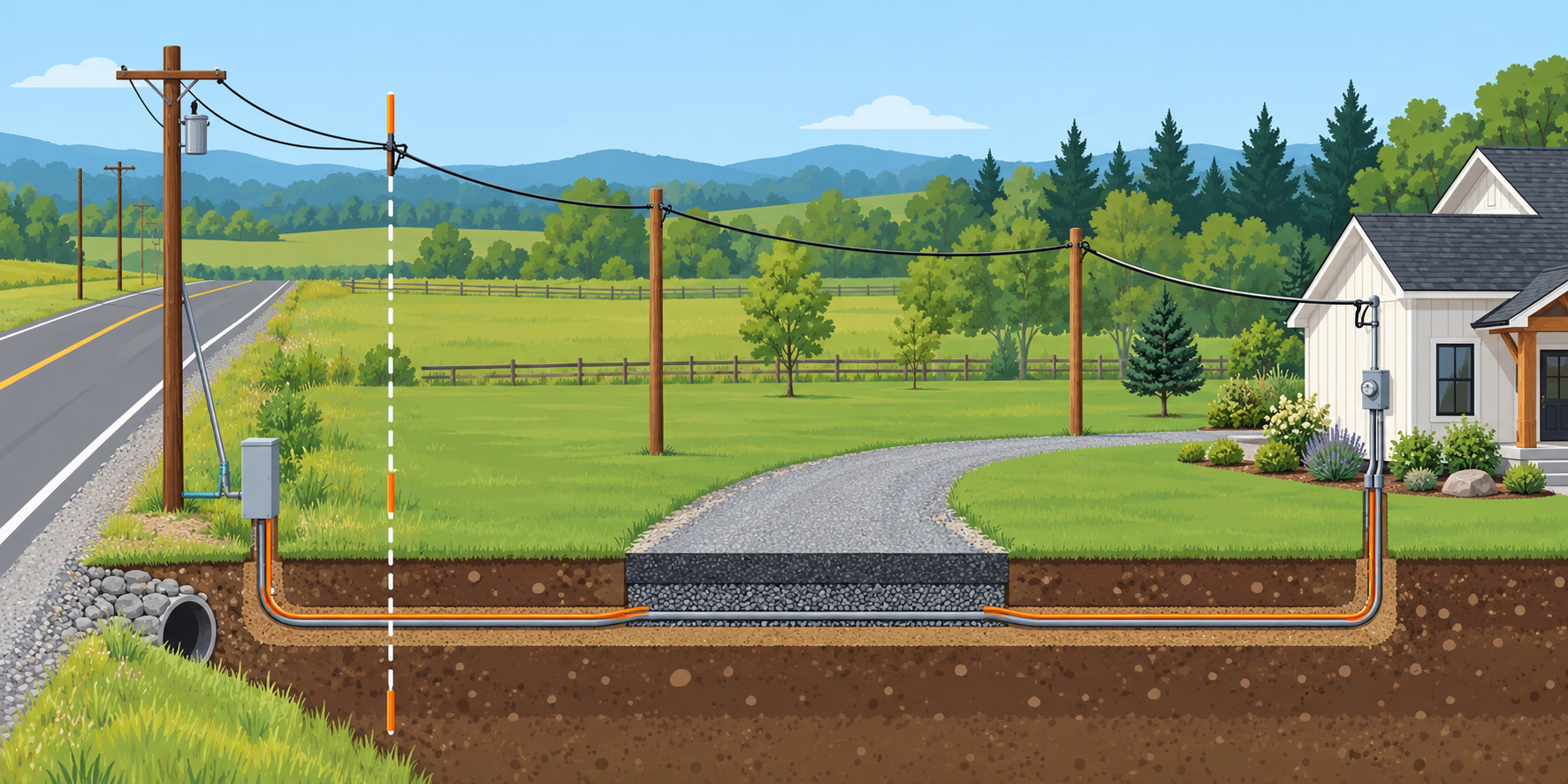
The route can cross rock, wetlands, steep slopes, public roads, driveways, streams, or land owned by someone else. A short difficult route can cost more than a longer accessible one. Ask about trench depth and protection, boring or open-cut crossings, traffic control, restoration, seasonal working conditions, and where excavated material goes.
Coordinate compatible services only when the providers permit it. A shared trench can reduce duplicated excavation in some projects, but it can also create separation, inspection, scheduling, or ownership constraints. Written designs and provider requirements control.
Separate provider-owned and customer-owned work
Request a written extension or connection proposal that identifies:
- the existing service point and available capacity;
- the provider’s construction and equipment allowance;
- customer contributions, connection fees, deposits, or refundable allowances;
- poles, transformers, meters, service equipment, and line ownership;
- easements and rights-of-way;
- trenching, site wiring, inspection, and restoration left to the owner;
- future maintenance and access responsibility.
The rules and tariff structure vary by provider and jurisdiction in both the United States and Canada. Do not turn a case-specific utility policy into a national per-foot rate.
Overhead, underground, and private alternatives
Overhead service may reduce excavation but can still require poles, clearing, crossings, and storm exposure. Underground service may reduce visible infrastructure but adds trenching, bedding, protection, rock handling, and restoration. The right comparison is the complete installed scope, not the material visible at the property line.
Where extension is unusually expensive, compare a current provider proposal with a professionally designed private or hybrid system. The U.S. Department of Energy describes remote line-extension economics as one reason to evaluate distributed generation, but its illustrative figures are not current utility quotes and are not Canadian estimates. A private system still needs generation, storage, backup, maintenance, and a way to support high-load equipment such as pumps or heating.
Request comparable estimates
Give each bidder the same site plan, service location, route, expected loads, occupancy schedule, access assumptions, and restoration expectations. Request alternates for overhead versus underground work, difficult crossings, future service, and private-system options. Confirm whether estimates include design, permits, inspections, taxes, engineering, temporary access, and post-work repair.
If the route or responsibility cannot be confirmed in writing, treat the connection as an open project risk rather than as a known budget item.
Read allowances as one line in the estimate
Provider rules can show how an extension bill is allocated without telling you what the property will cost to connect. For example, BC Hydro lists a maximum residential contribution of $2,798 per single-family dwelling for April 1, 2026 through March 31, 2027. It is a contribution toward construction, not the total extension cost or a payment every customer receives; the page displays a dollar sign without an ISO currency code. A project still depends on the design, charges, credits, and eligibility.
PG&E’s California Electric Rule 15 lists a $3,255 allowance per meter or residential dwelling unit for permanent residential service. The tariff applies the allowance within its defined service and line-extension rules; seasonal or intermittent loads use a different formula, and mixed-fuel new-construction provisions also differ. The tariff displays a dollar sign without an ISO currency code. These are provider-specific rules, not a California-wide estimate or a usable comparison against BC Hydro’s contribution. A property needs a current classification and written utility estimate.
Hydro One’s Conditions of Service page currently identifies a revised document as a draft and notes that the comment period ended in July 2026. Earlier August 2024 terms describe a limited basic-connection inclusion for certain new residential customers, but the current effective status of the draft was not established in the materials checked. A homeowner should ask Hydro One which terms govern the actual application instead of pricing from an old or proposed rule. The same principle applies anywhere a utility policy or tariff changes.
| Example | What the published rule helps explain | What it does not tell you |
|---|---|---|
| BC Hydro residential contribution | A maximum construction contribution in a stated utility and fiscal-year context | The extension fee, total installed cost, or eligibility for a particular home |
| PG&E permanent-residential allowance | How a California tariff applies an allowance to eligible service or line-extension costs | A rural-home quote or the classification of a seasonal property |
| Hydro One service conditions | Which provider work may be included and which project costs can remain with a customer | Which version applies today or the amount for a specific service route |
| County of Paintearth rural water | A local water connection may depend on adjacency, a viable model, and capacity; the landowner pays actual installation costs | A connection estimate, water-hauling price, or rule for another county |
The County of Paintearth also says homes on the described shared transmission line need private cistern or reservoir storage. Its page gives no connection installation amount. This is useful evidence that a “water line available” statement may still leave a storage system and owner-funded service connection in the project scope. It is an Alberta example only.
A contribution can also have a later refund path, but that is not cash to subtract from the initial estimate. Nova Scotia Power describes possible refunds when new permanent customers connect to an eligible contributed residential overhead extension: an application is time-limited, a 10% administration deduction applies, refunds are capped at 90% of the latest contribution, and extensions older than 15 years receive no refund. Confirm the current tariff and your line’s eligibility directly with the utility.
For water, Manitoba’s Rural Water Development Program is a municipality-led regional pipeline project, not an individual homeowner grant. The Province reports a typical two-to-five-year development process and an average connection fee of $20,000–$30,000 with no ISO currency code stated; assistance to the municipality is conditional on funding and review. A local connection is not a well, cistern, or delivered-water quote. Confirm service area, current cost, rate, and municipal participation before using it in a property budget.
Compare routes and installation methods as complete projects
An overhead route can require clearing, poles, anchors, transformers, road or stream crossings, and easements. An underground route can add trenching, boring, rock removal, bedding, conduit, inspection, and surface restoration. The choice is not simply which line looks better. Utility standards, local rules, terrain, property ownership, storm exposure, and long-term maintenance determine which options are available and who owns each segment.
Where electric, communications, and water work are all planned, ask whether compatible work can share a construction window. Shared mobilization may reduce repeated disturbance, but different utilities can require separate trenches, clearances, inspections, contractors, or ownership points. Do not assume one excavation can carry every service. Ask each provider to approve the proposed coordination before treating it as a saving.
Map the complete route before collecting prices. Include the service origin, parcel boundary, building location, road crossings, wet or rocky areas, existing structures, neighboring land, and the place equipment can stage. A short route with a difficult crossing or no legal right-of-way may be more expensive or infeasible than a longer route through accessible land. The drawing should identify whether the estimate ends at the property line, meter, building, or interior distribution point.
Use a staged estimate when the route is uncertain
If the connection point or ground conditions are not known, request a paid design or site review before comparing construction bids. Ask the provider to separate refundable deposits, non-refundable design charges, construction allowance, connection fee, customer contribution, trenching, and restoration. Then obtain separate owner-side estimates for excavation, private wiring or piping, driveway repair, and any required temporary access.
Ask bidders to state their assumptions about route length, depth, soil, rock, traffic control, permits, easements, material supply, tax, and seasonal scheduling. Request an alternate price for a difficult crossing or extra distance only when the alternative is technically acceptable. Confirm whether a later customer joining an extension can trigger credits or refunds, and do not count a possible future refund as guaranteed project funding.
Decide when a private system is a real alternative
An expensive extension can make a private or hybrid system worth investigating, but the comparison must include the full service need. For power, that means generation, storage, backup, installation, maintenance, replacement, and the loads the home must support. For communications, check whether fixed wireless, satellite, or another service actually meets the household’s needs. For water and wastewater, a well, cistern, or onsite system involves its own feasibility, quality, approvals, maintenance, and delivery access.
Private infrastructure is not automatically cheaper because there is no utility line charge. Obtain a designed proposal and compare equivalent capacity, reliability, service life, and owner responsibility. If a system cannot be maintained or supplied during the season the property will be occupied, its lower initial quote may not solve the service problem.
Confirm what the connection allowance buys
A utility contribution or allowance is only one part of a connection estimate. Ask the provider to identify the point where its scope ends, the customer work that remains, and whether the figure assumes a standard service size, clear route, existing easement, or nearby network. Request an on-site design review when terrain, rock, road crossings, water, wetlands, or other utilities could change the route. The estimate should name any owner-supplied trenching, conduit, meter base, transformer pad, restoration, inspection, or temporary power. Ask how long the proposal remains valid and which changes require redesign. Keep the utility’s written contribution separate from contractor quotes so buyers do not mistake an allowance for a fixed total connection price.