
Clearing or replacing a strainer may cost hundreds of dollars. Rebuilding membrane around a drain or scupper commonly costs high hundreds to several thousand. Adding outlets, replacing interior piping, correcting slope, rebuilding parapets, or addressing structural deflection can turn it into a much larger roofing, plumbing, or structural project.
Ponding does not prove the drain itself failed.
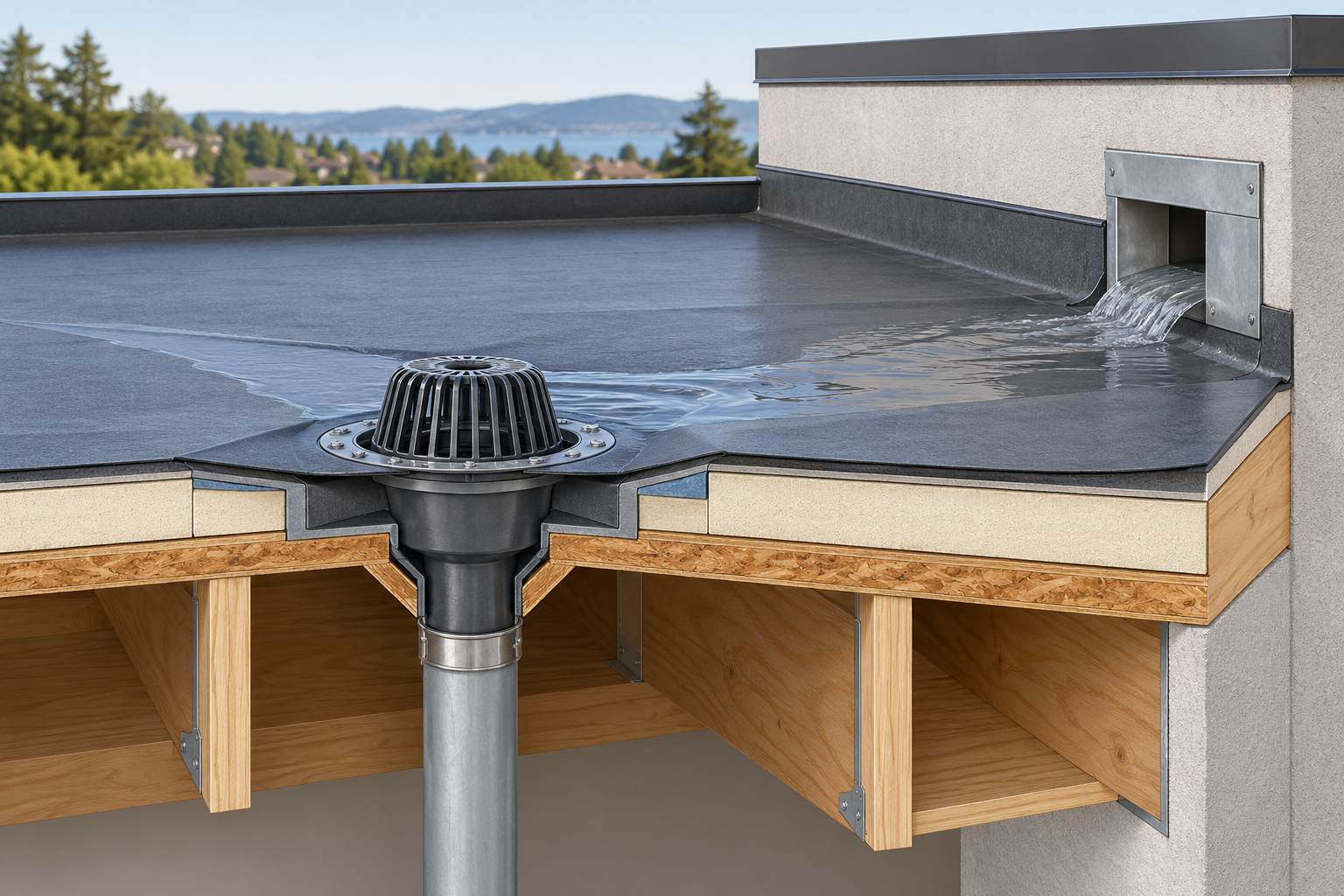
Components and boundaries
Internal roof drains collect water into piping. Scuppers pass water through a wall or parapet, sometimes to a conductor head and downspout. Strainers reduce debris entry. Overflow drains or scuppers provide a separate path in applicable designs.
Roofers generally own membrane integration, flashings, strainers, and local substrate. Plumbers may own internal piping. Wall, structural, and site drainage work can be separate.
Common repair paths
Blockage service: Remove debris and investigate outlet/piping. Cleaning is appropriate only when components and membrane remain sound.
Local membrane repair: Open, prepare, and rebuild compatible membrane around a drain or scupper.
Drain or scupper replacement: Replace body, clamping or flashing components, wall opening, or connected leader as designed.
Drainage redesign: Add outlets, tapered insulation, crickets, overflow, or piping after technical assessment.
Why ponding occurs
Blockage, inadequate outlet capacity, poor original slope, compressed insulation, deck deflection, settlement, membrane buildup, and changed roof equipment can all retain water. Replacing a drain at the same high point will not create slope. Adding a larger outlet will not fix a blocked downstream pipe.
Map ponding depth and duration through professional assessment, while recognizing weather and surface tolerances vary by system.
Cost drivers
- drain/scupper type and size;
- membrane system and compatibility;
- wet insulation or deteriorated deck;
- parapet/wall reconstruction;
- interior access to piping;
- tapered insulation or slope correction;
- overflow requirements and local code;
- occupied-space protection and water testing;
- height, restricted access, and emergency leakage.
Scenarios
Debris-blocked strainer: Clear, inspect, and establish maintenance. Lowest-cost path.
Leaking drain flange: Rebuild membrane and drain interface; replace wet local materials. Detail labor dominates.
Persistent ponding away from outlet: Tapered insulation, substrate, or structural work may be necessary; a service call becomes a reroof-design decision.
Interior pipe leak: Roof membrane may be sound. Coordinate plumbing diagnosis before opening the roof.
Safety and code
Overflow paths, outlet sizing, piping, and structural loading are consequential and jurisdiction-specific. Do not block or modify an overflow based on appearance. Suspected structural deflection or heavy retained water warrants professional evaluation.
Quote checklist
Require diagnosis, roof elevations/ponding observations, component, membrane system, local wet-material removal, piping boundary, wall work, slope correction, overflow treatment, water testing, code/design responsibility, and warranty. A durable repair restores a continuous path from roof surface through an outlet that can carry the water away; replacing one visible component without that path is incomplete.
Investigation before opening
Clear visible debris where professionally appropriate, inspect strainers and flashings, review interior piping/leak locations, map low areas, and identify primary/overflow paths. Moisture investigation or selective opening can determine whether ponding has wetted insulation or deck. These steps narrow a repair allowance without guaranteeing every concealed condition.
Drain-body and membrane coordination
Clamping rings, flashings, inserts, sumps, lead or other components, and membrane details vary by system. A plumber replacing piping without preserving roof integration can create a leak; a roofer sealing the surface cannot repair a cracked interior leader. One coordinator should define the handoff.
Scupper and wall work
Scuppers cross parapet or exterior walls. Repair may include membrane, metal liner, wall finish, conductor head, downspout, and discharge. Price each boundary. Enlarging the wall opening can invoke structural or code review and is not an ordinary patch.
Slope-correction alternatives
Localized sump work, tapered insulation, crickets, added outlets, deck carpentry, or structural correction can improve drainage depending on cause. Each has different cost and effect. Coating over a low spot does not create slope; a new drain cannot lift a deflected deck.
Maintenance economics
Accessible strainers and planned checks are inexpensive compared with water entry, but frequency follows debris and exposure. Guards must not obstruct required overflow. Keep drain maps and interior cleanout locations for future service.
Reroof timing
If the field membrane is broadly failing or wet, rebuilding one outlet may be temporary. During replacement, renew drains/scuppers and slope as a coordinated design. If the field is sound, a compatible local repair preserves value and avoids premature tear-off.
Approval and closeout
Verify local design requirements through qualified professionals, especially for overflow and structural questions. Closeout should include photographs of concealed detail, component and membrane records, flow testing within safe parameters, and clear roof/plumbing workmanship contacts.
Normalize the opening and trade boundaries
Compare drain/scupper location and type, membrane removal area, flange or drain-body work, clamping or compatible integration, sump or slope work, insulation and deck allowance, wall/parapet reconstruction, piping or leader work, strainer and overflow, interior protection, access, temporary dry-in, and testing. “Repair drain” can mean clearing, membrane reflashing, replacing a body, or redesigning a low point.
Identify whether the roofer, plumber, sheet-metal contractor, mason, carpenter, or structural professional owns each line. One coordinator should control sequencing and weather protection, but responsibility should not disappear inside a lump sum.
Three bounded project cases
A low-complexity case has a blockage or localized compatible membrane defect at an accessible outlet, with sound surrounding field and reliable downstream discharge. Cleaning or a bounded reflash may restore function.
A typical case requires opening around the outlet, replacing wet local insulation or deck, renewing the body/flange and membrane integration, and confirming piping or exterior leader flow. A base scope plus measured concealed units controls uncertainty.
A complex case has chronic ponding, structural deflection, multiple blocked or undersized paths, parapet damage, distributed wet roofing, internal-pipe problems, or missing/poor overflow. Drainage design, structural correction, and broader roof work may be necessary.
Local repair, slope correction, or reroof
Choose local repair when the failure is at the component and the surrounding assembly remains dry, compatible, and serviceable. Add sump, cricket, tapered insulation, carpentry, or another outlet only when investigation shows local geometry is the constraint. Escalate to structural review for deflection or capacity concerns and to broader roof replacement when wet or failing material is distributed.
A coating can renew an eligible surface but does not create slope or repair a failed drain body. A new drain cannot correct blocked downstream piping or guarantee drainage from a deflected field. Compare alternatives by the mechanism they solve.
Timing and repeat-work economics
If reroofing is imminent, price the incremental cost of renewing outlets and correcting slope while layers are open. A finished local repair that must be removed soon duplicates labor. If the field has a meaningful horizon, a compatible durable repair preserves value and avoids premature tear-off.
For recurrent clearing, compare maintenance frequency and consequence with better strainers, access, debris control, or redesign. Keep primary and overflow paths observable. The article remains scoped to roof drainage components; concealed building plumbing and site discharge beyond them require their own diagnosis and budget.
Read quote wording
“Reflash drain” should identify the body/flange condition, membrane opening, insulation/deck assumptions, exact compatible integration, and testing. “Replace scupper” should state wall/parapet removal and restoration, exterior leader or splash treatment, overflow role, and trade responsibility. “Correct ponding” needs a mapped slope or structural intervention rather than more sealant.
For concealed work, set local wet-material and deck units plus a threshold for broader moisture or structural review. Require safe dry-in while another trade or owner decision is pending. This small opening can become costly when responsibility and stopping rules are undefined.
Why this guide remains bounded
Once the outlet component, immediate membrane, slope at the sump/scupper, overflow, and connection boundary are resolved, further whole-roof replacement or plumbing design belongs to separate decisions. Repeating generic membrane or site-drainage material would add length without improving the component choice. The shorter endpoint is justified by that narrow physical boundary, not by lack of a second depth pass.
Compare component and system totals
A clearing service prices access, obstruction removal, safe flow testing, and disposal. A local drain reflash prices the body/flange condition, membrane opening, insulation/deck units, and compatible closure. A scupper rebuild adds wall/parapet and exterior discharge. A slope or drainage redesign adds tapered insulation, carpentry, structure, or new outlets. A reroof adds the entire field assembly.
Put these options on one map. The least costly one is sufficient only when it solves the mapped mechanism and retained field remains suitable. A new drain body cannot solve distributed wet roofing; a reroof does not automatically solve internal piping.
Low, expected, and difficult ownership cases
The low case needs cleaning or one bounded compatible repair and documented maintenance. The expected case includes local wet-material removal, body or scupper work, and plumbing/wall coordination. The difficult case adds chronic ponding, structural geometry, multiple drainage paths, distributed moisture, or failed internal/exterior receiving systems.
Final homeowner worksheet
Record primary/overflow paths, ponding pattern, membrane and component identity, body/scupper/piping findings, opening and concealed units, slope alternatives, trade sequence, dry-in, testing limits, and reroof timing. The shorter endpoint remains appropriate because structure, whole-roof replacement, and downstream plumbing become separately designed projects once this component boundary is resolved.