
Most localized gutter or eavestrough repairs cost a few hundred dollars, while long re-pitching, high access, several damaged runs, fascia work, or custom metal can reach the low thousands. A small material repair still carries a service minimum, ladder setup, testing, and cleanup.
The same symptom—overflow—can come from blockage, a leak, poor slope, too few outlets, inadequate capacity, or a downstream problem. Diagnose before choosing a repair.
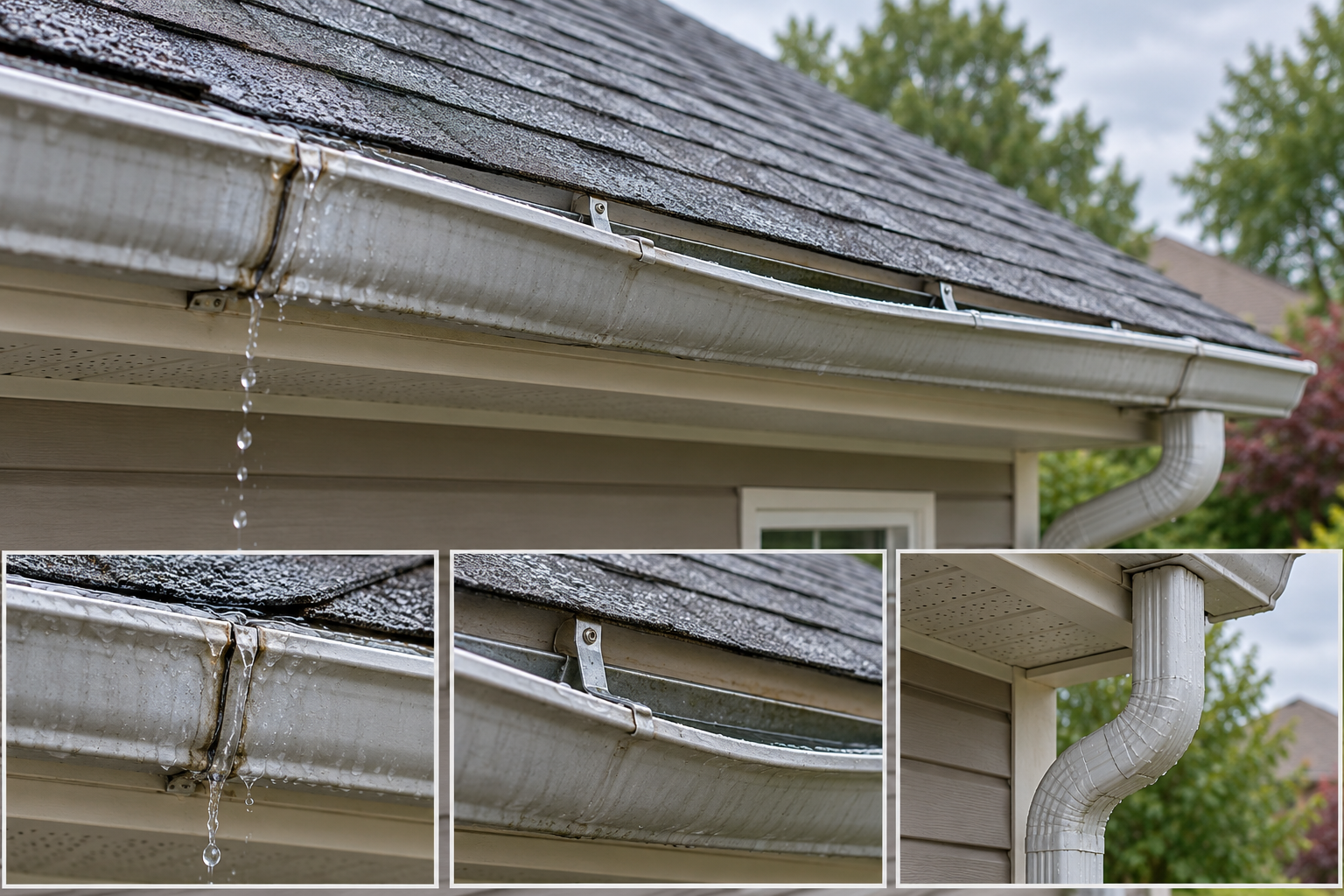
Common repair scopes
| Symptom | Possible scope | Important alternative cause |
|---|---|---|
| Leaking joint/end | Clean, prepare, reseal, refasten, or replace fitting/section | Water may be overtopping rather than leaking through |
| Sagging run | Replace/add hangers, correct fasteners, re-pitch bounded run | Rotten fascia may not hold new fasteners |
| Loose section | Reattach or replace hangers/straps | Snow, ice, impact, or roof-edge damage may remain |
| Overflow at outlet | Clear or enlarge outlet, add downspout if designed | Buried line or downstream discharge may be blocked |
| Crushed/corroded area | Replace a bounded section | Broad material failure may favor complete replacement |
Cost drivers
- repair length and number of separate locations;
- one-, two-, or three-story access;
- seamless versus sectional construction;
- aluminum, steel, vinyl, copper, or specialty profiles;
- matching color and profile;
- guard removal and reinstatement;
- fascia/soffit condition;
- outlets, downspouts, corners, and roof-valley concentration;
- water testing and downstream investigation.
Leak repair
Sectional joints create serviceable seam locations; seamless runs still have joints at corners, end caps, and outlets. Surface sealant can be appropriate after cleaning and preparation when the joint remains stable. Sealing a moving, deformed, corroded, or poorly pitched connection may be temporary.
Ask whether the contractor is resealing, refabricating, or replacing the component and how flow will be tested.
Sagging and attachment
Loose or insufficient hangers can allow low spots. Re-pitching may require releasing and resetting a long run, not simply adding one screw. If fascia is deteriorated, new hangers may not have a sound substrate. Fascia replacement belongs to exterior repair and should be a separate line item.
Repair versus replacement
Repair is strongest when material is generally sound, defects are localized, profile is available, and corrected slope/capacity will meet the roof’s runoff needs. Replacement becomes stronger when corrosion or deformation is distributed, many seams fail, attachment substrate needs broad work, or added outlets make the existing layout impractical.
Compare today’s repair plus likely additional mobilizations with complete replacement, but do not discard long sound runs for one joint.
Scenarios
One leaking end cap: Prepare and reseal or replace it; a service minimum governs cost.
Long sagging second-story run: Re-pitch, replace hangers, inspect fascia, and test outlet. Labor and access dominate.
Clean system overflows at a valley: Capacity or layout analysis is more valuable than seam repair.
Repeated leaks across old sectional system: Complete seamless or new sectional replacement may reduce recurring joints, though no gutter system is joint-free.
Quote checklist
Require mapped defects, repair length, material/profile, hanger spacing basis, pitch correction, outlet/downspout work, fascia exclusions, guard handling, water testing, and workmanship. A durable gutter repair restores both physical integrity and a continuous path to an appropriate discharge point.
Repair pricing models
A service minimum suits one joint or hanger. Per-foot pricing can fit re-pitching or section replacement. Time-and-material may be reasonable for uncertain custom metal but needs labor rates, material markup, and authorization cap. Ask whether testing and return for sealant cure are included.
Material-specific repair
Aluminum can be field-fabricated in common profiles; sectional vinyl may use replaceable fittings; steel corrosion and copper joining need different work. A repair material should be compatible and visually acceptable. Do not accept universal sealant or fastener claims across materials.
Ice and snow damage
Detached or bent gutters may be a consequence of ice, sliding snow, or roof-edge failure. Repair the attachment while evaluating why load concentrated there. Snow retention or roof/attic work can be a separate decision; a stronger hanger alone may move the failure elsewhere.
Alternatives
Cleaning resolves blockage. Re-pitching resolves some low spots. Added outlets/downspouts address long-run flow. Larger components address verified capacity. Fascia repair creates sound attachment. Whole replacement is reserved for distributed material or layout failure. Match the intervention to the cause.
Future replacement interaction
If reroofing is imminent, ask whether edge work will require gutter removal and whether today’s repair will be retained. Temporary stabilization may be rational. If the roof is sound, postponing necessary gutter repair can expose fascia and walls to repeated water.
Closeout
Observe the next meaningful rain if possible from the ground. A hose test can check joints and slope but may not reproduce valley flow or rainfall intensity. Keep repair location and material records for future service.
Normalize repair proposals
Map the affected run, joint, corner, outlet, downspout, hanger, fascia, and discharge path. Compare cleaning/preparation, seal or patch material, re-pitch length, hanger quantity and attachment, metal replacement length, outlet/downspout work, access, testing, and fascia allowance. “Seal leaks” does not state whether the cause is a failed joint, corrosion, standing water, or movement.
A service-call minimum can make several verified local repairs efficient during one visit. Ask for a base scope and prices or authorization limits for additional hangers, joints, outlets, or fascia found during work. Do not authorize blanket repair of every component without condition evidence.
Low, typical, and complex cases
A low-complexity repair addresses one accessible leaking joint, loose short run, or disconnected downspout on otherwise sound material. Cleaning and preparation may matter as much as the repair product.
A typical case includes a longer sagging run, several attachment points, local fascia deterioration, re-pitching, or an outlet change. The quote should distinguish water-collection work from carpentry and downstream discharge.
A complex case has widespread corrosion, repeated failed seams, distorted long runs, high access, specialty metal, chronic snow/ice damage, or a poor layout. A repair allowance can approach replacement while leaving the same distributed risk.
Repair-versus-replacement economics
Repair when the failure is bounded, remaining material holds attachment, and slope and capacity are fundamentally suitable. Replace a run or system when defects are distributed or the geometry/material cannot be restored without repeated patches. Consider targeted redesign when the gutter is sound but outlet quantity, downspout size, valley concentration, or discharge causes overflow.
Do not use a universal percentage. Compare today’s repair, likely follow-up mobilizations, fascia exposure, compatibility with the next reroof, and what portion of the system remains. A modest repair can buy useful service; several small invoices can be poor value when each addresses a symptom of the same layout failure.
Boundaries and decision thresholds
Set a stop point for fascia damage or widespread corrosion. If it is crossed, require a priced run-replacement alternate. Keep roof-edge flashing, soffit/fascia carpentry, buried drainage, grading, and basement-water work separately accountable even when they must be coordinated.
Closeout should show corrected attachment and slope, clear outlets, sealed or replaced joints, and discharge. Observe performance safely during rain and record remaining known limitations rather than promising that one repair eliminates overflow in every event.
Read repair quote lines
“Reseal all joints” needs joint count, preparation, corrosion limits, and the condition that would require replacement. “Add hangers” needs quantity, attachment substrate, spacing/design basis appropriate to the system, and fascia contingency. “Re-pitch” needs the run length, outlet destination, and how adjacent roof-edge details are protected.
For a damaged run, ask whether a sectional repair, seamless patch, or full re-form is proposed and what new joints result. For specialty metal, identify compatible material and fabrication. For snow or tree damage, separate impact repair from any elective redesign.
Example: sagging with overflow
If a run sags because hangers pulled from deteriorated fascia, adding more hangers into the same substrate repeats failure. The complete path is removal as needed, carpentry to sound support, correct attachment and pitch, then outlet/discharge testing. If fascia is sound but the long run has too few outlets, structural attachment repair alone may not fix overflow.
Price those alternatives separately. The useful decision is whether the mechanism is attachment, slope, collection capacity, blockage, or discharge—not whether the gutter can be made to look straight during a dry-day inspection.
Ownership scenarios
A recent sound system with one impact or loose outlet favors a bounded repair and retained-material record. An older system with several sound runs and one failed elevation may justify run replacement, provided transitions and appearance are acceptable. Distributed corrosion, recurring seam failures, poor layout, and failing fascia can make whole replacement more economical than several mobilizations.
For a planned reroof, compare stabilization with complete removal/reinstallation or replacement at the edge. For a long retained-roof horizon, pay for attachment and discharge that can remain. These timing choices should appear as priced options, not be left to whichever project happens first.
A repair is complete when the observed mechanism is corrected and the remaining system’s limitations are documented. It need not promise performance in every rainfall, but it should not leave a known blocked destination or failed support hidden behind new sealant.
Compare cash flow paths
The repair path includes today’s service minimum, mapped work, controlled extras, and plausible repeat visits. Run replacement adds fabrication/material and transition work but retains other elevations. Whole replacement spreads mobilization over all runs and can correct layout, yet may discard sound material. A capacity or discharge redesign can cross all three scopes.
Use actual repair history. One isolated invoice is not evidence of a failing system; repeated joints and hangers across elevations are. Add fascia or downstream work only to the option that needs it, and do not credit replacement with solving site water beyond the downspout.
For a short horizon, choose functional documented work without assumed resale recovery. For long ownership, repeated high-access visits, material availability, and reroof coordination can justify a broader scope. The lowest first invoice wins only when the likely next intervention remains bounded.
Low, expected, and difficult repair totals
The low case is one prepared joint, outlet, or short attachment repair on sound support. The expected case includes a longer re-pitch or hanger scope, several joints, localized fascia, and discharge correction. The difficult case reveals distributed corrosion, failed support, or poor layout and converts to run or full replacement.
Agree on the threshold and alternate before opening fascia or removing a seamless run. This preserves the value of diagnosis and prevents a small repair authorization from becoming an undefined replacement invoice.
Uncertainty boundary
Hidden fascia and internal corrosion can enlarge work after removal, but the quote can still define visible scope, added units, evidence, and a replacement threshold. That process lets repair preserve sound material without giving a contractor unlimited authority to chase distributed failure.