
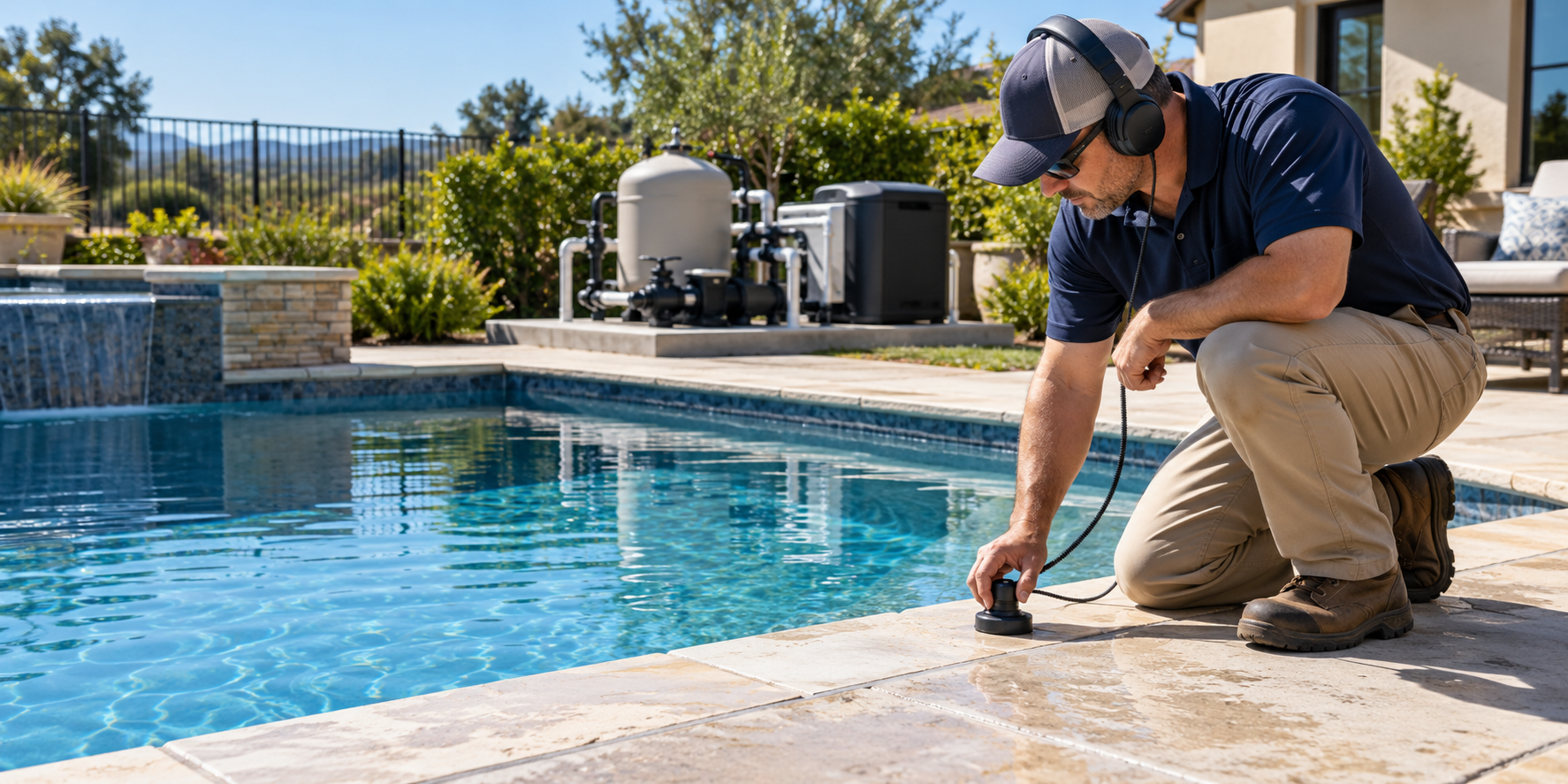
Leak detection answers a different question from leak repair: where is water leaving the pool system, and what additional access or testing is needed to confirm the location? Price the diagnostic separately when the repair scope is not yet known.
Cost orientation
A current U.S. specialist market observation places pool leak detection at about $100–$1,000. The range is a diagnostic signal, not a promise that every visit includes pressure testing, buried-line locating, excavation, or a written repair plan. Ask whether the quote covers one body of water, equipment-pad testing, return visits, documentation, and travel. Repair, surface restoration, and refilling should remain separate lines.
Start with the water-loss question
Before paying for a detection service, record the pool’s condition and the timing of the loss. Evaporation, splash-out, backwash or discharge, rain, water features, autofill behavior, a liner or shell issue, a fitting, equipment, and buried plumbing can affect the observed level. A simple observation may establish that water is leaving the expected system, but it cannot identify the location or cause by itself.
The right objective is not always “find a hole.” It may be to determine whether the loss is associated with the pool, equipment, a visible fitting, or a buried line, and to decide what test or access is justified next. Tell the provider whether the pool has a liner, concrete or fiberglass vessel, attached spa, water feature, automatic cover, unusual equipment, or recent construction.
What professional detection may include
Depending on the symptom and pool configuration, the provider may observe water-level behavior, inspect accessible equipment and fittings, isolate parts of the system, use dye or other non-destructive observations, perform pressure testing, or use specialized locating equipment. The provider should explain what was actually tested and what the result does and does not establish.
Pressure testing or locating a buried line is a different scope from observing a visible fitting. A difficult leak may require more than one visit, additional access, draining, excavation, or a repair contractor. Do not assume that a non-destructive method will find every leak or that a detected location identifies the complete repair.
Detection cost drivers
The quote can change with pool type, attached spa or water feature, number of lines, equipment configuration, accessibility, suspected location, water level, testing method, travel, and whether the provider also performs the repair. Ask whether the price includes a written report, test result, marked location, pressure test, return visit, water handling, and repair estimate.
Keep detection and repair as separate decisions. A clear diagnostic result may lead to a small fitting repair, a liner patch, equipment-pad work, a buried-line excavation, or a shell assessment. A proposal that combines an unexplained leak with a large repair should state what evidence supports the repair scope.
Prepare information without altering the system
Record recent water levels, weather, use, cleaning or backwash events, autofill behavior, equipment changes, visible wet areas, and the date the symptom began. Provide access to the equipment pad and the suspected area. Do not open, pressurize, bypass, or energize equipment to create a test from a general article; the professional should choose the method for the actual system.
Make the result useful for the repair handoff
Request the tested areas, water behavior, method, limitations, equipment or line isolated, marked location or written report, and recommendation for the next step. Ask whether the result explains the full loss or leaves another source possible. A contractor who receives a clear detection record can price a fitting, liner, equipment, buried-line, shell, excavation, or restoration scope more accurately than one starting from “pool leak.”
If the detection is inconclusive, document that outcome rather than treating it as evidence of shell failure. The next step may be a different test, specialist, access plan, or period of observation. Keep any repair allowance conditional until the evidence supports it. Do not use the article as a pressure-testing, suction, electrical, or equipment-startup procedure.
Read a detection report as a location and confidence statement
A report should tell the owner which system segment was assessed, the method used, the conditions during the visit, and the confidence in the indicated location. It should also identify what was not tested: a second body of water, an isolated feature, a buried branch, a shell area under finish, or the equipment while shut down. A likely location is useful, but it is not the same as a fully exposed and repaired defect.
A professional may use visual observation, isolation, pressure testing, dye or other location methods, or specialized listening equipment depending on the suspected area and the pool. Ask the provider to explain why a method fits the pool and whether it can distinguish one branch from another. The article does not provide a testing procedure and cannot determine what equipment is safe for the homeowner to operate.
If the result is inconclusive, ask what additional uncertainty a second visit would address and what the next diagnostic fee includes. If the result points to an accessible fitting, request a repair quote that includes its water handling and verification. If it points below a deck or landscape, keep access and restoration conditional until a contractor defines the likely route. This staged approach avoids pricing an excavation from a symptom alone.
Key points
- Leak detection and leak repair should usually be priced as separate stages.
- A water-loss symptom does not diagnose a shell or buried-line failure.
- Access, testing method, pool configuration, and return visits affect cost.
- Ask what documentation you receive and what repair work is excluded.