
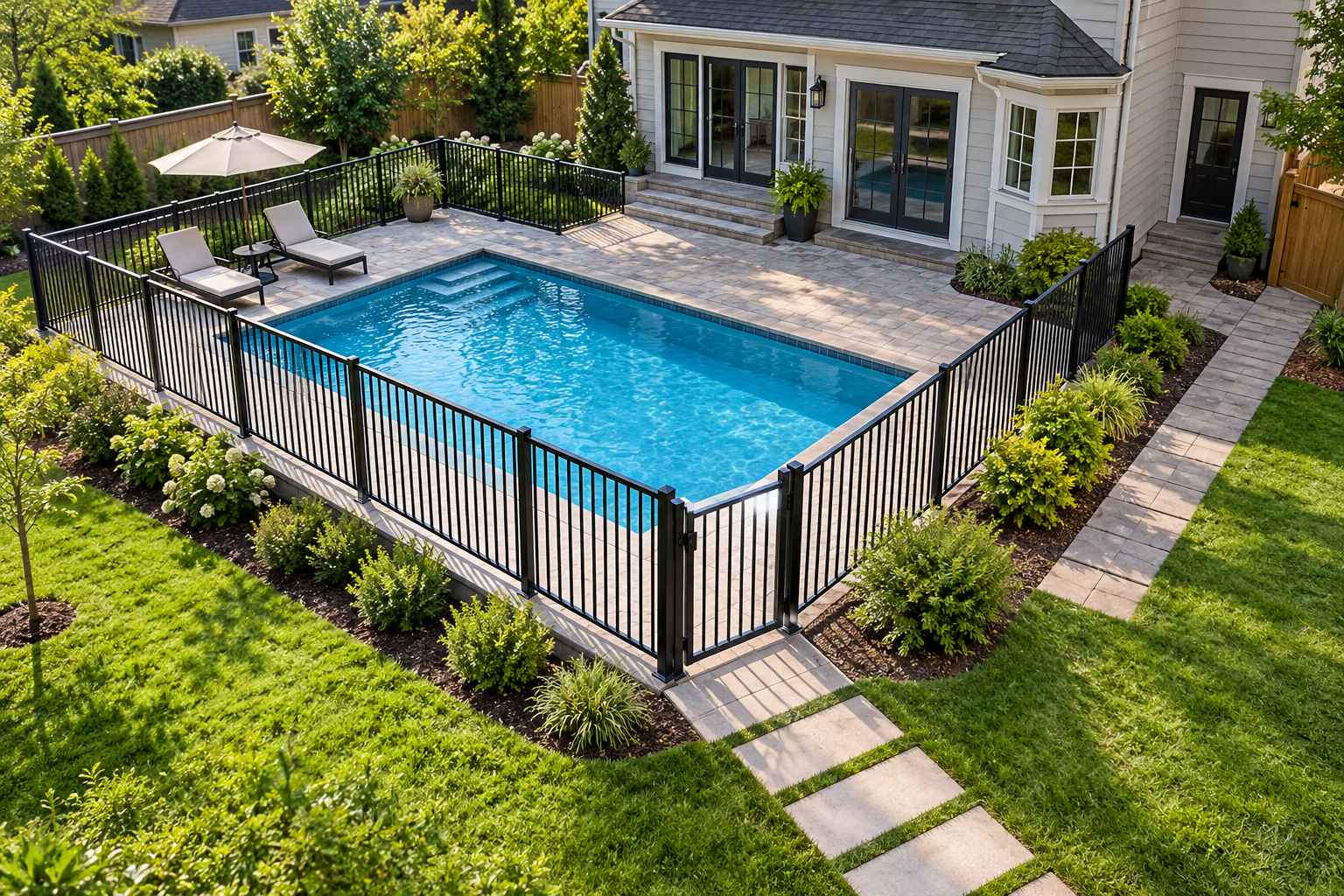
A pool barrier is a safety project, not just a fence-material purchase. The configuration of the pool, yard, house doors, gates, cover, ladder, neighboring structures, and local rules affects the required work.
Layered protection
A barrier should not be evaluated in isolation from supervision, door access, ladders, covers, alarms, and maintenance. A cover that is not designed or certified as a safety cover should not be presented as one. A fence quote should identify what it does and does not protect against.
Cost orientation
Do not infer a fence price from the pool total. A U.S. inground-pool market observation of roughly $44,300–$86,500 is useful only as project context; the barrier quote must separately price fence or wall length, gate hardware, latching and access features, ground conditions, permits, inspection, and restoration. CPSC and Health Canada guidance do not establish a universal installed price or replace local rules.
Start with the actual exposure path
Map how a child or other unauthorized person could reach the water: from the yard, a neighboring property, the house, a deck, a gate, an above-ground ladder, or a spa connection. The barrier project may involve a perimeter fence, a dedicated isolation fence, a wall, door and gate hardware, alarms, a cover, or access changes. The correct scope depends on the pool and property layout, not on the fence material alone.
The CPSC reference discusses a completely surrounding barrier, height and opening guidance, self-closing and self-latching gates, and other layers. Health Canada provides a Canadian reference point including a 1.2-metre fence and self-closing, self-latching access, while directing owners to municipal rules. These references are useful safety guidance but do not establish one universal legal requirement. Confirm the current rule for the actual jurisdiction, pool type, spa, cover, setbacks, and inspection process.
Price the installation conditions
A quote should identify fence or wall length, height and opening assumptions, posts, gates, hinges, latch location, self-closing hardware, removable sections, alarms, ground preparation, slopes, retaining conditions, landscaping removal, permits, inspection, and restoration. Existing perimeter fencing may or may not qualify for the intended function. A gate that looks secure may still fail the required self-closing, self-latching, or access arrangement.
Ask whether the design isolates the pool from the house and yard or relies on a boundary that has openings elsewhere. Above-ground pools need a specific review of ladders, steps, platforms, and access equipment. Covers and alarms can add layers but should not be used to disguise an incomplete barrier design. No barrier removes the need for supervision and a response plan.
Three planning scenarios
For a simple level-yard installation, compare posts, panels, one gate, hardware, permits, and inspection. For a complex retrofit, add demolition, slopes, retaining work, landscaping, multiple gates, house-door access, and restoration. For a compliance or safety correction, begin with the authority’s current requirements and then price the work needed to meet the specified configuration. Keep product, installation, and inspection responsibility clear.
Before approving a bid, request the drawing or measured layout, product designation, gate and latch details, exclusions, maintenance expectations, warranty, permit responsibility, inspection plan, and any conditional work. Do not infer a local legal conclusion from a national guideline or from a contractor’s generic description.
Keep the approved configuration documented
Before work starts, request a measured layout showing the pool, spa, fence or wall, gates, house access, neighboring boundaries, ladders, covers, alarms, and any openings or removable sections. Ask the authority or inspector which features are relevant and retain the approval or inspection record. A photograph of a finished fence is not a substitute for confirming the intended barrier configuration.
Maintenance matters after installation. Self-closing and self-latching hardware, hinges, gates, fence gaps, covers, alarms, and access controls need periodic attention. Ask who explains the maintenance and what the warranty excludes. The barrier remains one layer in a broader safety plan; supervision, access control, and emergency readiness remain important.
Identify who checks the finished barrier
The installation drawing and inspection answer different questions. The contractor can describe what was built; the local authority or qualified inspector determines whether the relevant requirement was met for the property. Confirm whether a permit, inspection, correction visit, or written approval is included in the estimate, and who requests it. A contractor’s statement that a product is “code compliant” should not replace the jurisdiction’s direction for the actual layout.
Gate behavior, latches, door access, removable sections, and openings can change after installation or with wear. Ask for the maintenance instructions and whether any adjustment visit is included. If landscaping, a deck, or another trade later changes the approach to the pool, have the owner determine whether the approved arrangement needs to be reviewed again.
A safety quote should also state what is not being certified. It may address the fence and gate but not a cover, alarm, house door, neighboring access point, above-ground ladder, spa, or supervision practice. Keep those boundaries in the handoff so an owner does not infer that one completed fence invoice resolves every access route.
Plan for construction, inspection, and continued maintenance
A fence project may include survey or layout work, posts and panels, gates, latch or closing hardware, removal of an existing barrier, ground preparation, slope or retaining work, landscape restoration, permits, and inspection. Ask the installer to show each segment on a drawing and identify existing sections that will remain. A measured linear-foot amount alone does not capture gate count, surface, access, or the number of transitions.
Before construction, confirm what the local authority expects to inspect and whether the design needs approval. After installation, retain the drawing, product information, inspection result, and instructions for adjusting gates and latches. If a later deck, yard gate, spa, or landscaping project creates another route to the water, the owner should reassess the barrier arrangement with the authority or qualified professional.
Safety function also depends on use and maintenance. Ask who will check that gates close and latch as intended, how a defect is reported, and what the service provider does not inspect. A fence quote cannot replace ongoing supervision or confirm conditions outside its drawn boundary.
Key points
- Pool barriers are configuration- and jurisdiction-specific safety systems.
- CPSC and Health Canada guidance are valuable references but do not replace local rules.
- Price gates, access, ground conditions, permits, and inspection—not only fence material.
- Use layered protection; no barrier replaces supervision.