
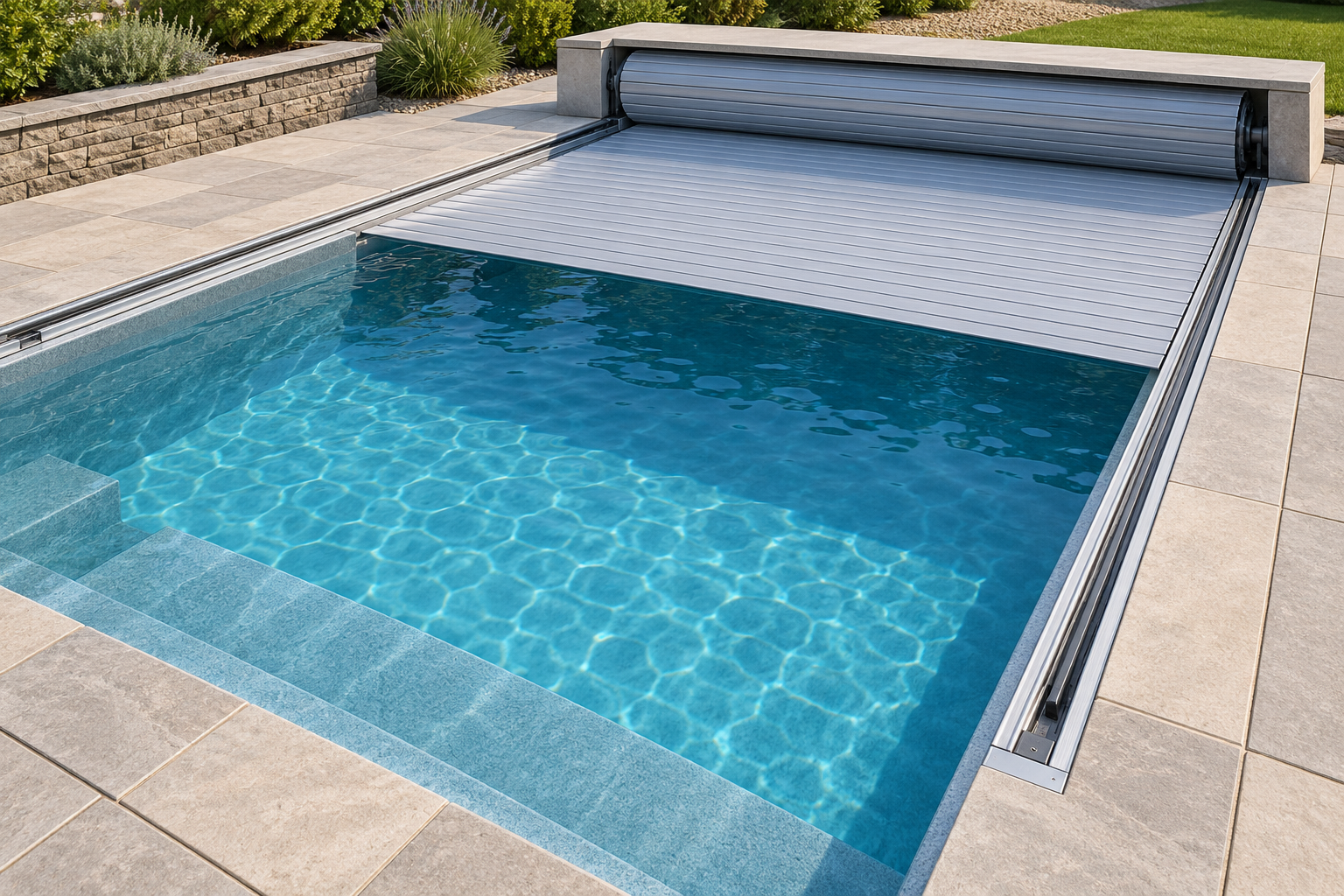
An automatic pool cover is a mechanical system with fabric, tracks, a reel, motor or drive, controls, anchors, and a deck relationship. Retrofit work can be substantially different from a cover installed with a new pool.
New build versus retrofit
New construction may reserve space for a track, housing, deck, and electrical connection. A retrofit must work with the existing shape, coping, steps, water features, deck, drainage, and access. Ask the installer to identify which conditions control feasibility before accepting a fixed price.
Cost orientation
Automatic-cover pricing should be built as a retrofit or new-installation scenario: cover and track, custom shape, coping and deck changes, motor or controls, electrical work, installation, testing, and restoration. The U.S. pool installation signals of $1,000–$6,000 for above-ground and $44,300–$86,500 for inground projects show system scale only; they are not cover prices. Confirm local product and safety requirements before comparing bids.
Separate the mechanical layers
An automatic cover can fail in one layer while the rest of the system remains usable. The service provider should identify the condition of the fabric, attachment, tracks, reel or tube, motor, drive, switches or controls, anchors, housing, deck interface, and any electrical supply. A motor replacement will not correct a track obstruction, misalignment, fabric problem, or damaged deck. Ask for a diagnosis before approving parts.
Retrofit feasibility should be documented before the price is treated as fixed. Existing steps, benches, coping, water features, pool shape, deck, drainage, landscaping, and equipment access can control whether tracks or a housing can be added. New construction may reserve space for these elements; a retrofit may need demolition, deck alteration, restoration, or a different cover arrangement. The quote should show those assumptions and conditional work.
Safety classification is not automatic
The CPSC guidance treats a cover as one layer of protection and does not make every automatic cover a universal safety barrier. Verify the product’s tested designation, operating limitations, control placement, and the local authority’s requirements. A motorized opening mechanism can improve convenience without establishing that the cover meets the safety function the owner expects. Supervision and other barriers remain relevant.
Electrical, bonding, controls, drainage, track installation, and deck changes may involve qualified professionals beyond the cover installer. Ask who is responsible for each scope, inspection, testing, restoration, and warranty coordination. Do not accept an unspecified allowance for a new circuit or deck modification if those conditions determine feasibility.
Evaluate the cover as a daily-use system
Convenience is part of value, but it should be tested against the household’s actual routine. Ask who operates the cover, where controls are located, how the system is protected from unauthorized use, how debris and water are managed, and how service access is preserved. A cover that is technically suitable but difficult to use or inspect can create a different ownership problem than the installation quote suggests.
The proposal should also address drainage and surrounding surfaces. Tracks, housing, deck transitions, and motor equipment need protection from water and debris. A retrofit may require the installer to coordinate with coping, deck, electrical, automation, landscape, or barrier work. State which trade owns each permit, inspection, restoration, and warranty obligation. If the system is being installed with a new pool, make the reserved space and finished-deck details part of the design rather than a later assumption.
For repair, ask whether the fabric, track, motor, drive, control, and deck interface were inspected together. A part replacement may improve one symptom while leaving alignment or water intrusion unresolved. For replacement, ask what condition of the existing tracks or housing is assumed and what happens if those components cannot be reused. Keep safety designation and local compliance separate from the convenience claim.
Ask for a serviceable final arrangement
The handoff should identify how the cover is operated, stored, inspected, and serviced, and what must remain clear around tracks, housing, motor, deck, and controls. Retain model information, safety designation, testing, warranty, and any excluded electrical or deck work. A future repair should not begin without knowing whether the installed system was new, retrofit, or adapted to an existing structure.
Separate likely service jobs by component
A service provider should identify whether the reported fault involves fabric attachment, track, reel or tube, motor or drive, switch, control, anchor, housing, or the deck interface. The owner should receive the diagnosis and the part that is being priced. A system with worn fabric and sound tracks is a different job from a retrofit with damaged anchors or a deck that no longer supports the arrangement.
For a repair, ask whether testing includes a full open-and-close cycle, alignment, and observation of the parts retained. For a new installation, ask who measures the opening, confirms the product’s safety designation, installs tracks or anchors, handles electrical work, restores the deck, and checks the finished operation. Keep the safety assessment separate from a claim that the motorized system is easy to use.
The quote should state parts availability, model support, warranty on labor and components, maintenance instructions, and any condition that makes the estimate provisional. These terms help the owner compare service with replacement without assuming an advertised cover price includes access, installation, testing, and restoration.
Key points
- Automatic covers have mechanical, deck, electrical, and product-specific costs.
- Retrofit feasibility depends on shape, coping, steps, deck, and access.
- Cover automation does not automatically establish safety compliance.
- Price diagnosis, repair parts, installation, testing, and restoration separately.