
Angi’s current pest-control cost page displays two inspection estimates: $150–$450 in Cost Insights and $125–$450 in a later section. It does not reconcile the difference, so neither figure is a settled U.S. market rate or a dependable stand-alone inspection quote. Some companies offer a free inspection or credit the fee toward treatment. A general visual visit, a termite/WDO report, a wildlife inspection, and a concealed-infestation investigation answer different questions.
An inspection is not the same as a treatment estimate
A treatment estimate is often designed to price the provider’s proposed service. It may be free because the provider expects to earn the treatment work. A paid inspection should be judged by the information it delivers: what was inspected, what evidence was found, what remains inaccessible, what intervention is recommended, and whether the findings are documented in writing.
Ask whether the fee includes photographs, a written report, a return call, treatment recommendations, and a credit toward later work. A credit can be useful, but it means the inspector and treatment provider have a commercial connection. That does not make the inspection invalid; it simply makes the deliverable and limitations more important.
What the provider may inspect
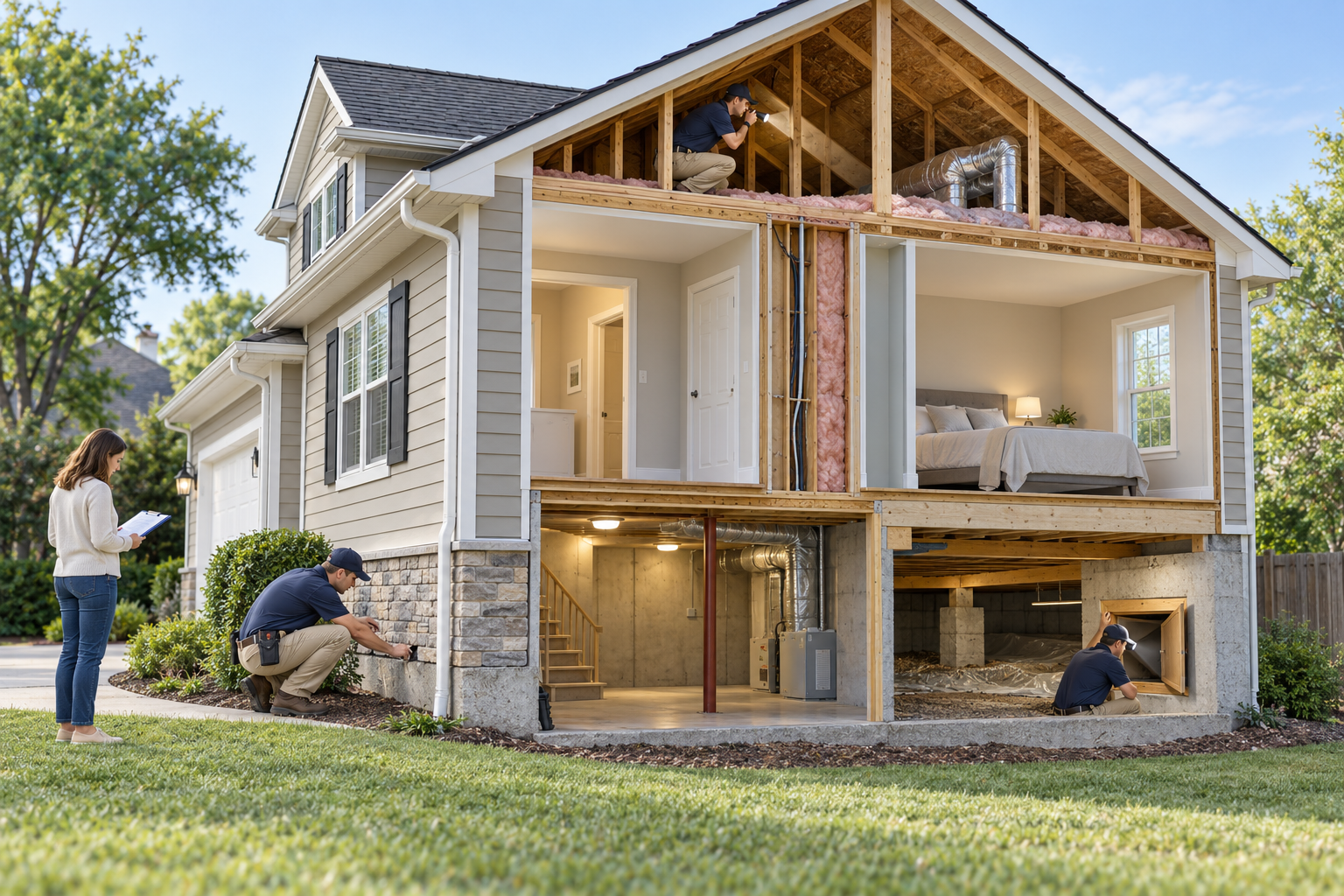
The scope can include some combination of:
- living areas, kitchens, bathrooms, garages, basements, and utility spaces;
- attic or crawlspace areas when safe and accessible;
- the foundation, siding, roofline, vents, penetrations, doors, and other likely entry points;
- droppings, frass, wings, mud tubes, nests, feeding damage, odors, and live activity;
- food, water, moisture, shelter, and building conditions that can support recurrence;
- evidence of earlier treatment or repairs.
The inspector may identify conditions consistent with pests without proving that an infestation is active. Old holes, shed skins, dead insects, an abandoned nest, and current activity have different economic consequences. Ask the provider to separate observed evidence from a conclusion and a conclusion from a recommendation.
Match the inspection to the reason you called
| Your question | Useful inspection scope | Common limitation |
|---|---|---|
| “What is causing these ants?” | Species identification, trails, nest search, moisture and entry observations | A visible trail may lead to a concealed or exterior nest |
| “Is this termite damage active?” | Termite/WDO-focused inspection of accessible wood and likely moisture or soil interfaces | Concealed damage and transaction requirements may need separate professionals |
| “What is in the attic?” | Wildlife inspection with entry, den/nest, contamination, and repair observations | Young animals, protected species, and hidden cavities require local assessment |
| “Will a lender or buyer accept this report?” | Transaction-specific WDI/WDO or inspection deliverable | Requirements vary by jurisdiction, lender, program, and contract |
| “Why do pests keep returning?” | Inspection plus source, access, sanitation, moisture, and exclusion review | The provider may not own the building repair needed to correct the cause |
Do not treat a general home inspection, a free exterminator estimate, and a formal WDO report as interchangeable. Their training, purpose, documentation, and liability may differ.
What changes the price
Inspection cost tends to rise when the property has multiple stories, difficult attic or crawlspace access, many outbuildings, extensive evidence, concealed wall or roof activity, or a request for detailed photographs and a report. A wildlife visit may require roofline or chimney observations. A termite investigation may require access to basements, crawlspaces, exposed framing, and areas where wood meets soil. Travel and urgent scheduling can also affect the price.
The market source reports that inspection fees may be waived or credited when treatment follows. Confirm whether that credit applies to the exact service you need and whether the treatment proposal is still itemized. A “free” visit that produces no durable findings may be less useful than a modest paid inspection that narrows the repair scope.
A regional Canadian inspection example
Emerald Pest Control publishes a 2026 inspection price of CAD $100–$200 for its Eastern Ontario service area, credited toward treatment when work proceeds; straightforward single-pest calls may be offered without an inspection fee. The published range is before Ontario HST, which the provider lists at 13%. It is one provider’s offer for Belleville, Quinte West, Trenton, Napanee, Kingston, Cobourg, and nearby areas—not an Eastern Ontario market average or a price for a formal WDO report. Confirm the current fee, tax, deliverable, and credit terms directly with the provider.
Use the report to avoid paying twice
Before the appointment, record where and when you saw the problem, whether activity changes with weather or time of day, past treatments, leaks, remodeling, and any rooms or spaces the provider cannot access. Do not conceal evidence while cleaning. Photos and samples may help, but they do not replace an inspection.
Afterward, ask the provider to classify each item as:
- confirmed current activity;
- evidence of past activity or damage;
- a condition that may support recurrence;
- an unresolved question requiring another specialist.
This classification gives you a better basis for quotes. Share the written findings with bidders and ask each to price the same observed condition. It prevents a visible symptom from becoming an automatic whole-house treatment or suspected wood damage from being represented as structural failure.
When a second specialist is reasonable
A pest professional can identify the pest and define treatment, but may not be the right person to assess a load-bearing beam, damaged wiring, hazardous contamination, a roof assembly, or a moisture source. Those are separate questions. A structural engineer, electrician, roofer, building-envelope professional, or environmental-health contractor may be appropriate depending on what the inspection finds.
If a proposal calls for destructive access, ask what new evidence supports it and who will close the opening afterward. The inspection has done its job when it makes the next decision clearer—even if that means another bounded investigation.
A negative inspection is still limited to its scope
A report may say that no current activity was observed in the areas the inspector could access. That is different from certifying that a concealed wall, blocked attic, finished floor, or shared building space is pest-free. Ask the provider to record the date, areas checked, access limits, and the evidence behind a negative or inconclusive finding. If the next proposal assumes activity in an area the inspector could not see, ask what new evidence supports the added work.
A return visit can make sense after stored items are moved, an opening becomes accessible, or a specific activity pattern is observed. Before scheduling it, ask what the second visit will answer, whether the original fee includes it, and what result would lead to treatment or destructive access. This gives the homeowner a price and decision point for the next investigation instead of treating uncertainty itself as proof that the broadest service is needed.
Translate the estimate into a complete inspection budget
A useful comparison separates the visit fee from the service that follows. Confirm the price of any extra building, return visit, written report, photographs, inaccessible-area revisit, specialist referral, or cleanup and repair handled by another trade. If the inspection fee is credited toward treatment, compare the treatment bid with and without that credit so you can see the actual total. A credit is not the same as an independent report, and a no-fee estimate is not automatically a poor inspection; judge the result by its scope and documentation.
| Situation | What the initial price may cover | What can remain outside it |
|---|---|---|
| Routine question about one pest | Accessible visual inspection, identification, and treatment recommendation | Formal report, second visit, concealed cavity, or repair diagnosis. |
| Multiple rooms or difficult access | Additional time, attic/crawlspace access, outbuildings, photos, and written findings | Lift or roof access, opening finishes, specialist testing, or travel. |
| Transaction or warranty | Required form, credential, report wording, or deadline | A general pest estimate may not satisfy the request; ask the lender or contract party first. |
| Suspected damage beyond pest control | Evidence map and handoff to another professional | Structural, moisture, electrical, roof, or environmental assessment. |
These are scope differences, not fixed price tiers. A longer inspection can still leave concealed areas unknown; ask what finding would trigger another phase before approving destructive access or whole-building work.
Bottom line
Treat Angi’s displayed $150–$450 and $125–$450 U.S. estimates as conflicting specialist context, not one settled rate. The Eastern Ontario example is one provider’s CAD $100–$200 offer before HST. Buy the deliverable and access scope, and confirm the local fee and terms.