
Before signing a contract for a factory-built home in Canada, determine what the transaction is buying and how the tax authority classifies the unit. A dealer’s use of “manufactured,” “modular,” or “mobile” does not decide GST/HST treatment. The agreement may cover the home and land together, the home alone, a long-term land lease, or a home placed on a park site. Those arrangements can lead to different tax calculations and application paths.
The practical decision is how much tax is due at closing, whether the seller can credit an eligible rebate, and what cash remains for delivery, installation, utilities, and completion. A possible refund received later does not reduce the money needed today unless the seller applies an eligible credit at purchase and documents it.
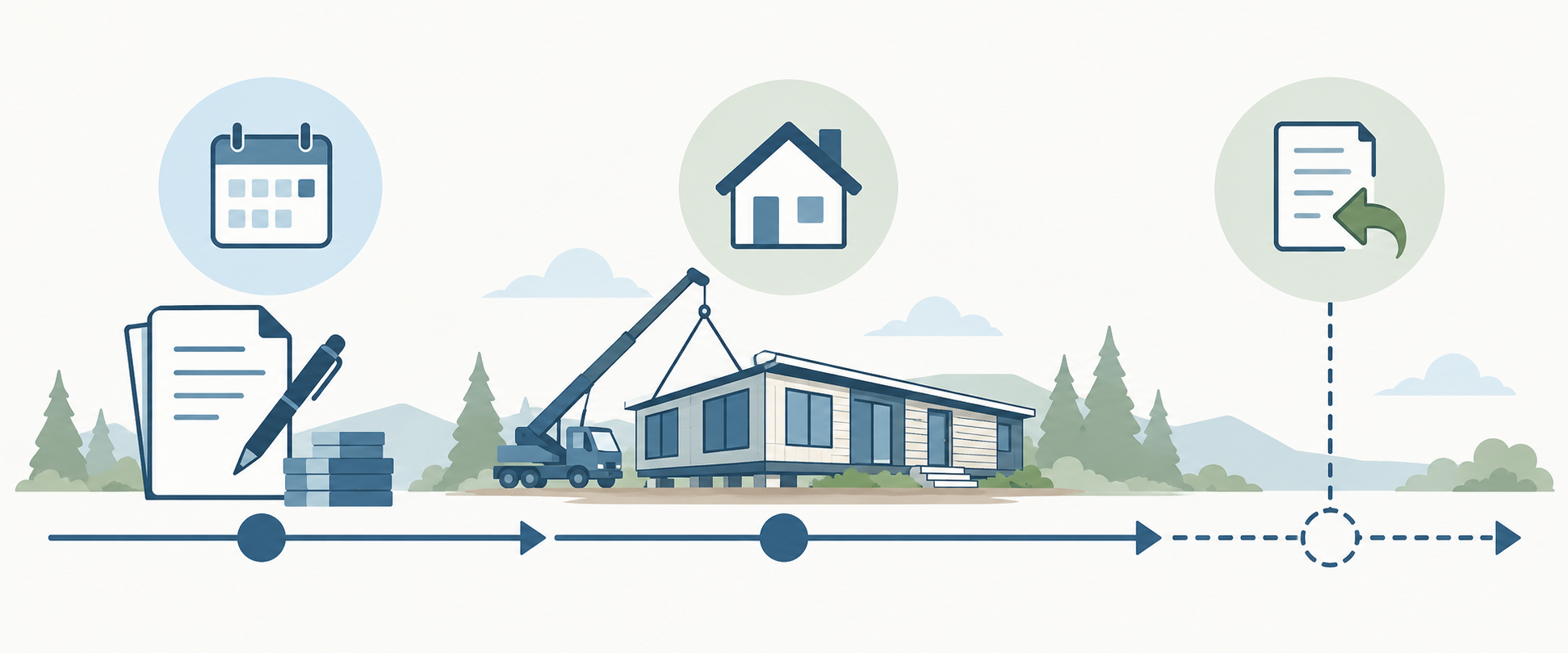
Identify the transaction before looking for a rebate
Gather the signed purchase agreement, invoice, closing statement, land deed or lease, site address, manufacturer and model information, certification documents, delivery plan, and occupancy purpose. Note who buys the home, who owns the land, whether a builder is selling the home, when the agreement is signed, and when possession or occupancy is expected.
Ask the builder or tax adviser to identify each amount in writing:
- GST or the federal part of HST on the home and any land included in the sale;
- any provincial HST component and a separate provincial rebate or refund;
- land transfer tax or another conveyance charge;
- taxes paid to a dealer versus taxes assessed later by a province or municipality;
- charges for delivery, site preparation, foundations, utilities, setup, or completion.
Keep these amounts on separate lines. A sales-tax rebate is not an annual property-tax exemption or a title conversion. Ontario land transfer tax applies to a qualifying conveyance and has its own refund rules; it is not a substitute for CRA GST/HST analysis.
Confirm what CRA means by a mobile home
The Canada Revenue Agency’s GST/HST guidance includes a mobile home within its definition of a residential unit, but that does not make every factory-built dwelling a mobile home for the rebate. In particular, marketing language, a provincial building-code label, or mortgage-insurance eligibility does not by itself establish the CRA classification.
The current CRA guide discusses mobile-home transactions in different arrangements, including a home sold with land, a home without land, and certain home or site-lease arrangements. It also describes the relevant application route and supporting documents for those patterns. A modular unit may need a specific tax-definition analysis; do not infer its GST/HST status solely from CSA A277 certification or from the word “modular.”
Ask CRA or a qualified Canadian tax professional to review the actual contract and unit description. If the dealer will charge tax and later credit a rebate, ask which rebate provision it relies on, which form the buyer must sign, and what happens if CRA later determines the transaction is ineligible.
Separate the existing new-housing rebate from the first-time-buyer rebate
The existing GST/HST new-housing rebate and the newer first-time home buyers’ GST/HST rebate are separate routes. A new home, substantially renovated home, owner-built home, or home bought from a builder may have different claimant and filing rules. The first-time route also has buyer, primary-residence, agreement-date, value, and occupancy conditions. CRA’s current first-time-buyer guidance sets the applicable timing and tests; use the version that applies to the signed agreement rather than relying on a news summary or a builder’s estimate.
Do not treat a qualifying mobile-home definition as proof that the buyer or transaction qualifies. Confirm the specific claimant, co-buyers, spouse or partner facts where relevant, intended primary residence, purchase date, possession date, value measure, and land arrangement. A buyer who has owned or occupied another home may fail the first-time test even when the new unit itself fits a home definition.
If the home is sold with land, determine whether the builder, buyer, or another party is the claimant and which part of the agreement supports the rebate calculation. For a home-only purchase or leased site, follow CRA’s route for that arrangement and retain the documents it requests. A dealer credit at closing and a refund applied for later have different cash-flow consequences.
Ontario land transfer tax is a separate check
Ontario’s first-time homebuyer land transfer tax refund is a provincial program with its own buyer and conveyance requirements. Ministry guidance describes an eligible-home category that includes a qualifying year-round mobile home complying with CSA Z240. It also describes a narrower factory-built case for specified homes intended for basement installation and meeting applicable Building Code and CSA standards. That language is not a blanket exemption for every manufactured or modular home.
Ask the lawyer or conveyancer to confirm whether the exact property and transfer fit the current eligible-home definition and whether each purchaser meets the first-time-buyer conditions. The refund may be claimed during registration or through a later application within the period set by the Ministry; if it is not credited at closing, budget to pay the tax first and wait for a decision. Check the current provincial page and controlling law for the exact form, amount, and deadline.
An Ontario land transfer tax refund is not the federal GST/HST rebate. Municipal charges, annual property taxes, and title-registration questions may also be separate. Do not use an Ontario example to infer treatment elsewhere in Canada.
Model cash to close without counting an unapproved refund
Create two versions of the purchase budget. In the first, list the gross contract price, tax due, conveyance charges, deposits, land or lease costs, lender requirements, delivery, site work, setup, utility connections, and contingency. In the second, show only credits or refunds for which the dealer or tax authority has confirmed the transaction and route in writing.
For a later refund, keep the gross tax payment in cash-to-close and show the potential refund separately as uncertain future cash. Note who applies, when the form is due, what evidence is required, and whether the claim is made at registration, by the builder, or directly to CRA. If the household needs the expected refund to afford completion, confirm that the timing works with the builder’s payment milestones and any CMHC Prefab Plus or other lender advances.
Use a simple worksheet:
| Item | Record |
|---|---|
| Home and land contract price | Builder’s signed amount and what it includes |
| GST/HST charged | Taxable amount, rate, and seller’s explanation |
| Provincial or municipal conveyance charge | Separate authority and amount |
| Rebate credited at closing | Only if the seller confirms the legal route |
| Rebate requested after closing | Applicant, form, deadline, and expected processing |
| Site-completion cash | Delivery, access, foundation, utilities, installation, and permits |
| Cash gap before any refund | Household funds required on each payment date |
Do not net an estimated tax benefit against a contractor’s setup quote. A rebate may be denied, reduced, delayed, or paid to someone other than the person who expected it. Keep enough liquidity to complete the home if no later payment arrives.
Save the documents that connect the home, site, and tax claim
Keep the agreement and amendments, invoices, proof of tax paid, title or land-lease documents, manufacturer description, serial or identification details, delivery and installation records, occupancy documents, rebate forms, seller confirmations, and CRA or Ministry correspondence. Match the unit and parcel identifiers across the tax claim and home documents.
If the tax treatment is uncertain, get a written answer before signing an unconditional agreement or relying on a builder’s rebate credit. Ask the tax professional to cite the exact provision and identify facts that could change the conclusion. If the contract changes from home-only to home-and-land, the site arrangement changes, or a co-buyer is added, request a fresh review.
Coordinate tax timing with delivery and financing
A rebate and a construction advance solve different cash-flow problems. CMHC Prefab Plus and participating lenders set their own borrower, home, property, and draw conditions; those financing advances do not decide tax eligibility. Put tax deposits, land closing, site work, home delivery, installation, inspection, and any rebate application on one calendar.
Ask the lender whether it needs a tax invoice or rebate confirmation before releasing an advance. Ask the builder whether a credit is conditional on later CRA approval and who repays it if disallowed. Ask the lawyer or accountant which records must be retained and who submits each form. Written responsibilities help prevent a buyer from arriving at closing with a refund in the budget but no approved credit.
Use a transaction-specific answer
There is no single Canadian tax result for all manufactured, modular, mobile, or factory-built homes. Federal sales-tax definitions, provincial tax components, conveyance rules, home certification, land ownership, leased-site arrangements, buyer history, and contract dates can all matter.
Before making a financial decision, ask the responsible tax authority or qualified professional to classify the actual home and agreement, state the gross amount due, identify the claimant and filing route, and explain the timing of any possible refund. Treat the refund as future or conditional cash until those points are documented.