
A modular home can be substantially complete when it leaves the factory and still require a large destination-site budget. The site must be ready, transport and setting must be feasible, modules must be connected and weather-sealed, utilities must be completed, and local inspections must be satisfied. The factory contract and the site contract do not automatically cover the same work.
Do not use manufactured-home assumptions
Modular homes are not automatically HUD Code manufactured homes. Canadian sources distinguish factory-built categories and certification systems, and a modular home may be evaluated under the building-code and site-work rules of the destination. Ask the builder to identify the certification, code path, and exact division of work before comparing prices.
Separate the cost layers
The destination budget may include:
- site clearing, grading, access, drainage, and temporary roads;
- foundation construction, survey, anchor points, and readiness inspection;
- transport permits, escorts, route preparation, and delivery protection;
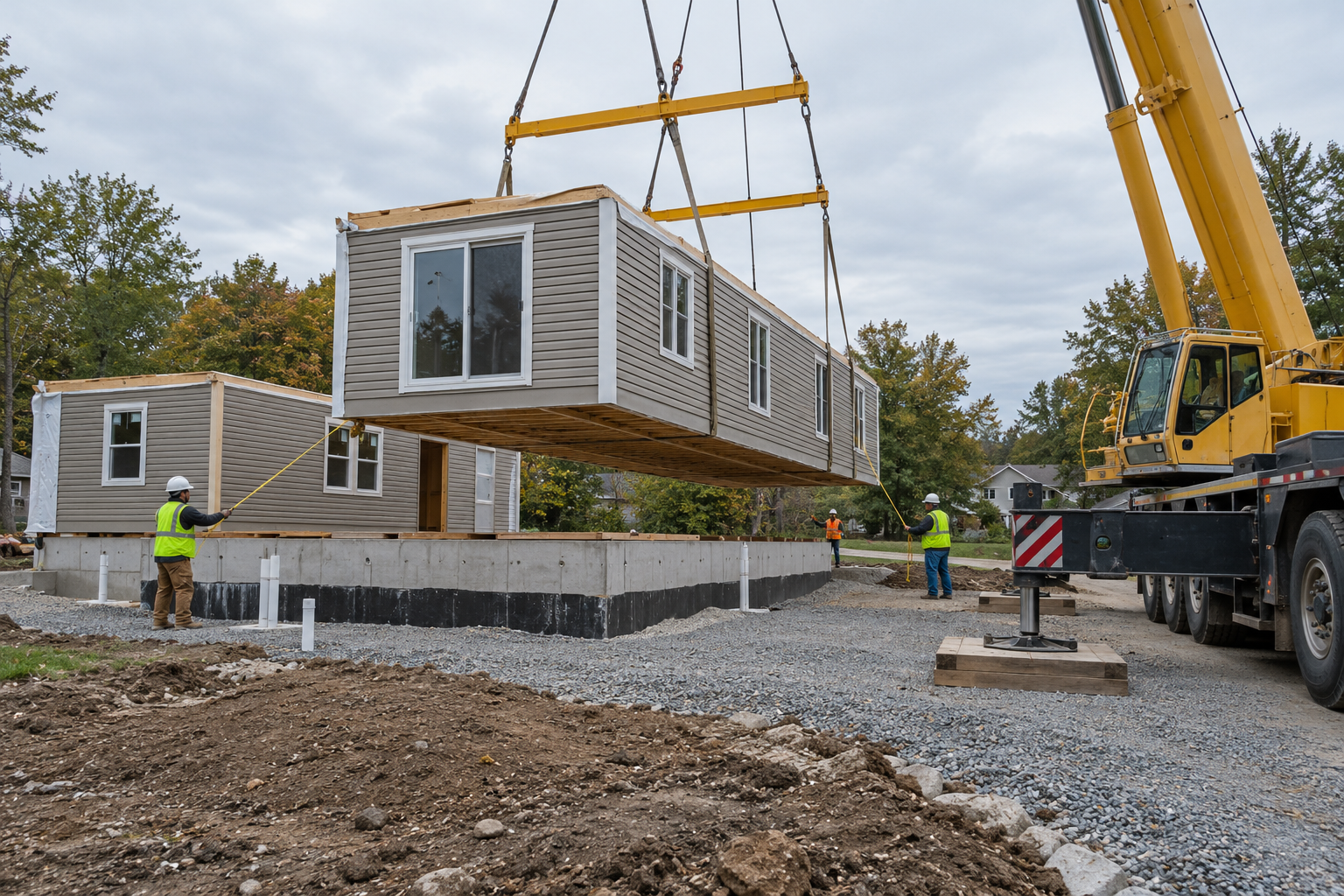
- crane, set crew, lifting plans, and weather limitations;
- module-to-module and module-to-foundation connections;
- roof, wall, floor, and interior or exterior close-up;
- plumbing, electrical, HVAC, energy, and other field completion;
- stairs, decks, porches, landscaping, and site restoration;
- permits, municipal inspections, testing, commissioning, and corrections.
Ontario guidance explains that CSA A277 factory quality control and in-factory inspection may cover much of the factory work while foundation, anchorage, grading, and other site requirements remain to be checked after delivery. It also identifies plumbing, energy efficiency, HVAC, electrical, accessibility, and fire safety as applicable building-code areas. This is an Ontario example, not a rule for every jurisdiction.
Ask what the crane quote assumes
Crane and set pricing depends on reach, lift weight, staging area, road access, overhead lines, wind, ground bearing, traffic control, and the number and size of modules. A low quote may cover only the lift while excluding permits, rigging, setting supervision, weather delays, or a second mobilization. The foundation must be ready to the builder’s tolerance before the crane arrives.
Module connections and close-up are equally important. Clarify who seals the exterior, finishes the roof, reconnects utilities, repairs transport damage, and accepts responsibility if the modules do not align as expected. Keep finish allowances separate from factory-finish warranties.
Build a site-completion budget
Use the builder’s inclusions list, engineering drawings, site plan, foundation quote, crane plan, utility scopes, permit list, and inspection sequence together. Price U.S. and Canadian projects independently; local labor, certification, code enforcement, transport, and currency make a converted number unreliable. Current evidence does not establish a universal crane, foundation, or completion range.
The decision-ready number is the cost of a code-compliant, weather-tight, serviced, inspected house at the destination—not merely the factory contract or the truck-and-crane line.
A modeled completion budget
As a U.S. planning example only, a simple accessible site might be modeled as $25,000 for foundation and site work, $15,000 for transport and crane setting, $18,000 for connections and weather-tight close-up, and $12,000 for utilities, permits, and inspections: $70,000 beyond the factory contract. A separate Canadian model could be CAD 32,000 + CAD 19,000 + CAD 23,000 + CAD 15,000 = CAD 89,000. The figures are transparent assumptions, not a claim that modular work has a standard national price.
The quote should state whether engineering, excavation, crane standby, weather protection, module joints, stairs, grading, service upgrades, taxes, and final inspections are included. If the factory contract assumes a finished foundation or the site contractor assumes factory-provided connection details, the apparent total may be missing the interface where overruns occur.
Separate the factory contract from the site contract
A modular-home order may cover design, factory construction, transport, a crane allowance, or interior completion, but these inclusions vary by seller and project. Before comparing an advertised price, ask for the contract schedule and identify which party owns: foundation, route and transport, crane, module placement, inter-module connections, weather seal, roof completion, stairs, decks, utilities, site drainage, inspections, and finish repairs. Ask whether the quoted home is at factory completion, weather-tight shell, set and connected, or ready for occupancy.
The module count and shipping configuration affect both delivery and setting. Ask the manufacturer and carrier for dimensions, weights, lift points, route constraints, clearance, staging space, and the sequence for setting. Confirm crane reach from a measured site plan and whether an alternate crane location or traffic management is needed. A narrow lane, overhead wire, soft access, nearby building, or a long boom can change equipment and crew requirements. Treat a crane allowance as provisional until the operator confirms access and setup conditions.
Foundation design and setting preparation should be confirmed before the modules arrive. Verify survey points, foundation dimensions, elevation, bearing, anchor or connection details, access for inspection, and who corrects a mismatch between the foundation and factory-built modules. If the set must be postponed after transport begins, ask the contract how storage, crane remobilization, weather protection, or return transport is charged. These schedule risks are often as important as the setting fee.
Price the completed building in layers
Separate the quote into factory package, transport, setting equipment and crew, module connection and weather-tightness, site foundation, service connections, local inspections, finish completion, and landscaping or access restoration. Note whether the factory price includes taxes, delivery insurance, appliances, stairs, decks, or HVAC. Distinguish owner-selected upgrades from work needed to satisfy the approved plan. Ask for allowances and exclusions to be shown individually rather than buried in an all-in total.
An allowance should state what it assumes. For a foundation, that could include soil bearing and excavation conditions; for a crane, reach, lift weight, setup radius, and hours; for utilities, connection distances, service capacity, trench route, and tests. Where the site has unknown soil or utility conditions, price an investigation first. A fixed quote based on unverified conditions can become a change order when the site is open.
The finished-cost comparison should include every step from land preparation to occupancy, plus financing charges that continue while the project is incomplete. A factory contract may be attractive but leave the buyer responsible for multiple site trades. Conversely, a turnkey package can include coordination and warranty value that should be compared against the explicit costs and responsibilities of separate bids. Neither structure is automatically cheaper; compare total scope and who bears delay risk.
Use the right standards and financing path
Modular homes are not automatically U.S. HUD Code manufactured homes. In Canada, Ontario and British Columbia materials illustrate different certification and site-completion boundaries; confirm the applicable province, municipality, certification, inspection, and connection rules for the actual project. Obtain the approved building plans and ask the authority which inspections apply at factory, foundation, setting, and completion stages. A factory quality certificate does not itself prove that a site foundation or service connection is complete.
Ontario’s off-site-construction regulation retains Building Code requirements for components built outside the factory and for site installation. Alberta’s variance distinguishes completed factory homes from unfinished units; permits are needed for the remaining completion work on an unfinished home. Use these examples to separate factory certification from the destination site’s permit and inspection budget, then verify the current consolidated requirements with the local authority.
For a Canadian project, CMHC Prefab Plus currently describes staged advances for eligible prefabricated homes, including land and site preparation, delivery of the unit, and post-installation finishing. That is a financing sequence, not an endorsement of a particular modular contract or a promise that a buyer qualifies. Ask the lender how it values each stage, what documents it needs before an advance, what costs it will recognize, and how delay affects funds. U.S. construction-loan programs and Canadian mortgage-insurance programs are separate systems; verify terms with the current lender.
Plan for a clean handoff
Before the set, identify the site supervisor and the person authorized to approve changes. Require dated photographs of the foundation before delivery, the connection and weather-seal stages, concealed utility work, and final finishes. Keep inspection reports, test results, invoices, as-built drawings, equipment manuals, and warranty paperwork together. Make a punch list with the responsible contractor and deadline for each incomplete item.
A home may look finished while a critical connection, inspection, or site restoration remains open. The closeout checklist should say which services have been tested, which approvals are complete, which defects remain, and who will correct them. This record helps protect the buyer’s ability to service the home and makes later insurance, refinancing, or resale questions easier to answer. Do not release a final payment based only on delivery or visual setting if the contract requires completion evidence.
Compare package warranties and responsibility
Ask which party warrants the factory work, transport, setting, weather seal, foundation, and site connections. Find out whether a factory warranty requires a specified installer or documented inspections and whether separate contractors can affect coverage. A turnkey bid may reduce coordination risk, while a split contract may offer clearer trade pricing but leave gaps at module connections. Record the start date, claim route, excluded damage, and inspection condition for each warranty.
If an issue appears after occupancy, the owner should know which contractor is responsible for the relevant interface. This information belongs in the decision alongside the initial price and payment schedule.
Define what “turnkey” means in the contract
Ask the seller to list which work is included in the final price and which is excluded, including appliances, utility fees, crane standby, steps, decks, driveway, landscaping, permits, and testing. Define the point at which responsibility transfers from factory to carrier, carrier to setter, and setter to site contractor. If a module is delayed or damaged, confirm who manages the claim and protects the opening. A single contract can simplify communication, but the owner still needs to see subcontracted scopes and exclusions.
Payment should correspond to factory completion, delivery, setting, and accepted site work. Keep a retention or final milestone tied to required inspections and documents where the contract permits. These terms can matter as much as the initial price when the project crosses several companies.