
Kitchen ventilation cost depends on whether the hood exhausts outdoors, whether an existing duct can be reused, the route and termination, cabinet integration, electrical work, cooking equipment, access, and local requirements. The hood appliance price is only one part of the project.
One U.S. cost guide does not isolate the air path
Angi’s 2026 U.S.-oriented range-hood guide reports a $1,750 average and $650–$2,500 typical range for an installation project and gives a separate approximate $500 ductwork signal. Its hood-type amounts do not consistently identify whether equipment, labor, duct routing, electrical work, or restoration is included. These are not a labor-only schedule and should not be added together. Use them to frame questions for local quotes, then price the selected hood and complete route under one clearly defined scope.
Recirculating versus outdoor exhaust
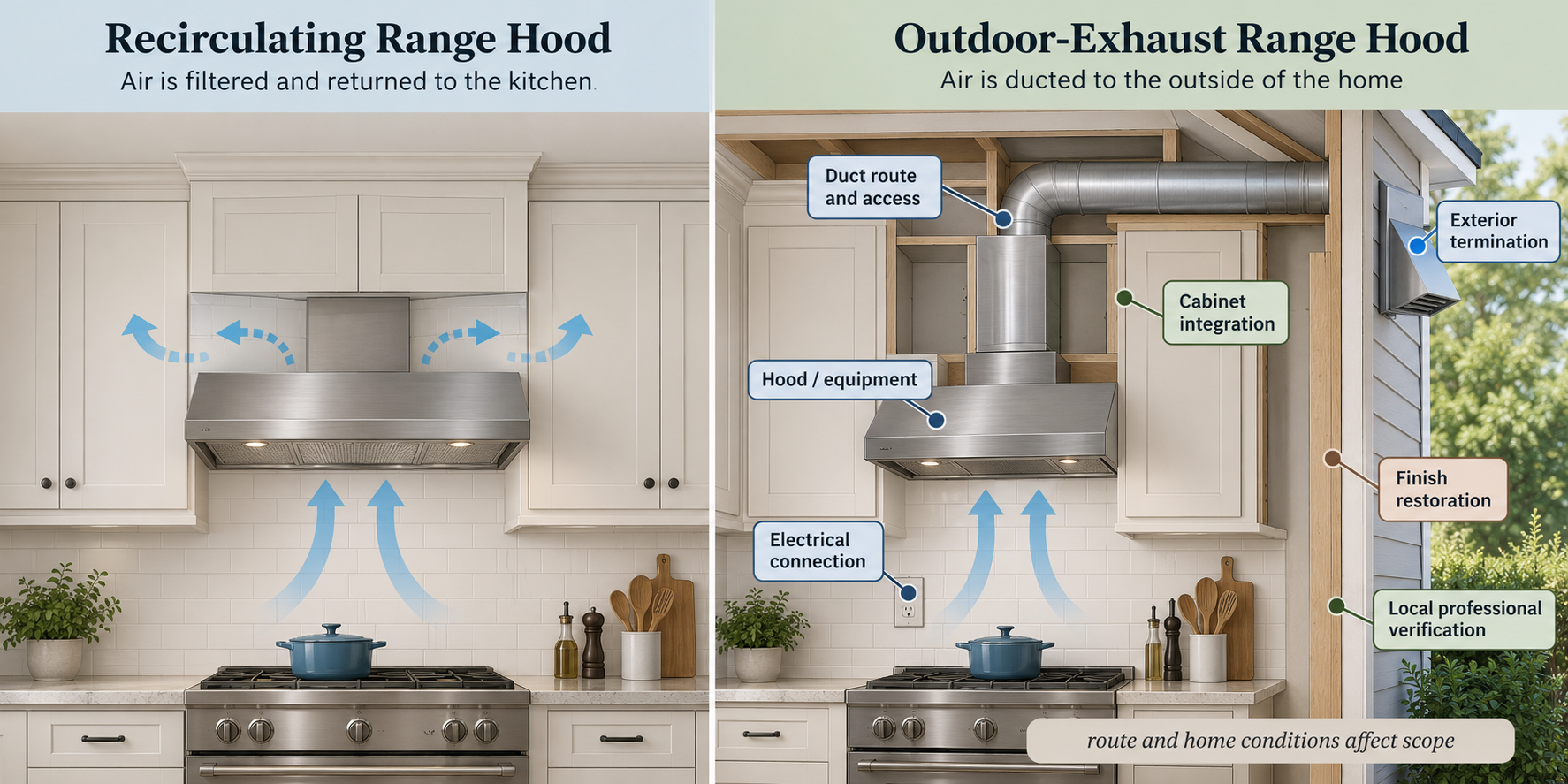
A recirculating hood avoids a duct route but does not provide the same source-exhaust arrangement as an outdoor-venting system. An outdoor system may require a suitable hood, duct, exterior termination, weather detailing, cabinet changes, electrical connection, and access through a wall, ceiling, attic, or roof.
EPA identifies cooking moisture, odors, and combustion products as ventilation concerns and recommends a correctly sized range hood that exhausts outdoors. It summarizes 100 cfm for a typical range in an ASHRAE/HVI context and warns that larger fans may require makeup air depending on the fan, house, combustion equipment, and local requirements. This is guidance, not a universal code rule.
Health Canada reports that cooking produces particulate matter, gas cooking can add nitrogen dioxide and carbon monoxide, and cooking moisture can contribute to mold growth. It recommends using a range hood, preferably on high, and says a fully extending hood improves coverage. Its 300 cfm and more-than-80% exposure-reduction figure comes from a cited study context, not a guarantee for every hood or home.
Compare the air path before comparing hood prices
Start by identifying whether the proposed system recirculates air or exhausts outdoors, then have the installer confirm the route and termination for the actual hood. An existing duct should be checked for route, size, condition, and compatibility rather than assumed reusable. A new route can involve cabinet changes, wall or ceiling openings, exterior work, access equipment, patching, and weather detailing. The distance on a floor plan does not show how difficult that path is to build.
If exterior exhaust is not feasible, ask the professional to explain the available product options and their limits for the cooking equipment and household. Do not assume that one recirculating product provides the same source removal as outdoor exhaust, or that a larger fan can be substituted without reviewing makeup-air and combustion conditions. The appropriate system and any safety requirements depend on the equipment, home, and local code.
Main cost drivers
- hood and control selection;
- duct size, length, bends, insulation, and termination;
- wall, ceiling, attic, cabinet, or roof access;
- exterior penetration and finish restoration;
- makeup-air design where applicable;
- electrical circuit, controls, and gas or cooking-equipment coordination;
- cabinet depth, hood enclosure, trim, and countertop or layout changes;
- permits, inspections, testing, protection, and cleanup.
Reuse of an existing duct is not automatic. Confirm its size, route, condition, termination, compatibility, and responsibility for corrections. Broader HVAC or indoor-air projects belong to the ventilation category; appliance purchase and lifecycle decisions belong to the appliance category.
Identify who owns each part of the installation
The hood supplier may provide the appliance, while an installer, electrician, HVAC contractor, roofer, or cabinetmaker handles separate pieces of the job. Ask who sizes or selects the hood, confirms the duct route, makes the exterior opening, connects the power, changes cabinets, evaluates makeup air when applicable, obtains approvals, tests the completed system, and restores finishes. Record which party coordinates the sequence and who is responsible if the selected hood cannot use the proposed route.
Compare the quote on the same hood and air path. Separate appliance purchase, duct and termination, cabinet work, electrical scope, access, exterior repair, permit/inspection, and makeup-air treatment. If the estimate assumes an existing route can be reused, request the inspection or documentation that supports that assumption. This helps distinguish a true equipment-price difference from a different installation scope.
Put the design assumptions beside the price
Record the cooking appliance type, hood model or performance target, capture width, duct size and route, number of turns, termination point, cabinet depth, exterior wall or roof work, and any makeup-air question. Have the qualified professional confirm which assumptions apply. If a quote uses a reused duct, request its route and condition review; if it proposes a new opening, identify who handles flashing or exterior repair.
Do not treat a manufacturer airflow label or a generic online price as a complete ventilation design. Exhaust, make-up air, gas equipment, building envelope, and local mechanical rules may interact. Ask the installer to identify the professionals who verify those interfaces and whether the quote includes testing or only equipment and installation.
For example, Angi’s guide lists different ranges for wall, island, under-cabinet, and insert hoods, plus a separate ductwork estimate. It does not consistently state whether equipment and labor are included in each row. Do not add the duct figure to a hood type or apply it to a different route without written confirmation. A short existing duct and a new exterior route across a finished ceiling are different installation scopes.
Quote and verification checklist
Ask the contractor to identify the hood model or performance assumptions, outdoor versus recirculating path, duct route and termination, cabinet work, electrical work, makeup-air treatment, exterior repair, permit responsibility, and exclusions. Confirm the applicable building, mechanical, electrical, gas, combustion-safety, and condo or property rules locally.
EPA’s current cooking guidance recommends using an outdoor-venting hood while cooking and for 10–20 minutes afterward. If outdoor exhaust is not available, it lists conditional alternatives such as opening windows or doors, a properly sized non-ozone portable air cleaner, and the highest MERV filter the HVAC system can accommodate. These are operating or fallback measures, not a substitute for design verification or a universal installation standard.
Bottom line
Price ventilation as an air path and coordination project, not a hood purchase. Confirm capture, ducting, access, exterior work, combustion and makeup-air implications, electrical scope, and local requirements before ordering cabinets or equipment.