
Specialist advice is not automatically required because a house is old. It can be worth paying for when the cost of an incorrect specification, destructive investigation, or mismatched repair is greater than the fee for understanding the problem first. The useful question is not “Does this house qualify as historic?” but “What decision is too consequential or too uncertain for an ordinary repair quote?”
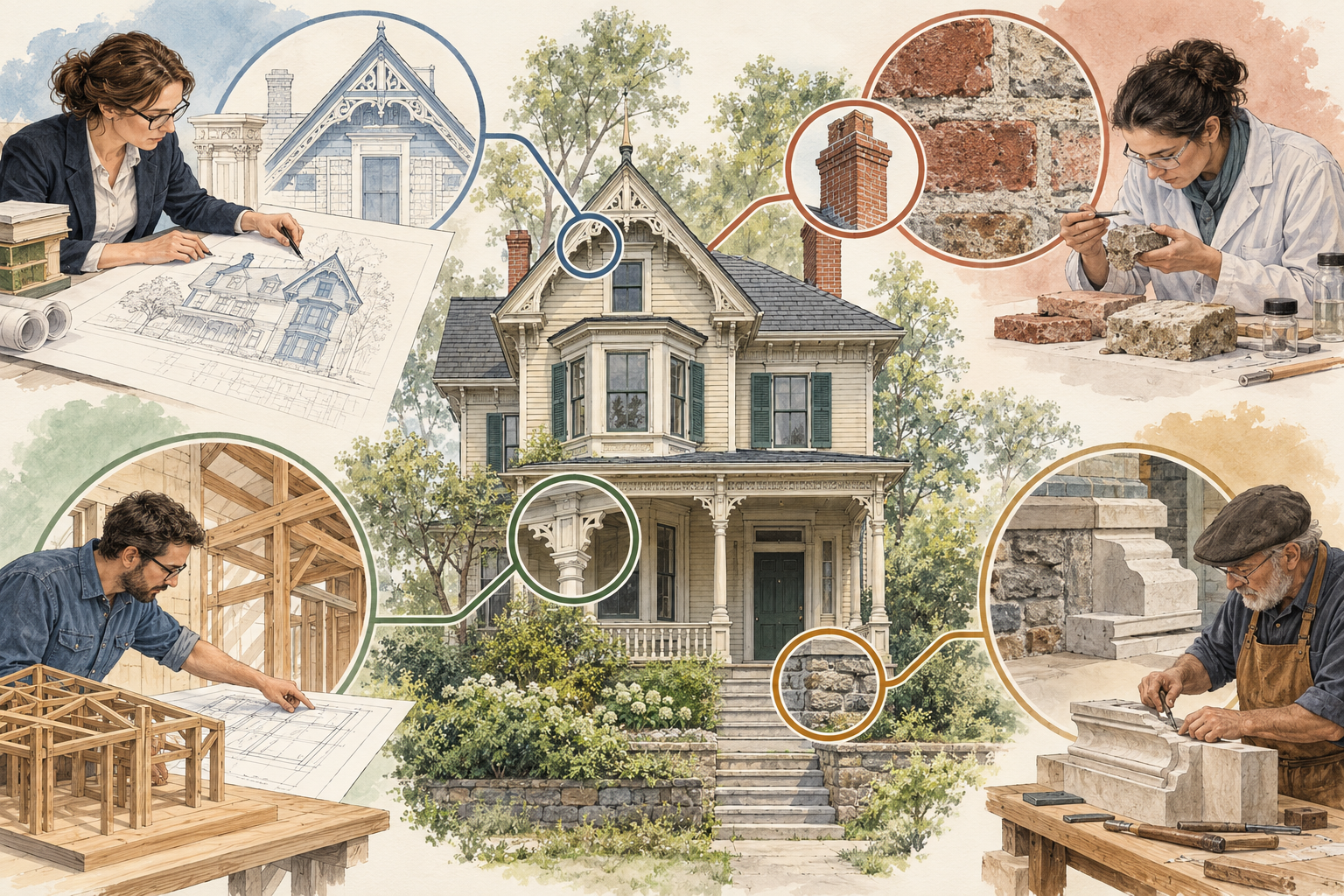
What different specialists do
A preservation architect can help define treatment goals, document character-defining features, prepare drawings, coordinate a rehabilitation design, and support a local review. A building conservator often focuses more narrowly on materials and deterioration: masonry, finishes, windows, paint, plaster, wood, or decorative elements.
A structural engineer evaluates load paths, movement, section loss, foundations, framing, and reinforcement needs. An envelope or building-science professional may investigate moisture, air movement, insulation, and condensation. A specialist contractor or craftsperson brings practical knowledge of repair methods and fabrication. These roles overlap, but they are not interchangeable.
Situations that justify early expertise
Specialist involvement is particularly useful when:
- a character-defining feature may be removed or replaced;
- the cause of deterioration is uncertain;
- masonry, timber, plaster, windows, or finishes have unusual materials;
- a proposed coating, insulation, or repair may alter moisture behavior;
- the property is designated or in a district with review;
- an addition or system upgrade must avoid important fabric;
- previous repairs may be incompatible;
- a structural, electrical, combustion, or hazardous-material issue is present;
- several trades need to share limited access.
The specialist does not make a contractor unnecessary. The best result may be a short condition assessment and clear specification that lets several qualified contractors bid on the same scope.
What the fee can buy
Professional cost is not only a design line. It can purchase investigation, measured documentation, material sampling, test panels, repair specifications, bid review, site observation, and responses to heritage comments. It may also reduce the chance of paying for full replacement when repair was practical or of repeating work after a source condition was missed.
Ask whether the proposal covers an initial consultation, report, drawings, specifications, contractor selection, permit or heritage submissions, construction administration, and follow-up visits. A limited advisory visit may be enough for a repairable window or a small masonry area. A whole-house rehabilitation may need a coordinated team and a larger design phase.
Titles and regulated scopes differ by jurisdiction. Confirm credentials, insurance, licensing, and experience for the specific work. “Historic” is not a substitute for competence in structural engineering, electrical safety, hazardous materials, or building science.
Compare the fee with the avoidable loss
The value is easiest to see when the project has a clear failure mode. Repointing with an incompatible mortar can damage adjacent masonry. A coating can trap or redirect moisture. A new duct or electrical route can destroy plaster and trim if access is not planned. An addition can trigger redesign if its location or visibility conflicts with protected attributes. The potential loss includes material, labor, delay, and the cost of restoring work that should not have been disturbed.
The specialist fee is harder to justify when the work is routine, well-defined, visible, and already supported by a sound specification. Even then, a short consultation can clarify whether the ordinary scope is appropriate. Do not commission a broad study simply because it sounds comprehensive; define the decision the study must improve.
Get a useful deliverable
Before hiring, ask for a written answer to these questions:
- What will be inspected, sampled, measured, or documented?
- Which features or materials are considered significant, and why?
- What repair, replacement, and compatible-substitute options will be compared?
- What uncertainty will remain after the work?
- Will the result be usable for contractor pricing and local review?
- Which safety or regulated decisions must be referred to another professional?
- How many site visits and revisions are included?
A helpful report identifies observations, limitations, recommended next decisions, and scope boundaries. It should not present a preservation preference as a universal legal rule or offer structural, electrical, combustion, or hazardous-material instructions outside the professional’s competence.
When an ordinary contractor may be enough
An experienced local contractor may be sufficient for maintenance, a small repair with a known cause, or a replacement that does not affect significant fabric. Ask for references to comparable materials and a clear plan for protecting adjacent work. A contractor who knows when to stop and seek engineering, conservation, or hazard advice may be more valuable than one who claims every old-house problem can be solved from a standard template.
Use specialist expertise when it changes a real decision: whether to repair, how to specify the work, how to protect the fabric, or how to coordinate the project. Price the consultation against the likely cost of destructive mistakes, not against the lowest available contractor visit.
Match the specialist to the decision
The first professional does not have to be the person who designs or performs every part of the project. Match the scope to the uncertainty:
| Question | Useful lead professional | Useful deliverable |
|---|---|---|
| What is significant and what treatment goal fits? | Preservation architect or conservator | Feature inventory, condition notes, and treatment options |
| Why is a material failing? | Conservator, envelope specialist, or materials professional | Cause assessment, testing plan, or compatible repair brief |
| Is movement or load a concern? | Structural engineer | Condition and structural design scope |
| How can new services reach the rooms? | Architect with the relevant licensed trades | Coordinated access and restoration plan |
| Who can perform the work? | Specialist contractor or craftsperson | Method, sample, mockup, and price for the defined repair |
One person may fill more than one role on a small project, but the proposal should say which decisions are actually covered. A preservation consultant who identifies a significant wall finish does not thereby establish structural adequacy. An engineer who designs reinforcement does not automatically specify the historically compatible finish that will be restored afterward.
Decide when a limited consultation is enough
Specialist work can be scaled. A short site visit may answer whether a window, mortar joint, or wood detail appears repairable and what information a contractor needs. A written condition report may be justified when the work will affect several rooms or when the owner needs comparable bids. Full drawings, specifications, bid administration, and construction observation make more sense when the project includes a designated property, a major addition, complex structural work, or many interacting trades.
Ask the professional to state what remains unknown after each stage. That prevents a small consultation from being interpreted as approval of hidden conditions and prevents a broad study from continuing without improving a decision. It also helps an owner decide whether to spend more on investigation or move to a defined contractor scope.
A full Historic Structure Report (HSR) is one possible deliverable, not a default requirement for every old house. The National Park Service says HSRs are less common for privately owned residences and that scope can be limited or prepared incrementally. Ask whether a focused condition report, material investigation, or partial HSR can answer the decision at hand; define the affected features, disciplines, records, recommendations, and remaining gaps. A broader report is more useful when the property and long-term project justify its research and coordination.
The NPS brief also recognizes emergency stabilization to prevent immediate failure or damage, and temporary measures for critical health or safety, as exceptions to waiting for a full research and investigation phase. Route urgent conditions to the appropriate qualified professionals; do not commission a comprehensive report merely to authorize routine work.
Compare the fee with rework, not the cheapest bid
The relevant comparison is the fee versus the avoidable consequences of a wrong decision. Those consequences may include replacing a repairable feature, repairing damage caused by an incompatible coating, opening a finished wall a second time, paying for a custom item that fails review, or delaying a project while a missing condition is investigated. The risk is not always a dramatic failure; it can be the cumulative cost of poor coordination and lost options.
Request a fee proposal that separates research, site visits, sampling, drawings, specifications, contractor questions, review submissions, construction observation, travel, and additional services. Ask how changes in scope are authorized. This turns the specialist’s fee into a defined project-control cost rather than an open-ended premium.
Compare specialist value without inventing a fee range
There is no reliable national USD or CAD fee range for preservation architects or conservators. Request a dated local proposal that states the deliverable, site visits, research, testing, drawings, specifications, coordination, revisions, and exclusions. Price the specialist scope beside the likely cost of opening, replacing, or restoring significant fabric.
Keep the specialist decision in the handoff
When the specialist’s work informs construction, retain the accepted samples, treatment rationale, significant-feature notes, unresolved questions, and recommendations for future maintenance. This record helps the owner and later trades understand why a repair, reproduction, or compatible substitute was selected. It also makes clear which questions remain with an engineer, licensed trade, or hazardous-material professional.
Keep design, engineering, conservation, and construction fees separate. A local quote should also state which decisions remain outside the specialist’s authority, such as structural, electrical, combustion, or hazardous-material work.