
Historic designation can affect a renovation, but “old” and “designated” are not the same condition. A century-old house may have no formal heritage control. A newer property may be inside a historic district or have a designation that protects specific attributes. Before adding a preservation premium to the budget, confirm the property’s actual status and the work that status covers.
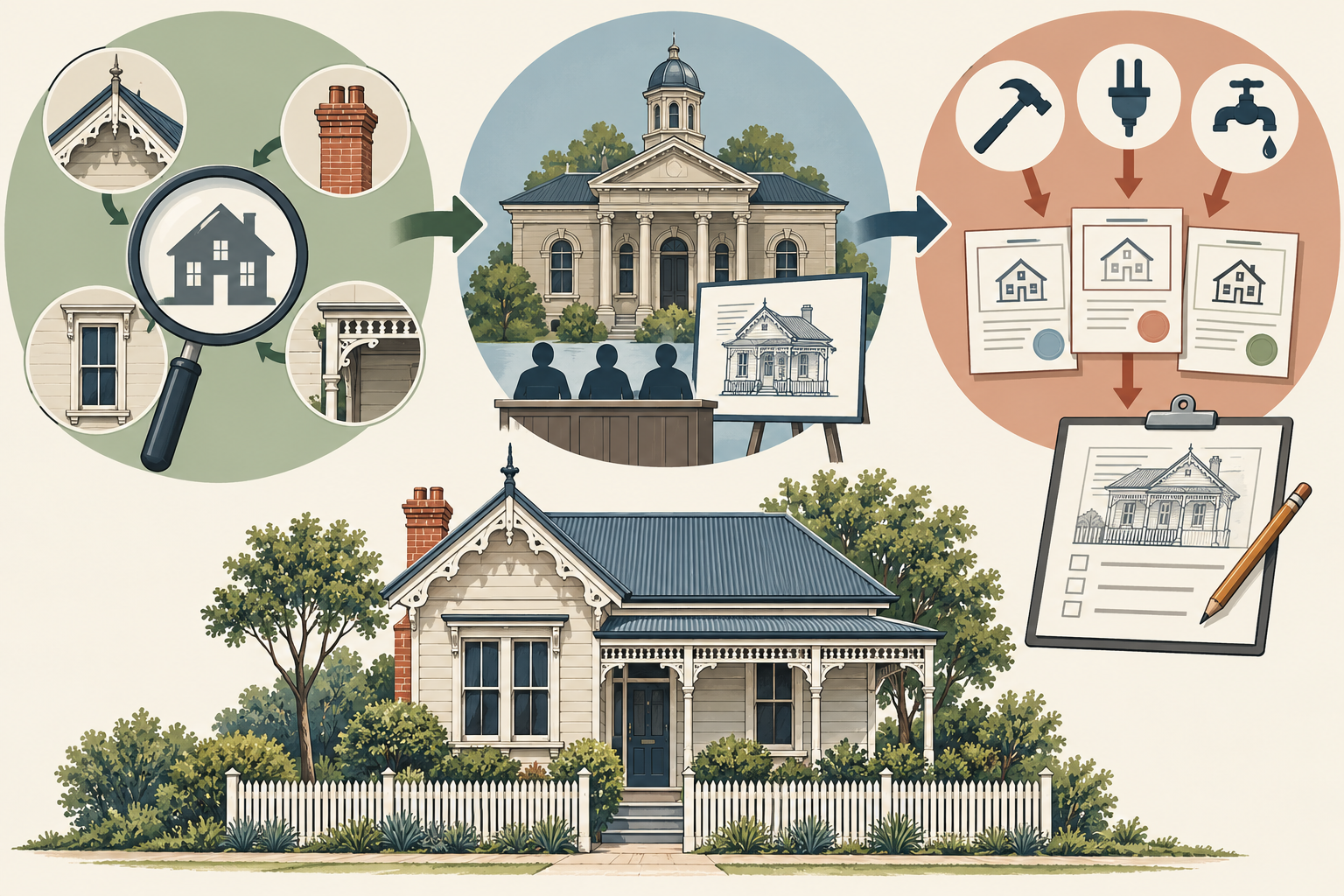
There is no single U.S. or Canadian approval matrix. Requirements depend on the designation instrument, the authority that administers it, the location of the work, the affected features, and the jurisdiction’s building and safety rules. Federal or national preservation guidance can help with treatment decisions, but it is not automatically a private-home permit regime.
Confirm the legal and administrative status
Start with the property address and the documents available from the municipality, county, state, province, territory, or heritage authority. Ask whether the property is individually designated, contributing to a district, listed without binding alteration control, subject to a conservation easement, or simply described as historic in a real-estate listing.
Then ask what the designation actually protects. It may cover the exterior, specific elevations, landscape elements, interior features, archaeological resources, or a defined list of heritage attributes. Do not assume that a register listing, a local designation, and a preservation easement have the same effect.
Separate maintenance, alteration, and demolition
Many jurisdictions distinguish routine maintenance from a change that affects protected material or appearance. Repainting in an approved or existing scheme may be treated differently from removing historic siding, changing window openings, adding a visible roof feature, or demolishing a contributing structure. The dividing line is local and should be confirmed in writing.
The practical cost issue is not only an application fee. A review may change the design, require drawings or photographs, request material samples, add review meetings, or cause a contractor to price additional documentation and lead time. If the project is urgent, ask the authority what can be confirmed before signing a construction contract.
Heritage review is not the building permit
Heritage consent and a building permit can be separate processes. A property may need local heritage approval even when a particular maintenance task does not require a building permit, and a building permit may still be needed after heritage review approves the design. Electrical, plumbing, structural, fire, energy, accessibility, and hazardous-material requirements may involve other authorities.
Treat every statement about approval as a question for the actual jurisdiction. An example from Ontario, for instance, illustrates how alteration affecting heritage attributes can involve written municipal consent, but it does not establish the process for every Canadian municipality or any U.S. property. The National Park Service standards likewise provide technical guidance and program-specific rules, not a universal permit requirement for privately owned houses.
Check notices and existing permits
Heritage status can be in transition while a property is being bought or a project is being designed. Ontario’s current ministry guide says an owner’s consent is not required for a designation to proceed. It also explains that a Notice of Intention to Designate can create interim protection and may void existing permits that allowed alteration or demolition. If a notice applies, check its listed attributes and ask the municipality which approvals remain valid before relying on an older permit or schedule. This is an Ontario example; the notice, current law, and local authority govern the actual property.
Application completeness can also affect a local review schedule. A heritage approval, building or trade permit, and assistance-program decision each answer a different question. A funding approval does not grant permission to build, and permission to alter does not establish that the work qualifies for support; see heritage assistance and timing.
What may increase the renovation budget
Designation can increase cost when it changes any of these work packages:
- measured drawings, condition surveys, or a preservation specification;
- architect, conservator, engineer, or heritage consultant time;
- custom windows, trim, masonry, roofing, or paint matching;
- mockups and review samples before full installation;
- careful removal, labeling, storage, and reinstallation;
- additional site protection and finish restoration;
- review-driven redesign or a longer procurement period;
- specialist contractor availability and travel.
These costs are not automatic. A straightforward repair using existing materials may need little extra documentation. A visible addition, façade change, demolition, or replacement of a character-defining feature may require much more planning than ordinary work.
Make the status part of the bid package
Give contractors the designation record, heritage-attribute description, approved drawings, site photographs, and written authority responses. Ask them to state whether the price includes heritage submissions, revisions, permit coordination, samples, inspections, and restoration after access. If the design is not settled, request separate allowances rather than a single unexplained preservation premium.
Ask which items are mandatory, which are owner preferences, and which are prudent conservation recommendations. A contractor should not present a voluntary technical standard as a legal requirement, and an owner should not assume that an attractive historic treatment will satisfy the local authority without confirmation.
Questions to resolve before contracting
Before signing, ask:
- What is the property’s formal status, and which features or locations are covered?
- Does the proposed work count as maintenance, alteration, demolition, or new construction under the local rules?
- Is heritage review separate from the building, electrical, plumbing, or structural permit?
- Who prepares drawings, material samples, and responses to review comments?
- What happens to the schedule if the authority requests a change?
- Are custom materials, mockups, storage, and finish restoration in the price?
- Which requirements are confirmed, and which still need written local verification?
Designation can create additional coordination and design constraints, and that can increase cost. It can also prevent an owner from pricing the wrong replacement or demolishing repairable fabric. Confirm the actual rule, the protected feature, and the approval path before treating historic status as either a penalty or a guarantee of expensive work.
Distinguish the kinds of cost
Approval-related expense is easier to evaluate when it is divided into separate kinds of work:
- Information cost: title, designation, heritage-attribute, easement, or district research needed to establish the starting position.
- Design cost: measured drawings, condition documentation, specifications, material samples, or revisions needed to explain the proposal.
- Process cost: application preparation, meetings, responses, waiting time, and coordination with other permit authorities.
- Construction cost: the actual compatible repair, custom material, protection, access, and restoration.
- Risk cost: redesign, procurement delay, temporary protection, or a change in scope if the review or opening of the work reveals a problem.
These costs do not all appear on the same invoice. A municipality may not charge a large application fee while the designer spends significant time preparing drawings. Conversely, a simple maintenance project may require little design work even if the house is formally designated. Ask for each category to be identified rather than accepting a single “heritage premium.”
Use a review checkpoint before ordering material
Do not order custom windows, slate, trim, siding, paint, or visible equipment until the status and review path are known. If a local authority asks for a different profile, location, finish, or degree of visibility after the purchase, the owner may carry restocking, redesign, storage, or rework costs. A written response about what is and is not subject to review is more useful than an assumption based on the property’s age or a real-estate description.
The same checkpoint applies to building and trade permits. A heritage decision may address appearance or identified attributes, while structural, electrical, plumbing, fire, energy, accessibility, or hazardous-material requirements are handled elsewhere. Put the responsible party and expected deliverable beside each approval in the schedule. “Permits included” is too vague if nobody has identified which permit or inspection is meant.
What a comparable bid should show
Ask every bidder to price the same approved or review-ready information:
- Existing conditions and features being retained.
- Proposed repair, replacement, or new construction and its visible locations.
- Drawings, samples, mockups, and review responses.
- Temporary protection, storage, access, and weather protection.
- Custom or compatible materials, lead times, and minimum orders.
- Related restoration after openings or removals.
- Allowances for unresolved conditions and the event that activates each one.
If the project is not ready for a fixed price, price the documentation and investigation phase first. That may feel like an added cost, but it can prevent the owner from comparing a fully documented preservation scope with a construction-only number that leaves approvals and restoration unresolved. The goal is not to predict every local rule nationally; it is to make the remaining local questions visible before the contract is signed.
Build a jurisdiction-specific estimate
No reliable national USD or CAD range applies to designation-related renovation work. Request a dated local proposal that separates heritage research, drawings, material samples, application and review time, building permits, specialist labor, protection, restoration, and possible redesign. Treat review duration as a schedule allowance, not a universal fee.
Keep U.S. and Canadian estimates in their own market and ask the authority or qualified designer to identify which requirements are confirmed. Do not price a national rule from one jurisdiction’s example.