
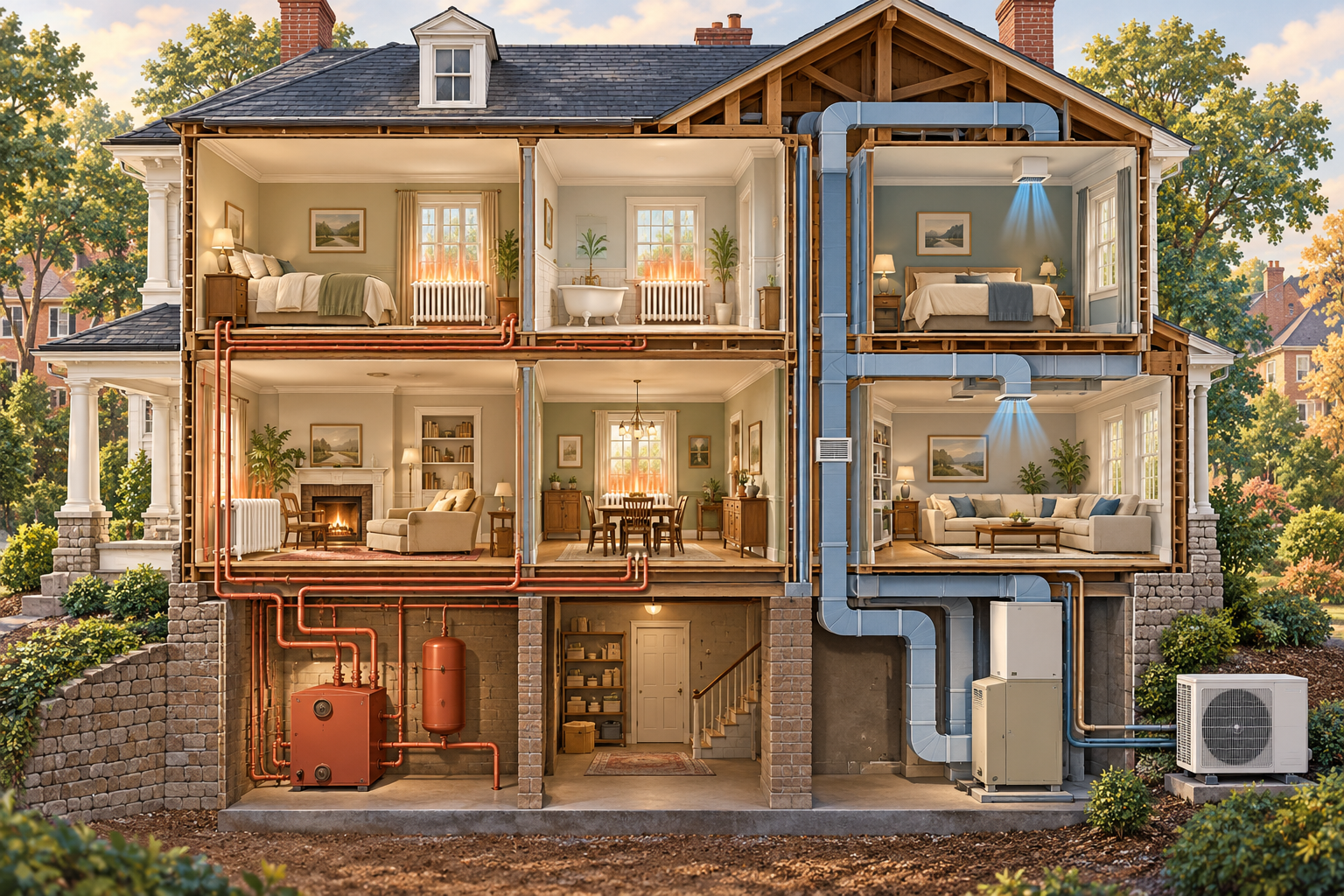
An old radiator system is not one component. The boiler or heat source, controls, distribution, radiators, piping, chimney, fuel, insulation, and building envelope all affect the decision. Converting to modern HVAC can add ducts, refrigerant lines, electrical work, equipment, and restoration through finished spaces.
Separate the heat source from the distribution
First establish whether the house has steam, hot-water radiators, another hydronic arrangement, or a mixed system. Assess the boiler or central equipment, pipes, valves, radiators, controls, chimney or venting, insulation, and room comfort separately. A central-equipment failure does not automatically mean the distribution should be removed, and a sound boiler does not prove that the system is the best long-term choice.
Condition, access, replacement parts, past alterations, building load, and the treatment objective all matter. Original radiators may be character-defining, but their preservation does not override combustion, pressure, flue, electrical, or structural safety. Use qualified heating professionals and current local requirements for those decisions.
Compare the broad pathways
Repair and retain may suit a serviceable distribution system with a defined equipment or control problem. Include diagnosis, valves, controls, boiler or central equipment, venting, insulation, and balancing as applicable. Replace central equipment while retaining radiators can preserve visible elements and avoid new duct routes, but capacity, controls, pipe condition, and future service must be confirmed. Convert to another distribution or heat-pump system may improve efficiency or cooling options but can add electrical capacity, ducting or refrigerant routes, equipment locations, condensate, demolition, and restoration.
Do not compare equipment prices without the building. A ducted system may need chases and finished-surface access; a ductless system may change visible interiors and exterior placement. A heat pump may need envelope work or backup capacity in a particular climate. The right choice is property- and system-specific.
Compare lifecycle and disruption
Ask for installation, removal, fuel or electrical changes, controls, service access, maintenance, expected replacement path, and restoration. Price temporary heat and occupancy effects if the project spans a heating season. Include chimney treatment if an appliance is removed or changed, and verify what happens to abandoned pipes, radiators, vents, and penetrations.
Operating-cost estimates should state climate, energy prices, equipment assumptions, load, and envelope condition. Do not present one payback or “cheapest to run” claim as universal. A higher installation cost may buy lower disruption or preserve an accessible distribution system; a lower equipment cost may shift expense to ducts, electrical work, or finish repair.
Ask for a coordinated proposal
Require the heating professional to show the existing system, proposed heat source, distribution retained or removed, controls, service access, and restoration. If conversion is under consideration, include equipment locations, routes, exterior visibility, electrical or fuel work, condensate, chimney treatment, and any abandoned pipes or radiators. A proposal that prices only the new equipment cannot be compared with a repair-and-retain scope.
Ask who is responsible for the building-load assessment, the heating design, the electrical or fuel work, and the finish restoration. These may be different professionals. The owner should receive one coordinated sequence even when the contracts remain separate: assessment, design, approvals, removal or protection, installation, commissioning, restoration, and follow-up.
Compare decisions by component
Make a table for the heat source, distribution, radiators, controls, chimney or venting, electrical service, and room finishes. For each component, record whether it is retained, repaired, replaced, removed, or left for a later phase. This exposes mixed options that may be more suitable than an all-or-nothing conversion.
For example, retaining visible radiators may preserve character while a central equipment change addresses reliability; retaining the heat source may be reasonable while controls or distribution are assessed; or a conversion may be justified where the existing system cannot meet the intended use. The technical professional must resolve capacity and safety; the homeowner should make the preservation and disruption tradeoff explicit.
Make lifecycle assumptions explicit
Ask how the system will be serviced, what access must remain available, what parts or fuel assumptions matter, and which components may need replacement first. Include temporary heat, seasonal scheduling, and restoration if the work spans an occupied heating season. An operating-cost comparison should identify the climate, energy prices, load, envelope, and equipment assumptions behind it.
Do not treat a short-term operating estimate as a guarantee. A higher installation cost may preserve a distribution system and reduce finish disruption; a lower equipment price may shift cost to electrical work, duct routes, or later restoration. Record the owner’s priority so the comparison remains meaningful when quotes change.
Make the comparison room-specific
List rooms with comfort complaints, retained radiators, visible pipes, important trim, and the available routes for new distribution. A whole-house label can conceal very different conditions: one room may need balancing or a control change, another may lack a practical route for a conversion, and a third may already be served by a later addition. Price the interfaces that make each room usable, not only the central equipment.
Ask how the proposal handles rooms that are difficult to serve, temporary heat during construction, and the finish around any new or abandoned route. If a radiator or pipe is removed, document its condition and decide whether it is stored, reused, or disposed of. If a visible element remains, include its protection and final restoration.
Define the end condition before work starts
The selected scope should state what heat source operates, which distribution remains, what controls are installed, what equipment is removed, what penetrations are closed, and what service access stays available. Include testing, balancing or commissioning by the appropriate professional, inspection, and owner instructions. “Conversion complete” is not specific enough if old pipes, radiators, chimney connections, or electrical work remain unresolved.
Set a review point after the first heating season or other meaningful operating period. Record comfort, noise, service issues, moisture observations, and operating assumptions. The review should identify maintenance or adjustment needs without promising that a historic building will perform like a new one.
Establish a repair-first benchmark
Even when conversion is attractive, price a credible repair-and-retain option so the owner can see what is being traded away. The benchmark should state the known equipment or distribution issue, required diagnosis, access, controls, restoration, and remaining uncertainty. It is not a promise that repair is possible; it is a comparison point grounded in the existing system.
Likewise, a conversion proposal should state what the repair option avoids and what new work it creates: routes, equipment locations, exterior visibility, electrical or fuel changes, condensate, chimney treatment, and finish restoration. If one option has not been designed to the same level, label it preliminary rather than treating its lower number as a saving.
Record the system and owner handoff
Keep equipment information, room-by-room decisions, photographs of retained or removed radiators and visible piping, routes and service clearances, inspection or commissioning records, restoration, and maintenance instructions together. Identify the heat source and distribution that remain, controls and connections changed or abandoned, and deferred conditions that need a qualified assessment.
After a representative period of operation, record comfort, service issues, moisture observations, and the operating assumptions used in the design. Set a follow-up point for review and adjustment; do not present that review as a guarantee of savings or comfort independent of the building and climate.
State what each price delivers
The estimate should identify the heat source, distribution retained or removed, room interfaces, controls, service access, temporary heat, restoration, inspection, and remaining uncertainty. Compare repair and conversion only when their end conditions are described to the same level.
Build a local estimate
No reliable national USD or CAD range applies to this specialized historic-home work. Request a dated local proposal that separates investigation, access, protection, materials, specialist labor, permits or review, restoration, and future maintenance. State the condition, area, and assumptions covered by each option.
Compare complete scopes in the market where the work will occur. Keep confirmed work, allowances, and owner-selected upgrades separate, and do not convert a price mechanically between U.S. and Canadian markets.