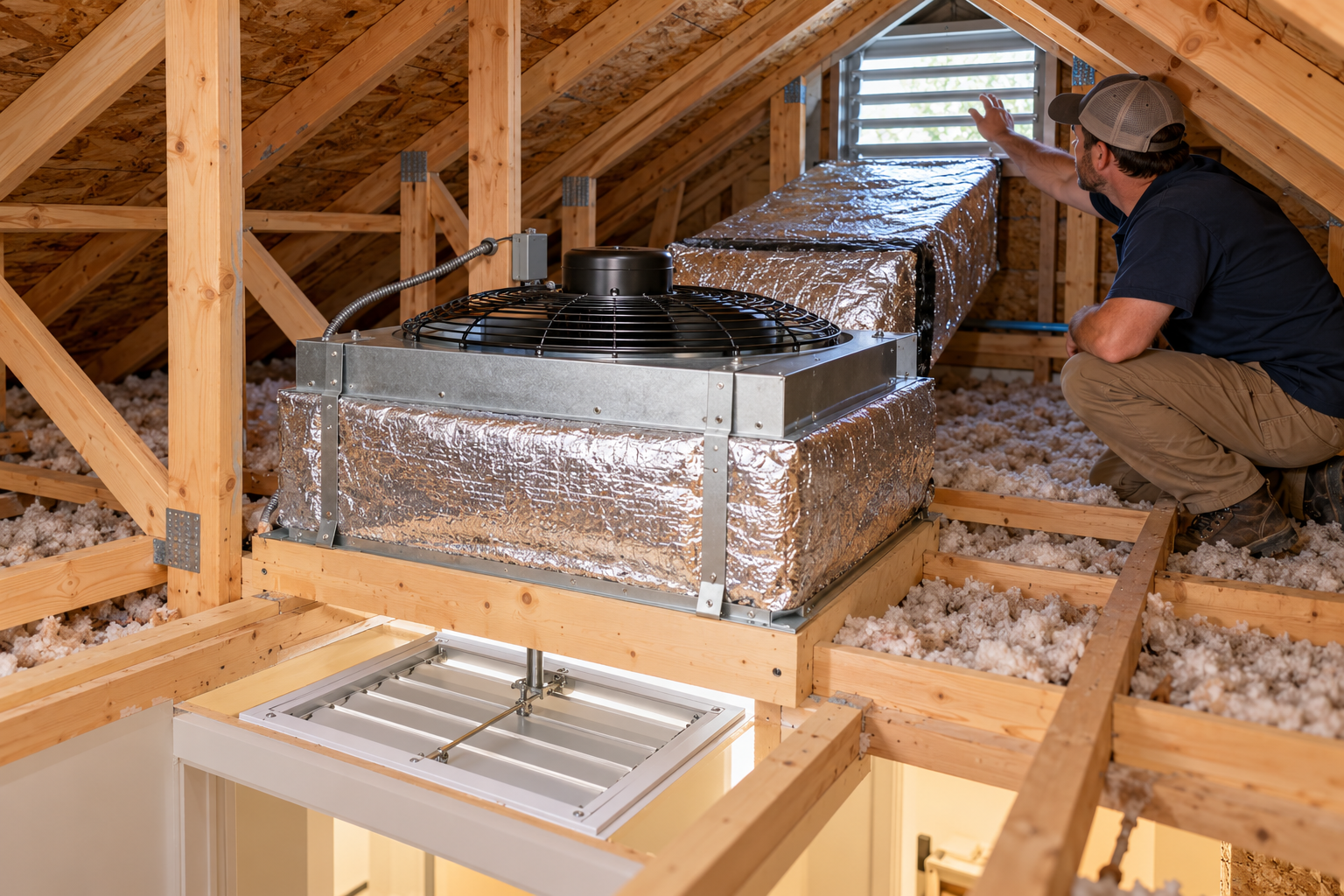
An Angi U.S. cost guide updated in 2026 reports USD $900–$2,400, with a typical project near USD $1,700 for materials and labor. It does not publish a representative sample, and attic venting, wiring, opening work, and finish repair may change a quote. A separate U.S. guide estimates USD $1,200–$3,000 for an insulated “fan-in-a-can” configuration when the attic is accessible and major framing or vent changes are not needed. These are different guide-defined projects, not a combined range. Current Canadian installed-price evidence is not established, so do not convert the U.S. amounts.
What a whole-house fan does
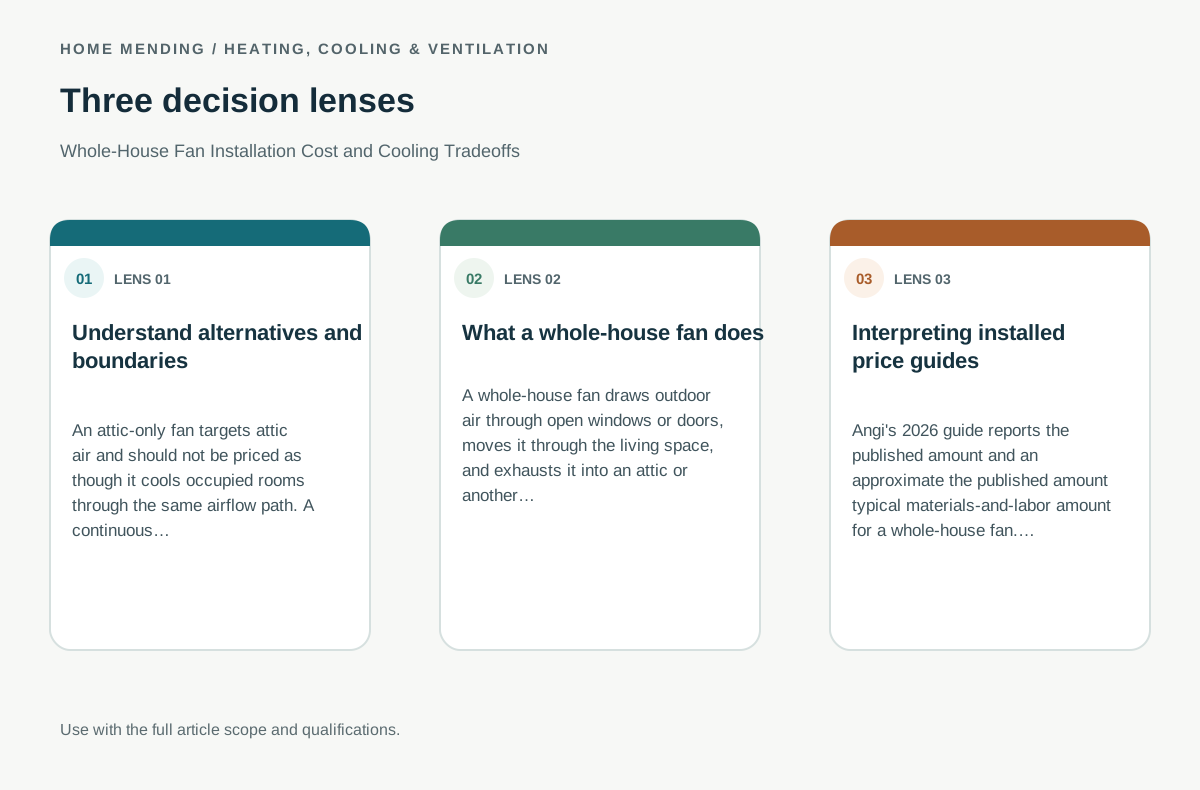
A whole-house fan draws outdoor air through open windows or doors, moves it through the living space, and exhausts it into an attic or another designed outlet. It can make use of cooler outdoor conditions when the weather and house are suitable. It is not an attic-only fan, which moves attic air without drawing air through the rooms, and it is not a continuous mechanical fresh-air system designed around controlled ventilation.
The system depends on an open airflow path. If windows are closed, the fan cannot deliver the intended room-to-attic flow. Its cooling value depends on the relationship between indoor and outdoor temperature, humidity, air quality, attic ventilation, and when occupants operate it. It may reduce air-conditioning use during suitable periods, but neither lower bills nor a particular indoor temperature is guaranteed.
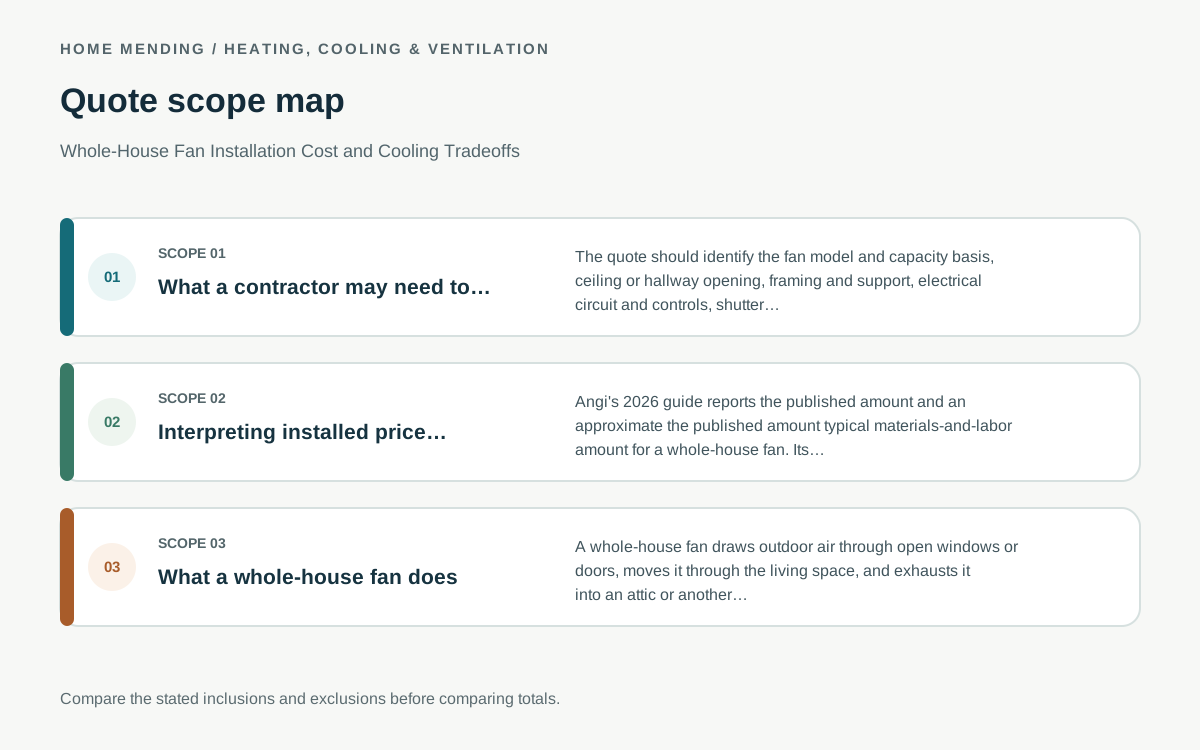
The U.S. Department of Energy’s ventilation-cooling guide treats the fan, inlet openings, attic exhaust, electrical supply, and controls as parts of one installation. A fan that is inexpensive by itself may not be an inexpensive retrofit if the attic, ceiling, or electrical circuit needs work.
Interpreting installed price guides
Angi’s 2026 guide reports USD $900–$2,400 and an approximate USD $1,700 typical materials-and-labor amount for a whole-house fan. Its page identifies house and fan size, roof venting, wiring, and drywall repair among cost drivers, but does not state a representative sampling method. Treat its numbers as one U.S. planning source and check what a local proposal includes.
The separate fan-in-a-can guide estimates USD $1,200–$3,000, averaging around USD $2,000, for its insulated duct-connected configuration. Its assumptions include an accessible attic and no major ceiling, framing, or attic-vent changes. That product type and scope should not be added to the conventional-fan range or presented as the same installation. If a bidder proposes it, compare its equipment, ceiling opening, insulation, controls, and exhaust assumptions directly with the conventional option.
There is no comparable Canadian installation sample in the evidence. Ask local contractors to quote the exact fan and airflow path in the currency and market where the work will occur. A Canadian homeowner should not treat a U.S. guide amount as a Canadian quote after currency conversion; labor, electrical requirements, equipment availability, and roof or attic work differ by project and jurisdiction.
What a contractor may need to include
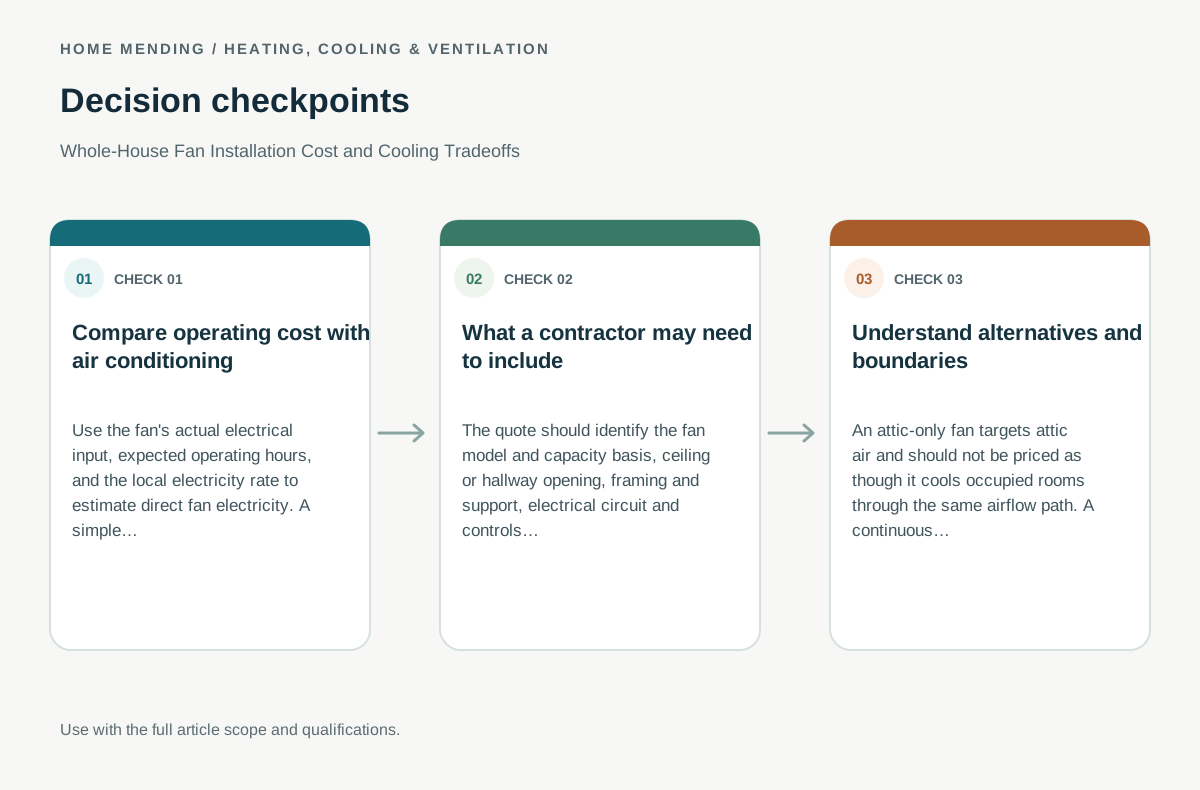
The quote should identify the fan model and capacity basis, ceiling or hallway opening, framing and support, electrical circuit and controls, shutter or insulated cover, attic vent capacity, access, protection, cleanup, and any finish repair. If a new opening is proposed, ask who confirms that the location avoids structural members and hidden services. This is a professional assessment, not a homeowner cutting or modifying the ceiling.
A retrofit through a suitable existing opening may have a different scope from a new fan that needs ceiling work, wiring, attic vent changes, and finish restoration. Ask bidders to price those conditions separately when the home is not yet opened for inspection. Fan noise and vibration can also affect whether the selected location works for a bedroom or living space; compare the proposed model’s sound information and installation assumptions rather than treating all fans as interchangeable.
Attic exhaust is a central part of the design. The fan pushes air into the attic, so existing vents must be adequate for the selected equipment and the building configuration. If additional roof or gable venting is needed, it should be listed as a separate scope with its own price. Do not assume a roof vent cost applies to every home or that a fan can be sized from floor area alone.
Ask the contractor to assess electrical supply, clearances, shutter movement, insulation around the opening, and the route from occupied rooms to the attic exhaust. The DOE guide is technical context, not a current code determination or a substitute for the selected product’s installation instructions. Permit, electrical, and structural requirements must be confirmed for the property.
Combustion appliances deserve special attention. A powerful fan can change pressure relationships in a house; homes with natural-draft fuel-burning equipment need an appropriate professional assessment of combustion safety and any required interlocks. Do not treat a generic installation checklist as proof that an existing chimney, furnace, or fireplace is compatible with the project.
When outdoor conditions support the idea
Whole-house fans are most useful when outdoor air can help cool the home. DOE homeowner guidance describes dry or moderate conditions with a meaningful day-to-night temperature difference as favorable, and hot-humid conditions as a limitation. It does not provide a universal temperature or humidity cutoff. A local installer can discuss the climate and building conditions, but the homeowner should also check local weather and air-quality conditions before operation.
The windows or doors used for airflow affect comfort, noise, privacy, insects, security, and the amount of air delivered. Ask whether the rooms you want to cool have practical openings and whether the fan’s proposed location reaches them. A plan that depends on opening inaccessible or insecure windows may not fit the household even when the equipment cost looks attractive.
Outdoor smoke or other poor air quality can make drawing outside air indoors a bad choice. The EPA’s smoke-filtration guidance recommends limiting smoke infiltration and using compatible filtration during smoke events. A whole-house fan is an outdoor-air cooling strategy, not a smoke filter; do not run it simply to circulate air during a local smoke advisory. High outdoor humidity or temperatures can likewise erase the expected comfort benefit.
Compare operating cost with air conditioning
Use the fan’s actual electrical input, expected operating hours, and the local electricity rate to estimate direct fan electricity. A simple estimate is kilowatts multiplied by hours and the price per kilowatt-hour. Obtain the wattage from the exact product documentation, and model your own likely use instead of borrowing a generic monthly bill. The whole-house fan itself is only one side of the comparison; the possible change in air-conditioner runtime depends on weather, house leakage, insulation, and occupant behavior.
If the decision is between installing a fan and replacing central AC, compare complete project scopes. A fan does not provide the same service in all weather or keep windows closed, and it does not dehumidify the way a cooling system may. If you still need reliable cooling during hot nights, humid weather, smoke, or security-sensitive periods, keep the air-conditioning option in the budget. The fan can be supplemental rather than a substitute.
A utility incentive can reduce the amount paid only when the household and installation meet the current program rules. For example, Los Angeles Department of Water and Power lists a USD $200 whole-house-fan rebate for eligible active residential electric customers; its program excludes attic fans, requires an application after installation within 12 months of purchase, and may require supporting documents or inspection. Funding is first-come, first-served, and approval is not guaranteed. This local offer is not a U.S.- or Canada-wide discount, and it should not be deducted from a quote before eligibility and current funding are confirmed.
Understand alternatives and boundaries
An attic-only fan targets attic air and should not be priced as though it cools occupied rooms through the same airflow path. A continuous ventilation system brings in and exhausts air for indoor-air purposes under a different design; see the whole-house ventilation guide for that decision. A whole-house fan may also be considered alongside an evaporative cooler, but those systems use different equipment and outdoor-air conditions.
If the home has central AC, compare fan cost with likely use, not with the full AC bill as if all cooling disappears. If air-conditioning equipment is already at end of life, review the replacement scope and ask whether the fan meets a separate shoulder-season need. If rooms remain uncomfortable because of duct imbalance, envelope leakage, or solar gain, those problems may remain after fan installation.
Questions to ask before accepting a proposal
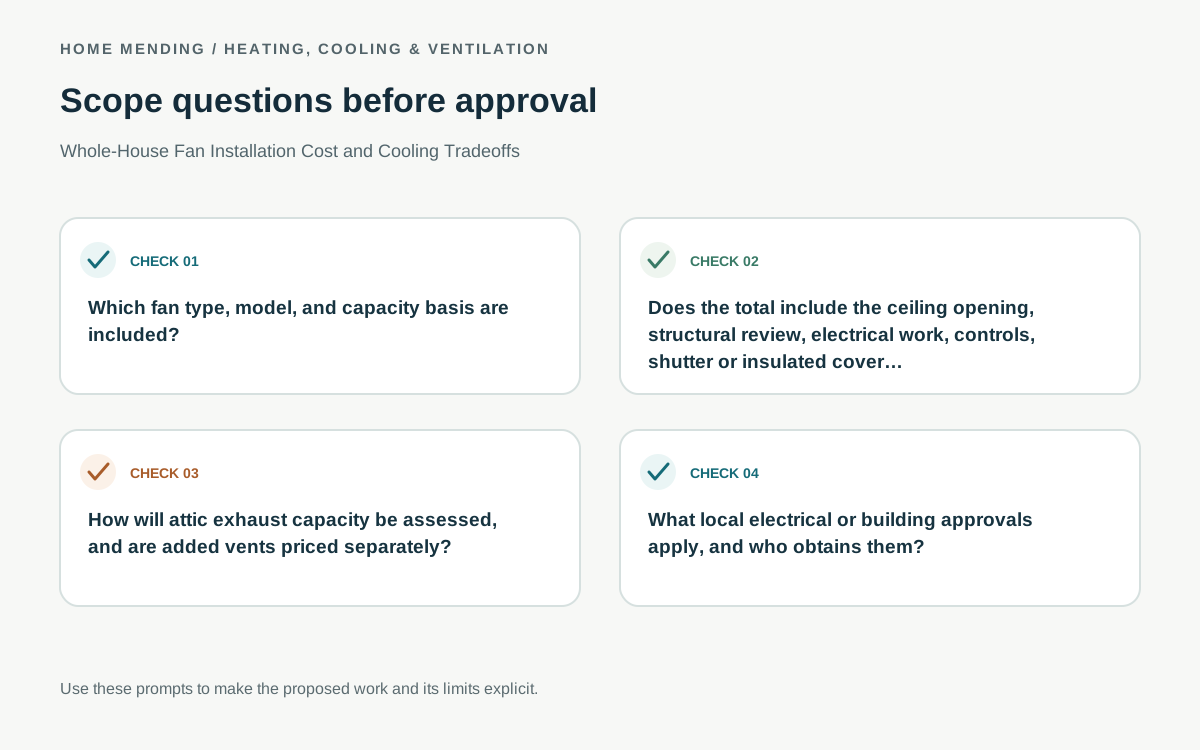
- Which fan type, model, and capacity basis are included?
- Does the total include the ceiling opening, structural review, electrical work, controls, shutter or insulated cover, finish repair, and cleanup?
- How will attic exhaust capacity be assessed, and are added vents priced separately?
- What local electrical or building approvals apply, and who obtains them?
- Does the house have combustion equipment that requires a pressure or backdraft assessment?
- What operating conditions, open-window path, and seasonal shutdown does the manufacturer specify?
- Which items are excluded, and what concealed condition would change the price?
A useful whole-house-fan quote identifies the path air will take, the site work required, and the conditions in which the fan can actually be used. If the project depends on opening windows in weather or air-quality conditions that are common where you live, compare it with a cooling option that fits those days as well.