
Illustrative planning scenario (U.S. dollars, September 2026)
This is a worked scope example, not a market quote: assume $350 for diagnosis, $450 for an accessible valve or connection repair, and $700 for an allowance if one radiator must be removed and replaced. The planning exposure is $1,500 before finish restoration; leaks affecting the wider hydronic loop need a separate assessment.
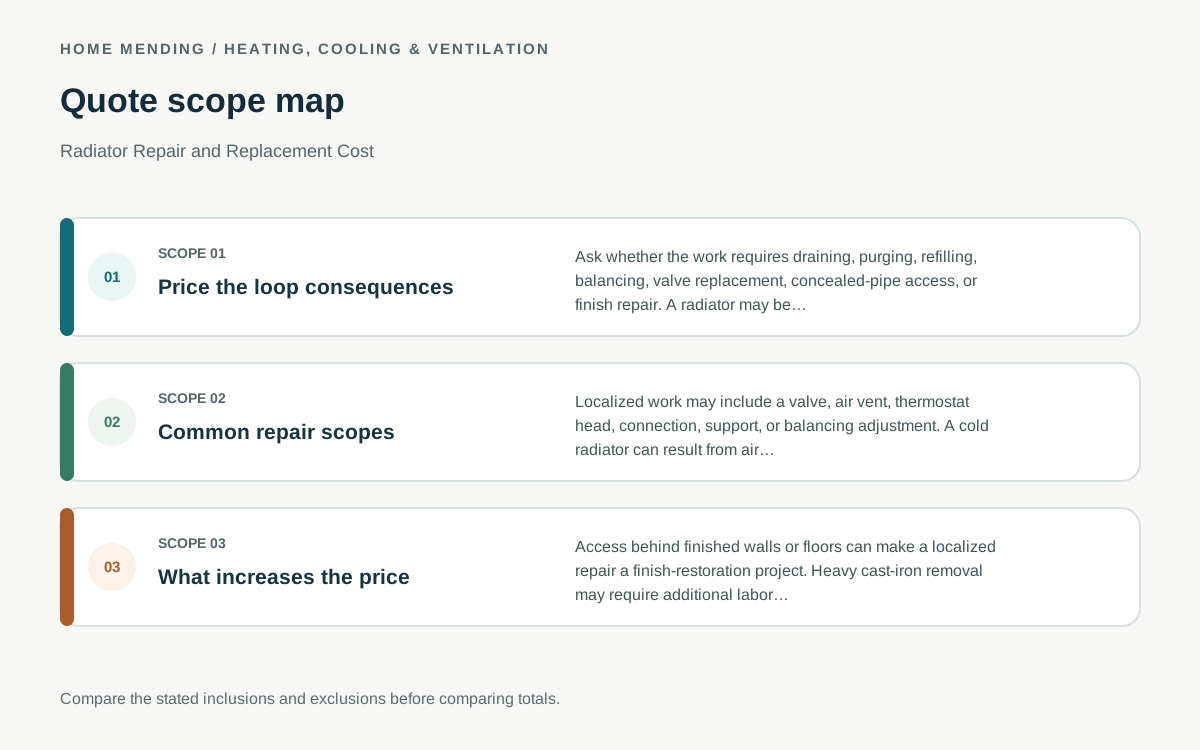
Price the loop consequences
Ask whether the work requires draining, purging, refilling, balancing, valve replacement, concealed-pipe access, or finish repair. A radiator may be easy to replace while its connections or the wider loop are not. A cold radiator may also reflect circulation, air, controls, or boiler performance.
Compare a bounded valve or fitting repair with radiator replacement and broader hydronic correction. Include the remaining condition of the radiator, pipe, controls, and service access. A long-term owner may value preserving a sound emitter, while repeated leaks or difficult access can support a larger scope.
Separate the emitter from the loop
A radiator that is cold, noisy, or leaking may have a valve, vent, fitting, circulation, air, control, balance, boiler, or concealed-pipe problem. Ask what observation identifies the radiator itself and whether the wider loop is being checked. Replacing an emitter will not cure a system-wide flow problem.
Compare a valve or fitting repair, radiator replacement, concealed-pipe work, and broader hydronic correction. Include draining, purging, access, removal, disposal, finish restoration, testing, balancing, and future service. A long-term owner may value preserving a sound radiator; a difficult access project may change the economics even when the replacement part is inexpensive.
A leaking valve or vent may be a small replacement; a leaking body or concealed connection can require draining, access, finish restoration, and balancing. A cold radiator may need a valve, air, flow, zone, boiler, or control diagnosis. A noisy steam radiator requires system-specific attention rather than an automatic new unit.
Ask for the expected outcome, residual condition, radiator and connection match, access, removal, finish work, testing, and warranty. If several rooms are affected, compare a broader hydronic assessment before repeating local replacements.
Radiator work ranges from a valve or vent repair to a leaking section, full radiator replacement, removal and reinstallation, or a wider boiler and distribution investigation. The active evidence does not establish a reliable universal radiator price. The useful estimate depends on whether the system is steam or hot water, the radiator material and size, access, finish restoration, and whether the radiator is actually the source of the comfort problem.
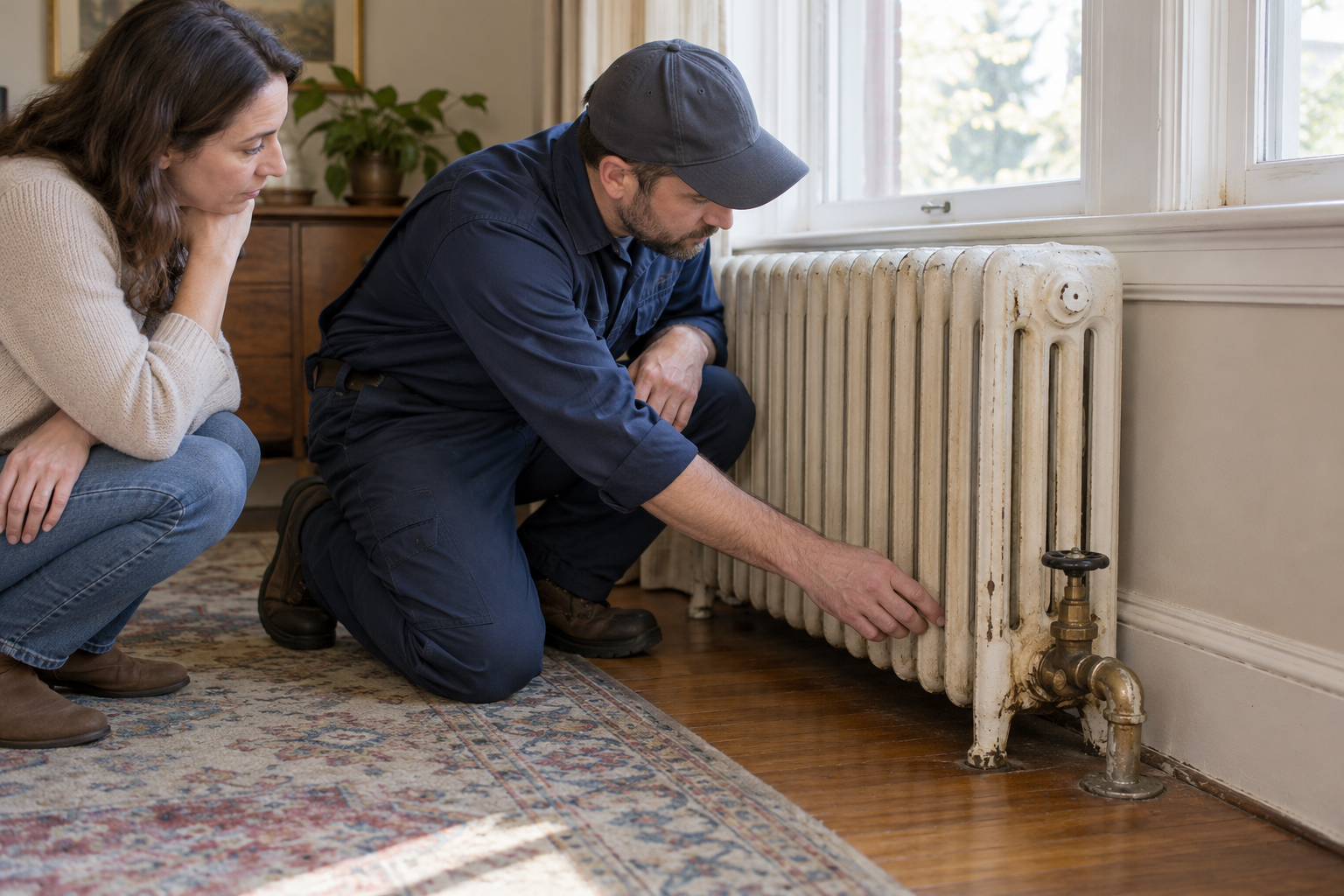
Common repair scopes
Localized work may include a valve, air vent, thermostat head, connection, support, or balancing adjustment. A cold radiator can result from air, flow, a closed or failed valve, control, boiler operation, or distribution balance. A leak may be at a fitting, valve, pipe, section, or radiator body. Diagnosis matters before ordering a replacement.
Steam and hot-water radiators are not interchangeable by appearance. Their valves, air management, connections, and operating behavior differ. Ask the contractor to identify the system and the component being replaced.
What increases the price
Access behind finished walls or floors can make a localized repair a finish-restoration project. Heavy cast-iron removal may require additional labor and protection. A replacement may require matching dimensions, connections, output, valves, and controls. If the new radiator changes heat output, the room and system balance may change as well.
The boiler and distribution interface matters. Replacing one radiator will not correct a boiler capacity problem, circulation issue, poor insulation, or a design deficiency. If multiple rooms are affected, price a system diagnosis rather than repeating local replacements.
Repair and replacement scenarios
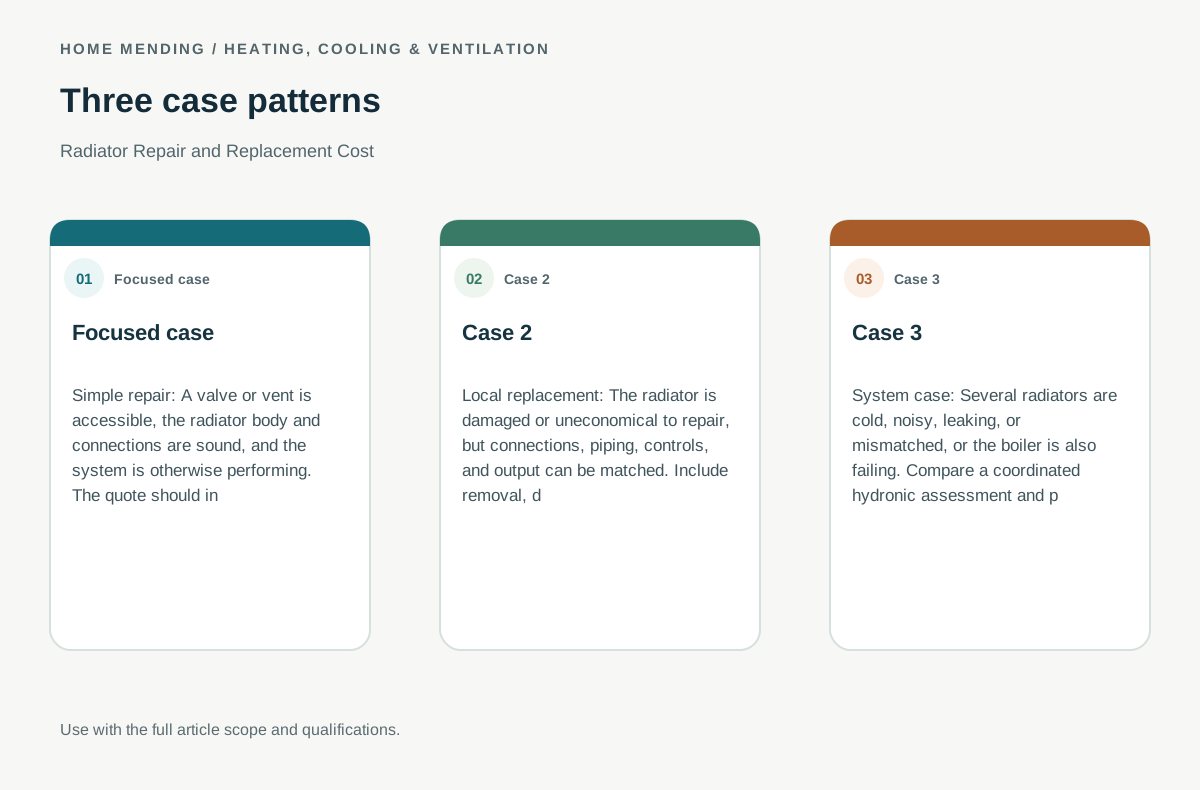
Simple repair: A valve or vent is accessible, the radiator body and connections are sound, and the system is otherwise performing. The quote should include parts, labor, testing, and cleanup.
Local replacement: The radiator is damaged or uneconomical to repair, but connections, piping, controls, and output can be matched. Include removal, disposal, finish protection, and any balancing.
System case: Several radiators are cold, noisy, leaking, or mismatched, or the boiler is also failing. Compare a coordinated hydronic assessment and possible boiler work. Do not disguise a distribution redesign as a radiator unit price.
Restoration and legacy context
Older radiators may be repairable, reusable, or desirable to retain, but preservation-driven decisions can involve a historic-home scope. If the dominant question is protecting historic fabric or matching a legacy system, that context belongs in the historic and legacy category. Ordinary repair economics remain here.
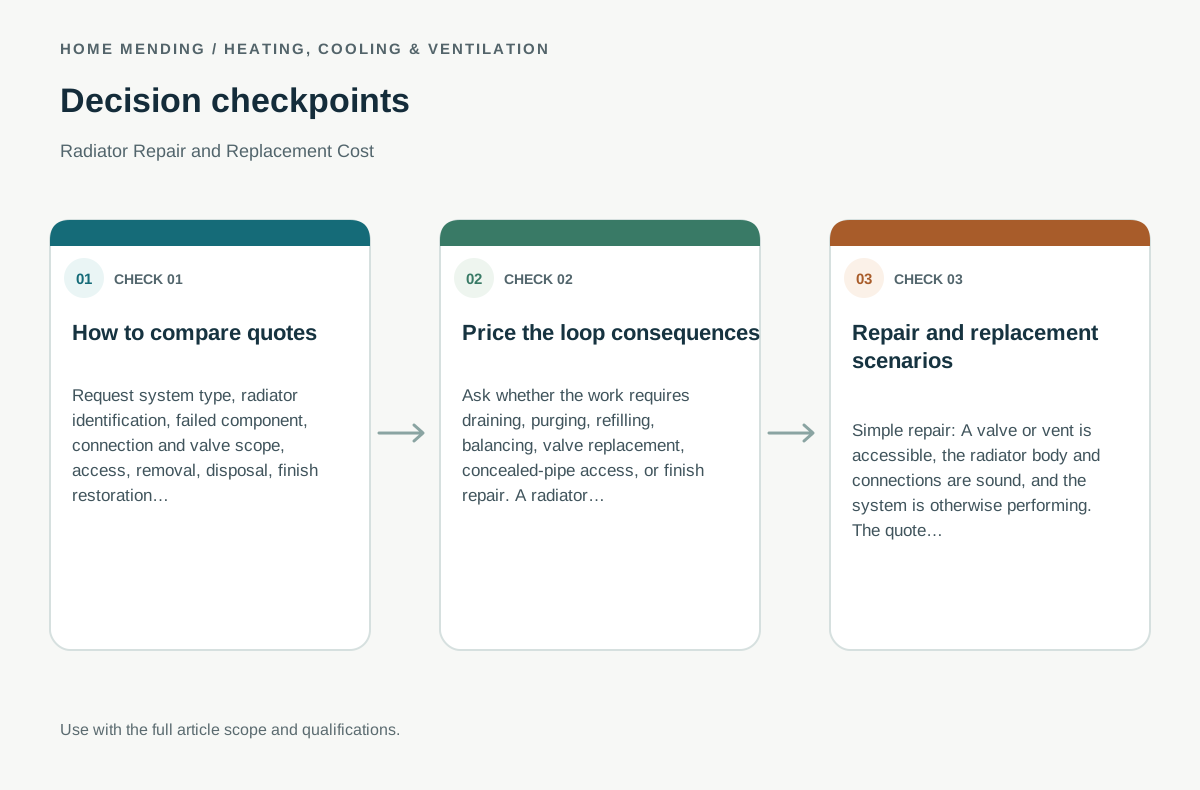
How to compare quotes
Request system type, radiator identification, failed component, connection and valve scope, access, removal, disposal, finish restoration, balancing, boiler assumptions, and warranty. Ask what condition is being retained and whether the work changes room output. If a contractor recommends replacing several radiators, ask what evidence shows the radiator rather than the boiler, flow, control, or envelope is the common cause.
Repair when the failure is localized and the system has a credible service horizon. Replace when the radiator body or connections are not economical to restore, the new unit can be matched, and the surrounding work is understood. Escalate to a wider boiler or envelope decision when the same comfort or moisture problem appears across the home.
Match the replacement to the system
Ask for radiator type, system type, connection size and position, control, dimensions, heat-output assumption, valve, access, removal, and finish restoration. A steam radiator and a hot-water radiator may look similar while requiring different connections and air management. A modern panel radiator may alter room output and balance.
If several radiators are cold, noisy, or leaking, investigate the boiler, circulation, controls, distribution balance, and building heat loss. Replacing one visible radiator can be a poor investment when the common cause is elsewhere. If retaining original fabric is the main concern, a preservation-driven legacy-home decision may require a different scope.
Set the repair boundary
A leaking valve or vent may be a small replacement; a leaking body or concealed connection can require draining, access, finish restoration, and balancing. A cold radiator may need a valve, air, flow, zone, boiler, or control diagnosis. A noisy steam radiator may require system-specific attention rather than a new radiator.
Ask for the expected outcome and residual condition. If the repair is one room in a home with several comfort complaints, compare a broader hydronic assessment. If a replacement changes size or output, ask how balance and room temperature will be checked afterward.
Use an allowance only for a genuinely concealed condition. The quote should identify the radiator, connections, valve, access, removal, disposal, finish work, testing, and warranty.
Distinguish the radiator from the hydronic fault
A cold radiator can reflect a valve, air, circulation, control, balancing, or boiler issue rather than a failed radiator. A leak may be at the body, valve, fitting, or concealed piping. Ask what was observed and whether the rest of the loop was tested before choosing replacement. Replacing a sound radiator will not fix a system-wide distribution problem.
A focused repair may cover a valve, vent, fitting, support, or accessible section. A difficult project may require draining, removing finishes, replacing concealed pipe, restoring walls or floors, and balancing afterward. Compare repair, radiator replacement, and alternate heat distribution on the same room coverage and disruption assumptions. If the radiator is obsolete or several components are failing, include parts availability and future service in the ownership decision.