
Illustrative planning scenario (U.S. dollars, September 2026)
This is a transparent planning example, not a market average: assume $300 for diagnosis, $500 for an accessible repair, and $900 if a 12-foot damaged section must be replaced with draining, refilling, and testing. The example totals $1,700 before wall or floor restoration; confirm the loop and finish scope in the quote.
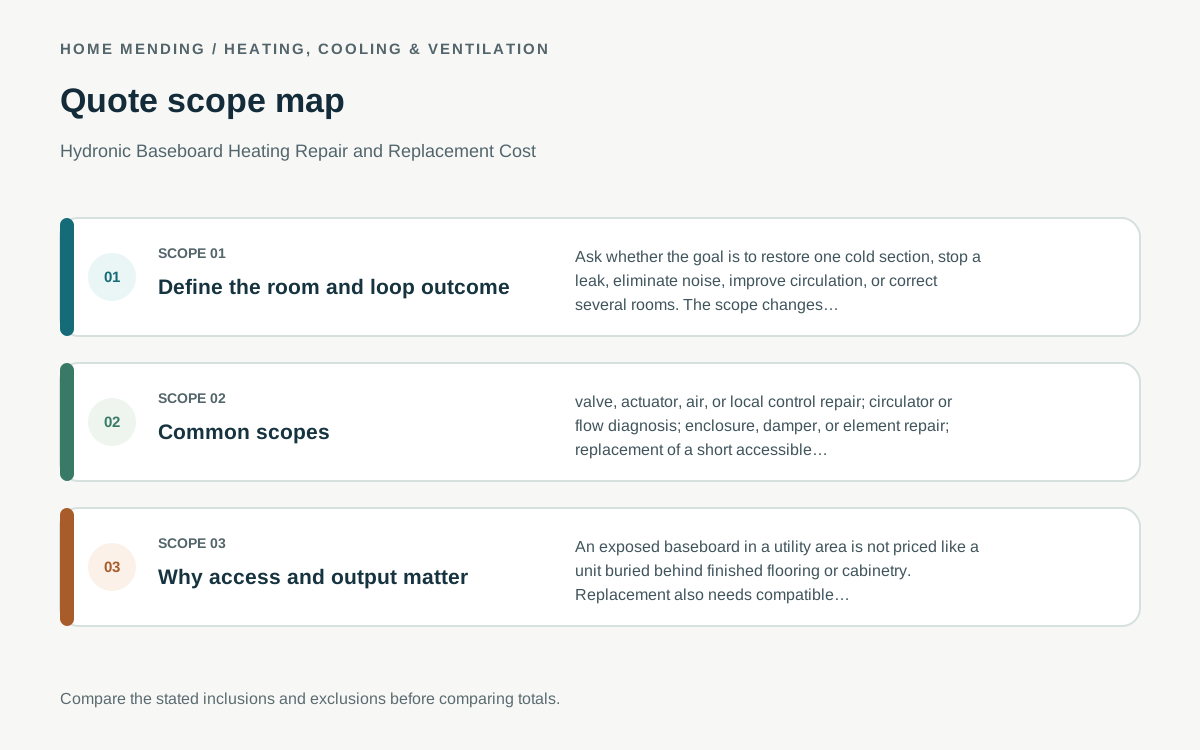
Define the room and loop outcome
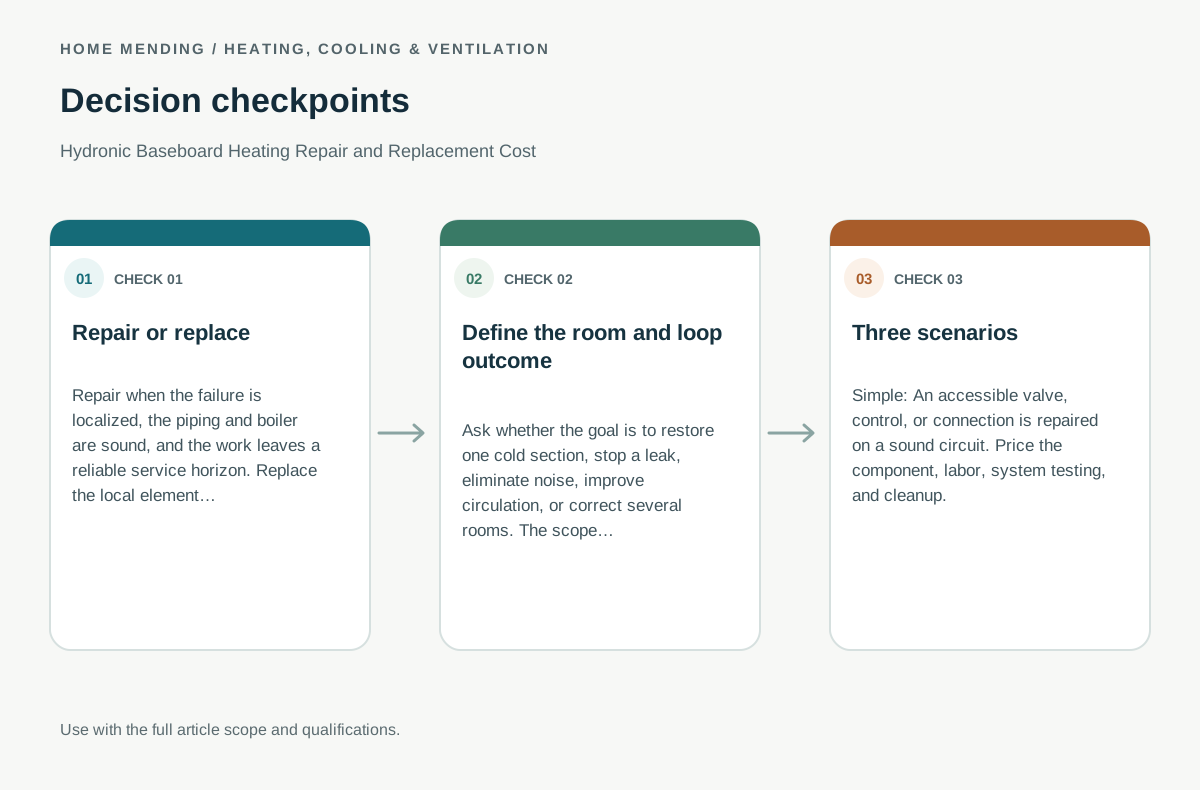
Ask whether the goal is to restore one cold section, stop a leak, eliminate noise, improve circulation, or correct several rooms. The scope changes depending on whether the cause is a valve, air, pump, control, boiler, balance, concealed pipe, or the baseboard itself. A component quote should not imply that the wider hydronic system was assessed.
Compare repair, section replacement, concealed-pipe work, and broader system correction on draining, purging, access, finish restoration, testing, balancing, and future service. If a boiler or control replacement is also near, show how the baseboard decision fits that sequence. The lowest immediate price may create repeat access and finish costs.
Follow the water path
Cold baseboard, noise, or leakage may originate at the element, valve, fitting, air, circulation, control, boiler, or distribution balance. Ask whether the repair will isolate the room from the wider loop and whether draining, purging, refilling, and testing are included. A local component replacement is not a system diagnosis.
Repair is stronger when the section or valve is accessible and the loop is otherwise sound. Compare replacement or broader hydronic work when corrosion, repeated leaks, inaccessible piping, or several cold rooms are present. Include wall and floor access, finish restoration, balancing, and future service in the comparison rather than treating the baseboard piece as the complete cost.
Ask whether the contractor checked the thermostat or zone, air and circulation, valve and actuator, boiler operation, and accessible piping. If the baseboard is hot but the room is cold, the problem may be heat loss, windows, air leakage, or insufficient emitter length. If it is cold, flow or control is plausible but still requires diagnosis.
Have the proposal state draining, purging, fittings, wall or floor opening, finish restoration, testing, and balancing. Repeated service on one circuit is a signal to price the underlying system.
Hot-water baseboard work can be a small local repair or a broader hydronic diagnosis. A leaking valve, damaged enclosure, trapped air, failed zone control, poor circulation, or damaged element may all produce a cold or noisy room. The active evidence does not support a dependable universal baseboard price, so the estimate should be built from the actual component, access, piping, and system condition.
Identify the problem class
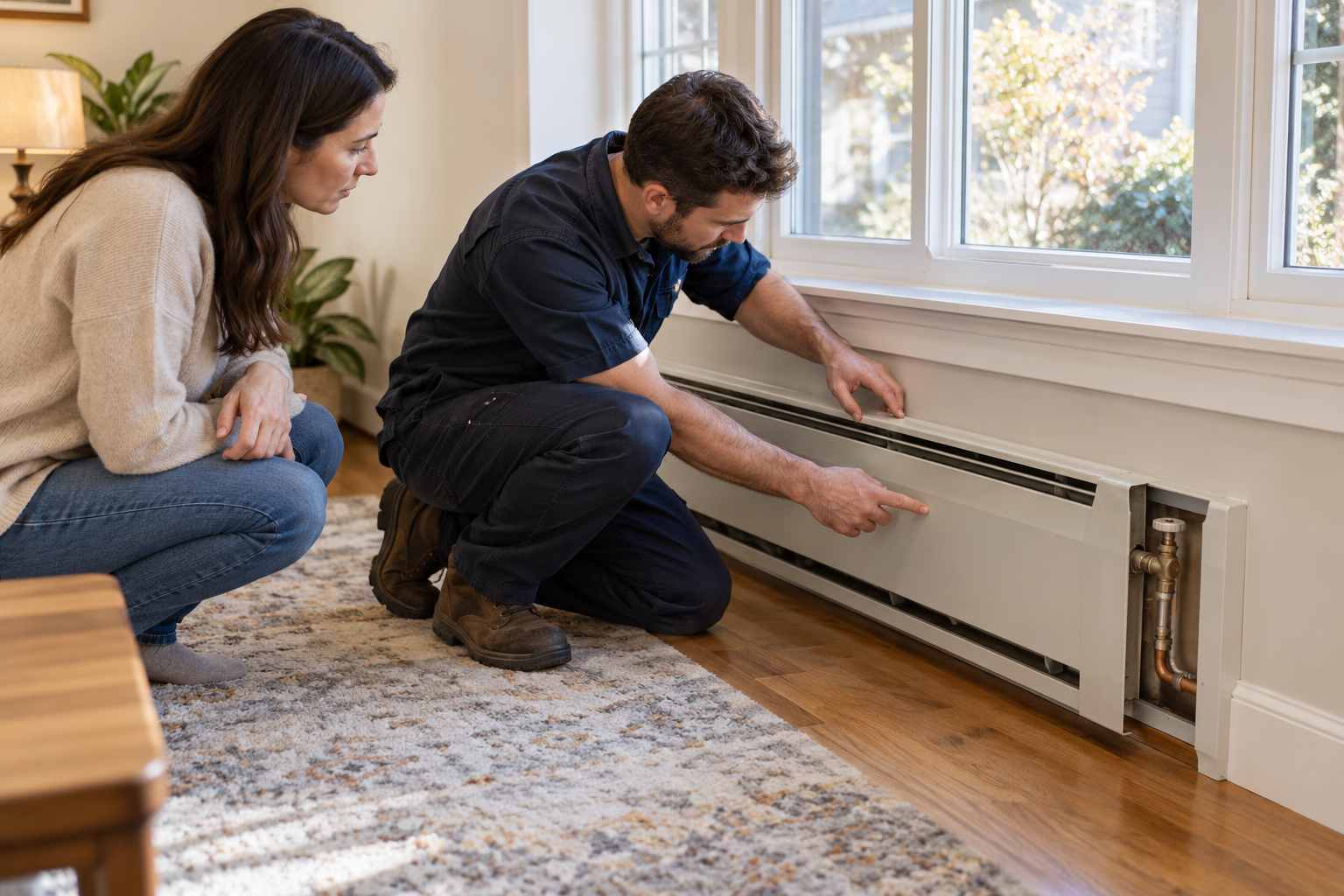
A cold baseboard does not prove the element has failed. Causes can include a thermostat or zone control, air, flow restriction, circulator, valve, boiler operation, pipe damage, or room heat loss. A leak may be at a fitting, valve, pipe, or element. The first paid service may therefore be diagnosis rather than replacement.
Do not drain, open, or pressurize a hydronic system without qualified guidance. Pressure, hot water, fuel, combustion, and electrical work have safety implications.
Common scopes
- valve, actuator, air, or local control repair;
- circulator or flow diagnosis;
- enclosure, damper, or element repair;
- replacement of a short accessible section;
- concealed piping repair requiring wall or floor access;
- local balancing or boiler-system investigation.
Ask whether the quote includes draining and refilling, purging, fittings, access, finish repair, testing, and any balancing. A baseboard-only total may exclude the reason the circuit is not heating.
Why access and output matter
An exposed baseboard in a utility area is not priced like a unit buried behind finished flooring or cabinetry. Replacement also needs compatible length, connection, control, and heat-output assumptions. A visually similar product may not deliver the same result or fit the existing piping.
If several rooms are cold, replacement of one element may not solve the problem. The common cause may be flow, zoning, boiler capacity, air leakage, insulation, or a control strategy. Keep building-envelope work separate when heat loss is the dominant issue.
Three scenarios
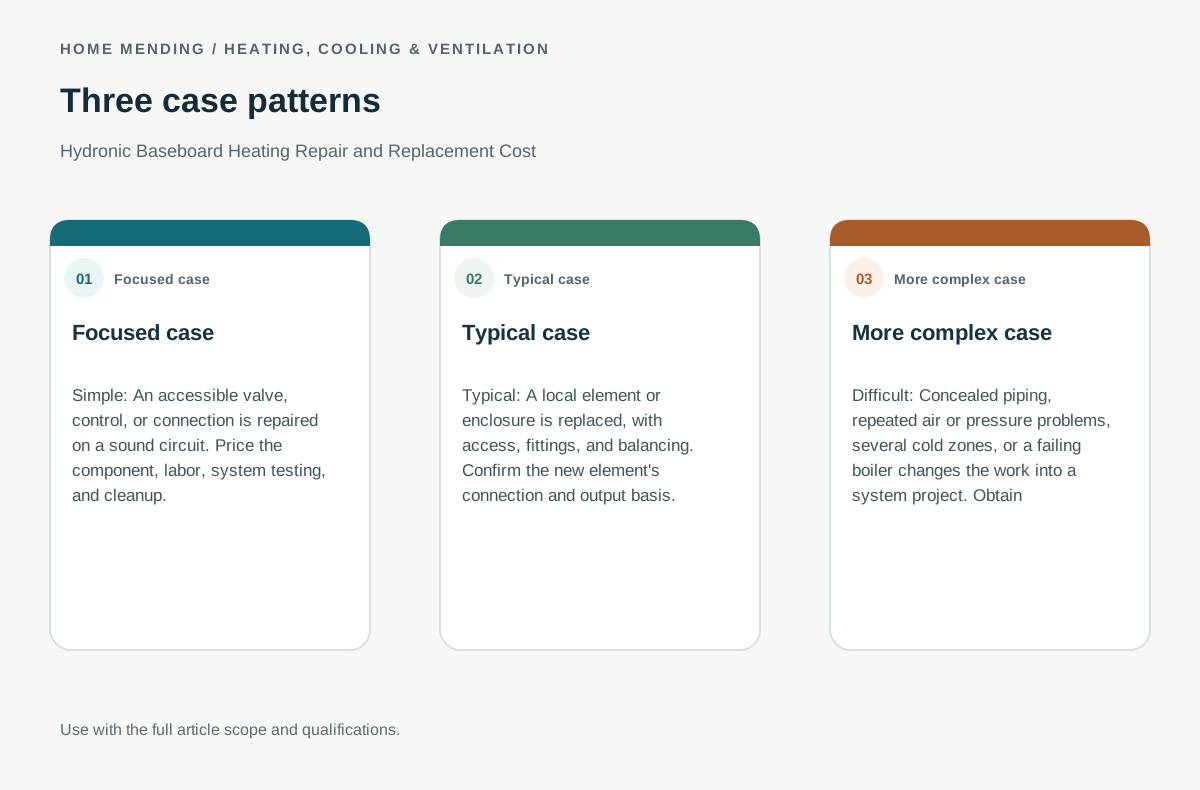
Simple: An accessible valve, control, or connection is repaired on a sound circuit. Price the component, labor, system testing, and cleanup.
Typical: A local element or enclosure is replaced, with access, fittings, and balancing. Confirm the new element’s connection and output basis.
Difficult: Concealed piping, repeated air or pressure problems, several cold zones, or a failing boiler changes the work into a system project. Obtain a hydronic diagnosis and a separate boiler or envelope scope.
Repair or replace
Repair when the failure is localized, the piping and boiler are sound, and the work leaves a reliable service horizon. Replace the local element when repair is not durable or when its output and connection can be matched. Expand the investigation when local repairs repeat or comfort problems span multiple rooms.
For quote comparison, request the system type, affected zone, failed component, access method, piping and valve scope, finish restoration, balancing, boiler assumptions, warranty, exclusions, and an approval threshold for concealed work. The right baseboard budget explains whether you are buying a part, restoring a circuit, or correcting a wider heat-delivery problem.
Identify whether the heat source is involved
Cold or noisy baseboard does not always mean the element is defective. The cause may be air, a valve, circulation, control, blockage, boiler performance, distribution balance, or a leak. Ask whether the technician will isolate the room-level component from the wider hydronic system. If several rooms have the same symptom, a local repair may not resolve the problem.
Repair is strongest when the valve, section, fitting, or support issue is bounded and the loop can be restored and tested. Replacement is more defensible when corrosion, repeated leaks, inaccessible piping, or a larger boiler or control problem is present. Compare access, draining and refilling, finish work, testing, and future service rather than a radiator or baseboard part alone.
Repair when the circuit is sound and the fault is localized. Repeated service on the same circuit is a signal to price the underlying system, not simply another element.