
Canadian specialist guidance places a broad geothermal heat-pump example around CAD $20,000–$40,000. That range is a planning signal, not a site quote. The ground loop, drilling or excavation, soil and groundwater conditions, land access, indoor equipment, distribution, controls, permits, restoration, and local design work can dominate the price. Geothermal is an HVAC decision with a substantial site-infrastructure layer.
Show the project in cost layers
Separate feasibility or design, loop field, excavation or drilling, headers, indoor equipment, electrical, controls, backup, duct or hydronic connections, removal, restoration, testing, and commissioning. This avoids treating a site-work allowance as if it were equipment cost and lets the homeowner compare an air-source alternative on the same basis.
Ask what is known before construction and what remains uncertain. A simple site with open access and compatible distribution is not comparable with a constrained property or a house whose load will change after envelope work. The decision is strongest when the owner expects to hold the property long enough to use the system and the loop and service path remain credible.
Treat feasibility as part of the investment
Before comparing equipment, document the available ground area, drilling or trenching assumptions, access for machinery, restoration, loop type, headers, indoor equipment, electrical, controls, backup, and service path. A ground-loop price is not portable from one property to another. If the site has rock, paving, landscaping, limited access, or uncertain subsurface conditions, price investigation and allowances separately.
The project may have a low-equipment case with an accessible loop field and compatible indoor equipment, a typical case with new loop work and restoration, or a difficult case where site work dominates. Ask what evidence changes the recommendation to air-source equipment or to retaining the existing system. A long ownership horizon can support more upfront work, but only if demand, site feasibility, serviceability, and operating assumptions are credible.
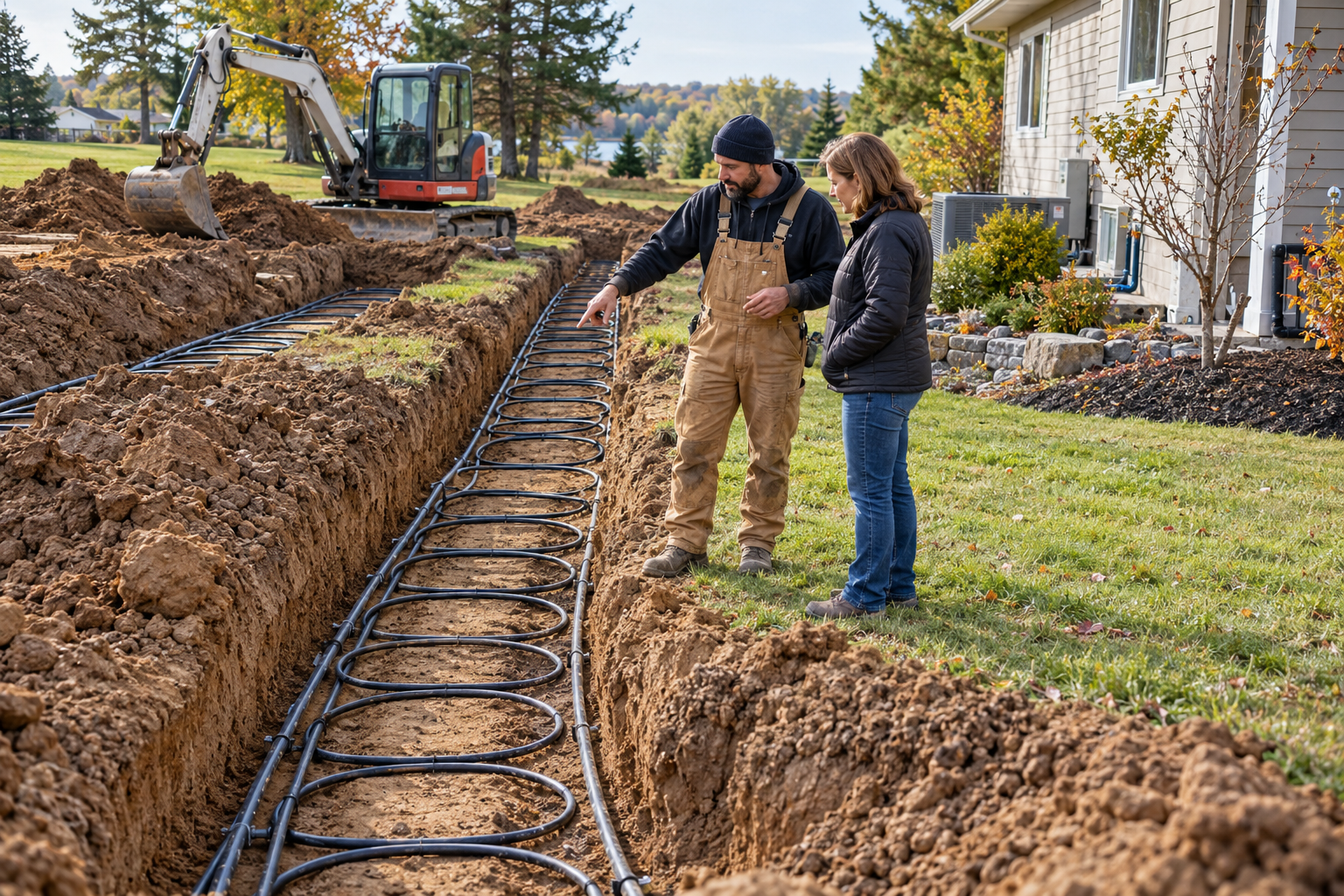
A ground-source system includes indoor heat-pump equipment, a ground heat exchanger or loop field, circulating pumps and controls, connecting piping, distribution, and electrical work. Loop configurations may be horizontal, vertical or borehole-based, open-loop, or another design suited to the site. The configuration is not a simple homeowner preference; feasibility and local professional design govern.
Why site conditions dominate
Land area, geology, drilling access, excavation, groundwater, rock, buried utilities, restoration, and local requirements can change cost dramatically. A small accessible lot may favor a different loop approach from a rural property with open land. A loop field may require landscaping, driveway, hardscape, or interior access work that should be priced separately.
DOE and NRCan distinguish ground-source systems from air-source heat pumps and recognize that loop installation has different cost and service characteristics. Do not compare geothermal with an air-source equipment-only quote.
Cost layers
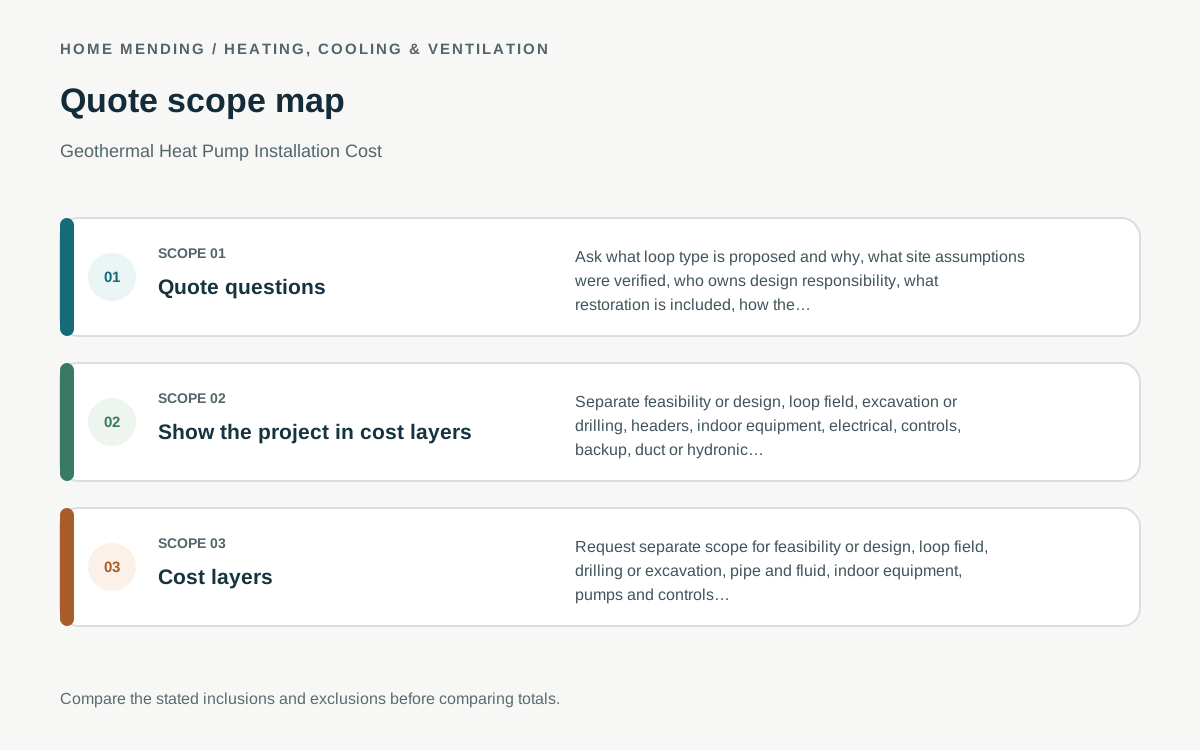
Request separate scope for feasibility or design, loop field, drilling or excavation, pipe and fluid, indoor equipment, pumps and controls, distribution, electrical, trench or borehole restoration, removal of existing equipment, testing, commissioning, permits, and warranty. Local design and permit requirements vary; verify them with the qualified designer and authority.
Scenarios
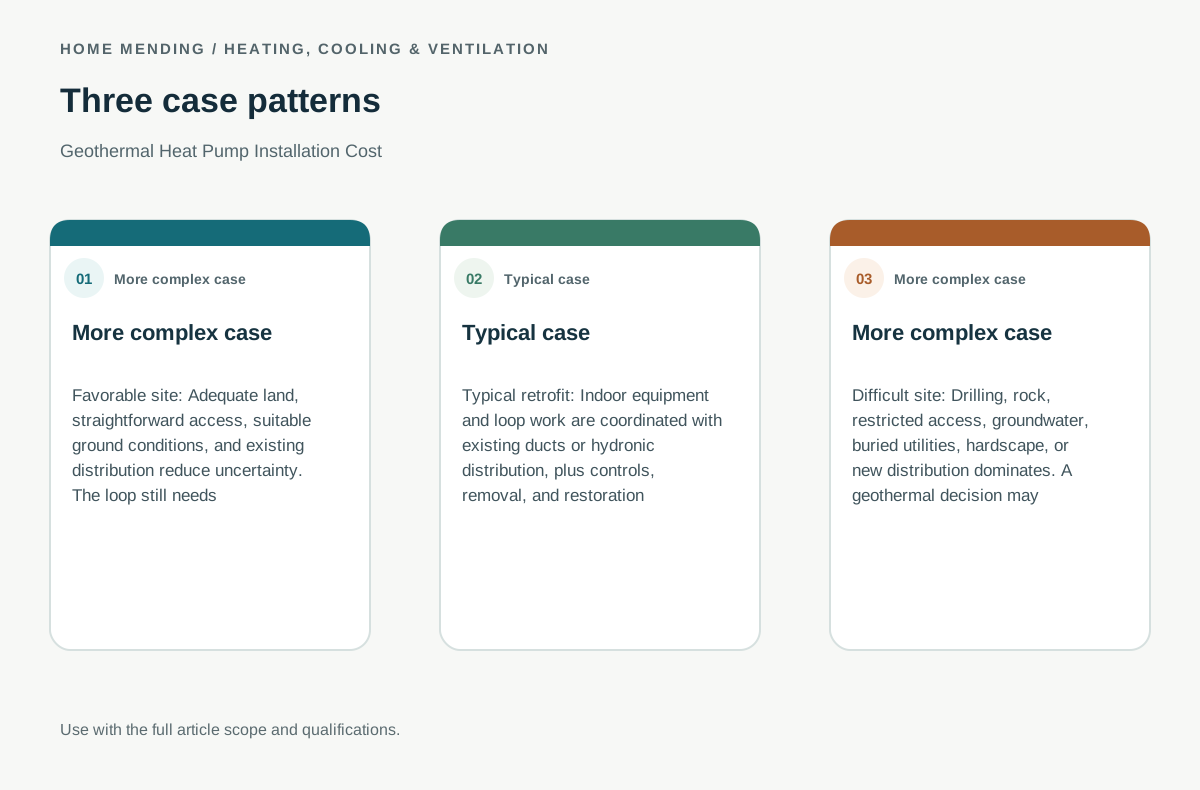
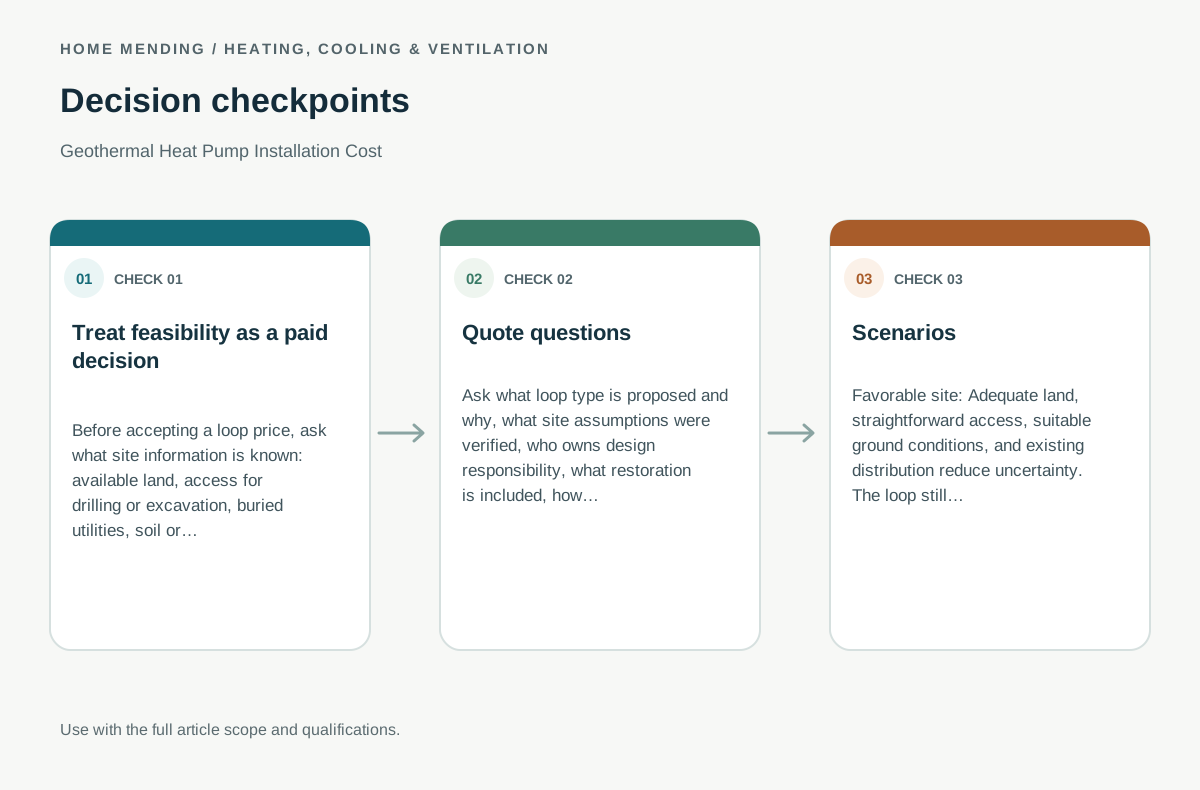
Favorable site: Adequate land, straightforward access, suitable ground conditions, and existing distribution reduce uncertainty. The loop still needs design and testing.
Typical retrofit: Indoor equipment and loop work are coordinated with existing ducts or hydronic distribution, plus controls, removal, and restoration. Price the interfaces explicitly.
Difficult site: Drilling, rock, restricted access, groundwater, buried utilities, hardscape, or new distribution dominates. A geothermal decision may be financially weaker than air-source equipment even when long-term performance is attractive.
Lifecycle economics
Compare installed cost, maintenance, loop and indoor-equipment service, electricity prices, competing fuel, climate, heating and cooling demand, ownership horizon, and financing. Do not promise a universal payback or treat an incentive as guaranteed. A long ownership horizon may make the site investment more defensible; a short horizon may favor simpler equipment.
Quote questions
Ask what loop type is proposed and why, what site assumptions were verified, who owns design responsibility, what restoration is included, how the indoor system matches the distribution, what testing and commissioning occur, and what warranty applies to indoor and buried components. Keep major excavation, hardscape, and specialized design scopes visible.
Geothermal is worth pricing when the property can support a sound loop design and the household values its long-term system economics. The honest budget is a site-specific project range, not a multiplied equipment price.
Treat feasibility as a paid decision
Before accepting a loop price, ask what site information is known: available land, access for drilling or excavation, buried utilities, soil or rock assumptions, groundwater, restoration, and distribution. A feasibility or design service may be separate from construction. That is useful when it prevents an expensive loop proposal from being based on an unverified site.
Compare against air-source equipment
An air-source alternative may have a lower site-installation burden, while geothermal may offer a different long-term operating or ground-loop strategy. Compare complete installed scope, electrical, distribution, controls, removal, maintenance, service, restoration, and ownership period. Do not compare the geothermal loop-plus-equipment price with an air-source cabinet alone.
Protect the handoff
Request loop drawings, testing, fluid or pressure records as applicable, indoor equipment data, commissioning, warranty boundaries, and restoration responsibility. Buried infrastructure is difficult to inspect after the fact; documentation has economic value for future service and resale.
Separate feasibility, construction, and restoration
Ask for a feasibility or design scope before construction, then identify the loop field, indoor equipment, distribution, electrical, controls, testing, commissioning, restoration, and warranty. A proposal can be technically complete while still excluding driveway, landscape, irrigation, or finish repair. Those exclusions materially affect the homeowner’s total.
The system may be more defensible for a long-term owner with significant heating and cooling demand and a feasible site. A short-term owner or difficult site may favor air-source equipment even if geothermal operating economics look attractive. Use local utility and fuel assumptions, but do not subtract unverified incentives from the budget.
Treat the ground loop as a separate risk
The loop field, drilling or excavation, trenching, headers, restoration, permits or design services where applicable, and access logistics can dominate the project. Request a site-specific feasibility scope before treating an installation price as firm. A difficult access route, rock, limited yard, landscaping, or a need to restore paving can change the economics without changing the heat-pump cabinet.
For a long ownership horizon, compare expected heating and cooling demand, loop serviceability, controls, pumps, auxiliary heat, and future equipment replacement with an air-source alternative. For a shorter horizon, the construction disruption and recovery of the initial investment may matter more. Do not promise a universal payback; make the assumptions about load, energy prices, site, and maintenance visible.