
Soil treatment, moisture management, excavation, and structural support are distinct scopes that may interact on one property. No dependable national installed range is supported for that combination; compare site-specific proposals that identify the investigation, treatment limits, structural work, monitoring, access, and restoration.
Published price context
HomeGuide’s U.S. foundation guide lists US$5,000–US$10,000 for structural stabilization using braces or anchors; that is not an installed-price estimate for soil treatment or ground improvement. A useful ground-work proposal identifies the soil condition, treatment method, depth and area, investigation basis, equipment, monitoring, and the separate structural support scope.
Soil work is not one product
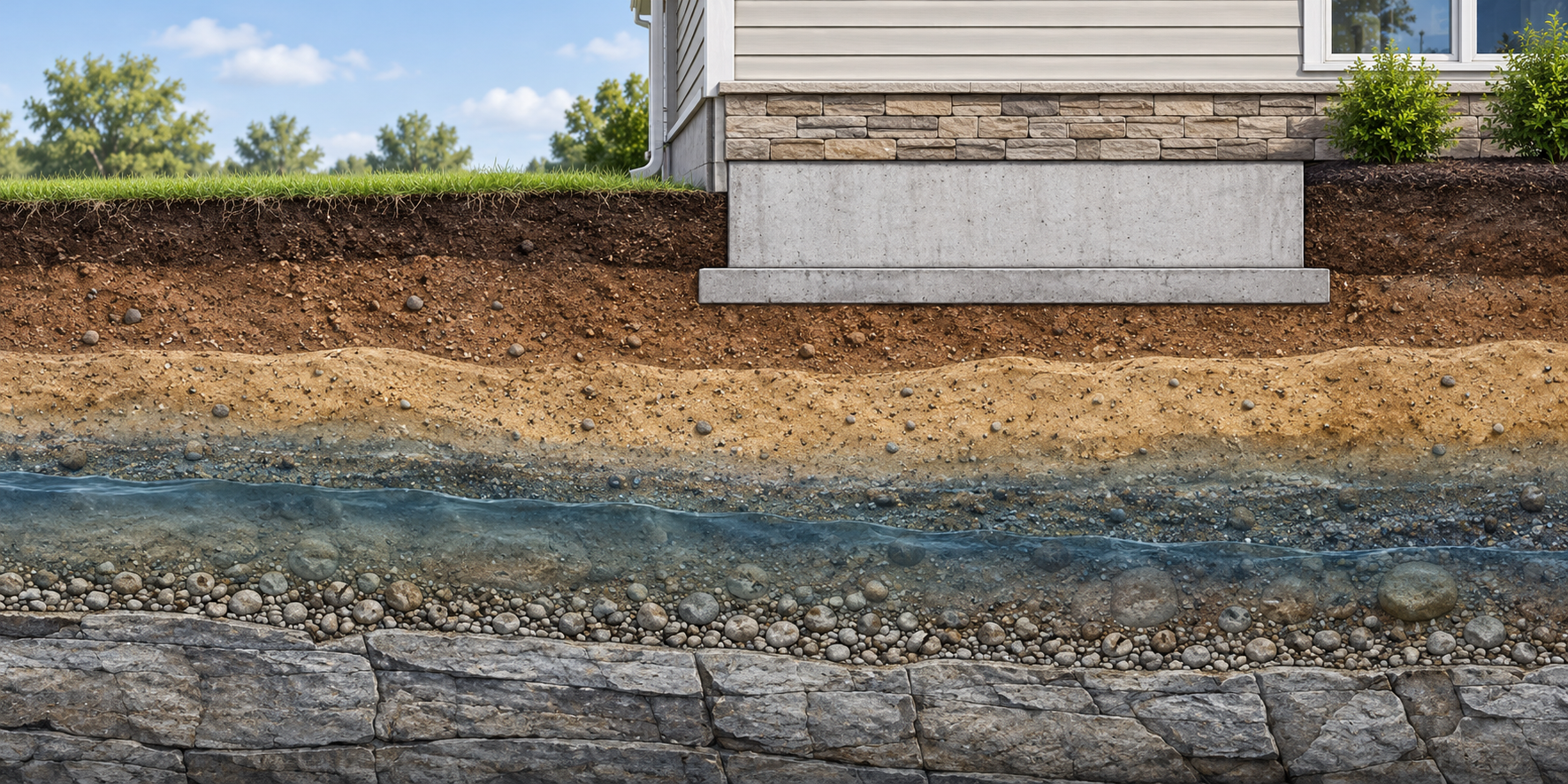
USGS describes several loss-reduction approaches for expansive soils: avoid the condition where possible, remove and replace soil where economical, control moisture, and use chemical stabilization in suitable soil. Those approaches differ in depth, area, equipment, monitoring, and permanence. “Stabilization” is not enough information to compare bids.
Soil work can be preventive, corrective, or enabling. It may protect a new support system, reduce moisture-driven movement, improve bearing, or address a ground-failure zone. It may also be unnecessary if the observed defect is actually a framing or foundation condition with a different cause.
When it becomes part of a structural project
Soil stabilization becomes economically material when the ground mechanism is causing settlement, heave, lateral movement, voids, or recurring support changes; when excavation exposes poor or variable fill; or when a repair cannot achieve a credible outcome without changing the support condition. The structural and geotechnical scopes should still be separated in the budget.
Removal and replacement may be economical for a shallow, bounded zone but not for a deep expansive layer. Moisture control can be less disruptive than excavation in one setting and inadequate in another. Underpinning may transfer load without correcting all ground movement. The choice needs site-specific design.
Cost drivers
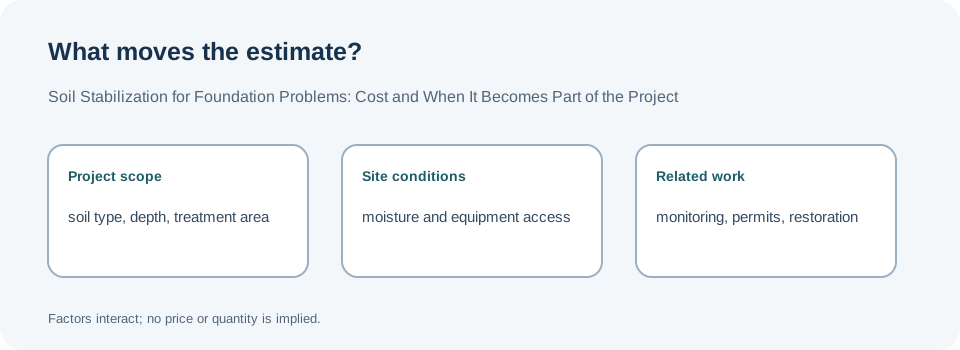
 The main drivers are soil type and depth, treatment area, moisture and groundwater, access, equipment, excavation and disposal, adjacent structures, utilities, monitoring, engineering, permits, season, haul distance, and restoration. Local market evidence is particularly weak because quantities and methods are not standardized.
Scenario budgeting
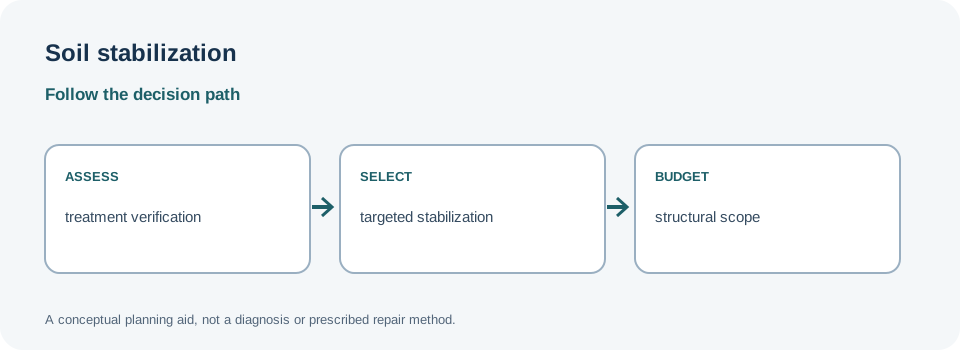 Limited correction: A defined drainage or moisture problem affects a shallow area. Price the correction and the structural repair separately.
Coordinated repair: Settlement or heave requires a ground treatment plus piers, supports, or foundation work. Require a single sequence plan so each contractor’s exclusions are clear.
Extensive improvement: Deep or distributed soil, slope, groundwater, or access issues make excavation or specialized treatment a major project. Carry a substantial investigation and contingency allowance.
How to compare proposals
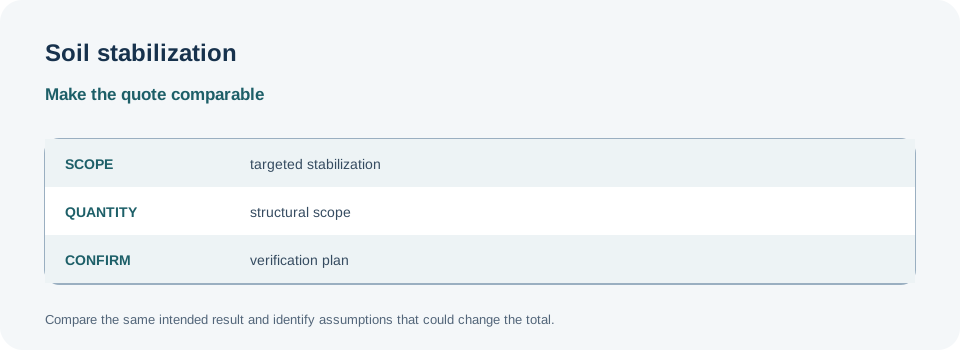 Ask for the soil condition being addressed, investigation basis, treatment type, depth and area, equipment and disposal, moisture assumptions, monitoring, structural interface, engineering, permits, warranty, and what happens if actual soil differs. Avoid universal claims about a chemical, injection, or replacement method.
Geotechnical investigation and structural design belong to professional-service decisions. The homeowner’s useful role is to compare the mechanism, intended outcome, remaining uncertainty, and total project boundary—not to select a ground-treatment recipe from a price sheet.
Put uncertainty into the contract
For variable soil, require a base scope, a defined allowance, and a process for testing or documenting additional quantities. The proposal should state what happens if the treated depth is greater, groundwater is present, access changes, or the structure needs more support than expected. A broad contingency with no measurement rule transfers uncertainty without controlling it.
Compare the cost of treating soil now with the cost of repeated structural repairs and repeat excavation. That comparison is meaningful only when both options use the same assumptions about drainage, support, monitoring, and restoration. Do not pay for an unbounded promise of “stability” without a stated outcome.
Decide when investigation is worth paying for
Investigation has economic value when the choice among removal, moisture control, stabilization, underpinning, or reconstruction would materially change the project. Ask what decision the investigation will inform and what evidence is already available. A report is not a guarantee of a particular repair price, but it can prevent a method from being selected on a symptom alone.
For a short horizon, limit the scope to the ground work needed for a defined repair when the mechanism is well understood. For a long horizon, include monitoring, future access, recurrence risk, and the cost of repeat excavation. Keep landscaping, drainage, engineering, and structural construction as identifiable budget layers.
Turn a ground proposal into measurable work
Request the soil or moisture condition being addressed, the treatment area and depth, the investigation basis, equipment, disposal, monitoring, structural interface, engineering, permits, and restoration. Ask what field result changes the method or quantity. A generic “stabilize the soil” line cannot be compared with a defined ground-improvement scope.
The best economic comparison includes repeat structural repair, repeat excavation, and the cost of preserving access. Treatment may be worthwhile when it reduces a known mechanism; it may be unnecessary when the symptom belongs to another structural layer. Keep site drainage, geotechnical work, and structural construction distinct.
A practical quote comparison
Request treatment area and depth, soil or moisture condition, investigation basis, equipment, disposal, monitoring, structural interface, engineering, permits, and restoration. Ask what field observation changes the quantity or method. Without those details, two “soil stabilization” bids may not be comparable at all.
Compare ground treatment with structural underpinning, moisture correction, or repeat repair only after defining the same outcome. For long-term ownership, include future monitoring and access. For short-term ownership, keep the intervention bounded when the mechanism is well established and the residual risk is accepted.
Pay for information when it can change the method
Investigation has economic value when the result could change the support depth, treatment area, drainage design, access plan, or choice between stabilization and reconstruction. Ask what the proposed test, sampling, survey, or monitoring will answer and what construction decision follows from each likely result. A generic allowance for “soil work” is difficult to compare when no treatment boundary or performance objective is stated.
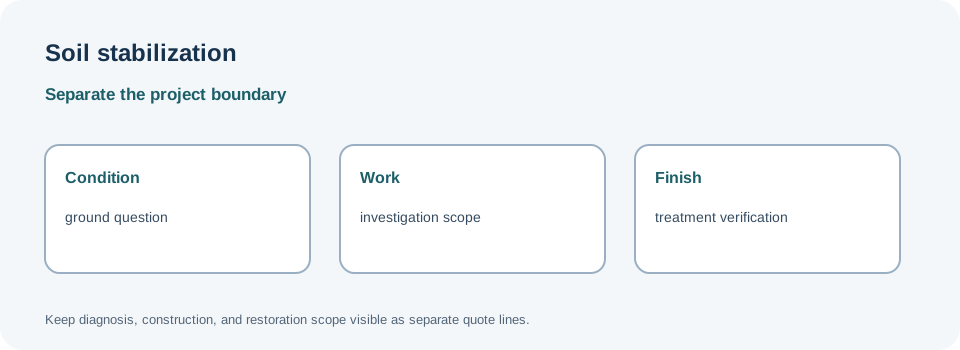
Separate investigation, design, treatment, structural repair, testing, and restoration. Ask how the contractor measures treated volume or area, verifies installation, handles refusal or unexpected material, and prices additional work. The lowest proposal may be reasonable for a known, accessible condition; it may be false economy when the ground behavior is the central uncertainty. A measurable investigation and change-order rule turns soil risk into a managed budget rather than an unexplained contingency.
Match the ground method to the decision it enables
Removal and replacement, moisture control, grouting or injection, compaction-related work, chemical stabilization, and deep support do not all solve the same ground problem. Some improve a shallow condition; some transfer building loads; some reduce moisture variation; and some are proposed only after investigation shows that the treatment is viable. The article’s evidence supports these as method families, not as interchangeable homeowner choices. Ask which project decision the proposed method is meant to support.
The scope should identify the soil or moisture condition, the affected depth and area, the building interface, and the expected post-work behavior. If the treatment is intended to protect underpinning or a foundation repair, price the structural work and the ground work as linked but distinct stages. If it is intended as a preventive site correction, keep it separate from a repair that is already required. This avoids paying for a general “stability” promise without knowing what changes at the house.
Make verification part of the budget
Ask how the contractor will document treated quantities, unexpected refusal, groundwater, access changes, or a different soil profile. A field result may change the treatment depth, equipment, disposal, support layout, or restoration. The contract should say who measures that change and when the owner approves it. Monitoring can be a useful deliverable when the method’s performance depends on moisture or seasonal conditions.
For a short horizon, a defined correction may be appropriate when investigation has narrowed the mechanism and the residual risk is accepted. For a long horizon, compare future monitoring, repeat excavation, access, and the consequence of treating only the symptom. The best soil proposal makes its limits measurable rather than claiming a universal installed outcome.
Keep the ground scope connected to the building scope
Soil treatment may be proposed because a foundation is settling, a slab is moving, a wall is displacing, or a support system cannot achieve its intended result on the existing ground. The structural proposal should say what ground condition it assumes, while the ground proposal should say what building outcome it enables. Without that connection, the homeowner may pay for soil work that does not address the structure or structural work that remains exposed to the same mechanism.
Ask whether drainage, grading, utilities, retaining work, excavation, disposal, and restoration are prerequisites or separate projects. A ground-improvement method can be technically plausible and still be uneconomic because access or quantity is wrong. A smaller defined treatment may be preferable to a broad promise when the affected area is known; a broader investigation may be worthwhile when the support condition varies across the site.
For long-term ownership, include records of treated areas, monitoring, future access, and the cost of repeat structural work. For short-term ownership, state the residual soil uncertainty and any conditions the owner is accepting. The decision is about a managed ground-and-structure outcome, not an isolated product or injection price.