
Slope, ground movement, access, and retaining conditions can change a foundation project before the repair itself is priced. Current evidence does not support a dependable national installed range for hillside work; compare site-specific proposals with the investigation, stabilization, excavation, shoring, drainage boundaries, and restoration stated.
Published price context
Published foundation guides do not isolate residential hillside work from the structural repair, equipment access, shoring, spoil handling, retaining or drainage interfaces, and surface restoration. A single range would combine different projects. Ask for separate amounts for the house repair, site access and stabilization, and related work, with the assumed slope and ground conditions stated.
A slope adds a site decision to the foundation decision
On a sloped site, settlement or cracking may involve the foundation, soil, surface water, groundwater, fill, retaining conditions, or movement of the slope itself. USGS ground-failure research shows why event and site conditions can materially affect residential repair losses, but event-specific findings are not a universal residential cost formula.
The repair must distinguish the building’s load path from site work. A foundation repair may be necessary while grading, drainage, retaining, soil stabilization, access, or landslide-related work remains separately required.
Why access can dominate
Limited staging, steep driveways, restricted equipment, material handling, excavation spoil, neighbor access, utility routes, and protection of landscaping can add cost before structural work begins. Shoring and temporary support may be needed, but their design and installation are high-consequence professional work.
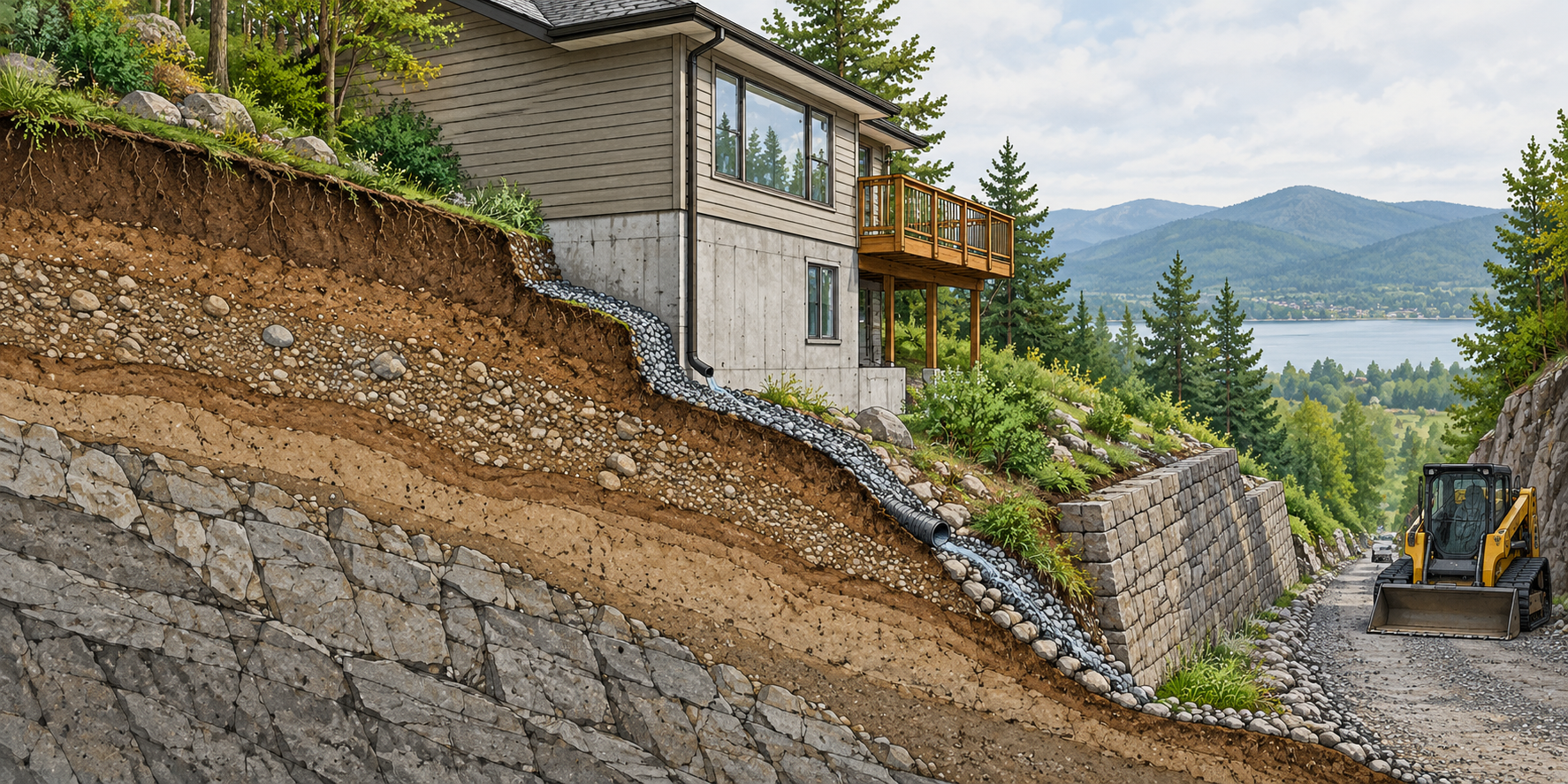
Drainage is often discussed alongside hillside repair. Keep roof runoff, surface grading, retaining drainage, and below-grade waterproofing separate from the structural scope while identifying dependencies. A low structural bid that assumes someone else will make the site stable is not comparable with a complete stabilization plan.
Cost drivers and scenarios
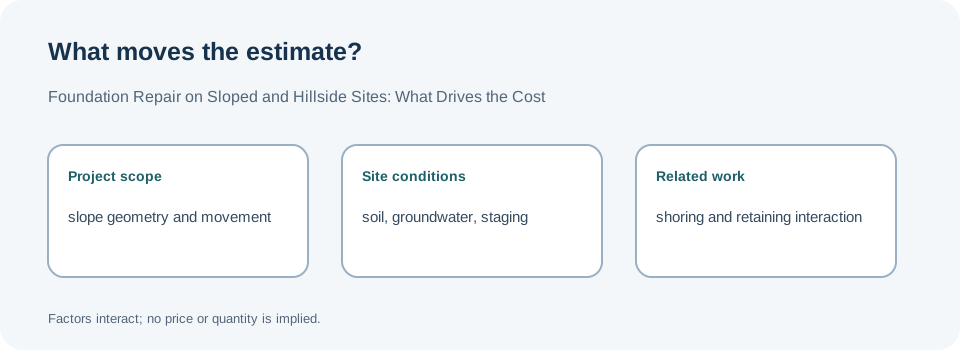
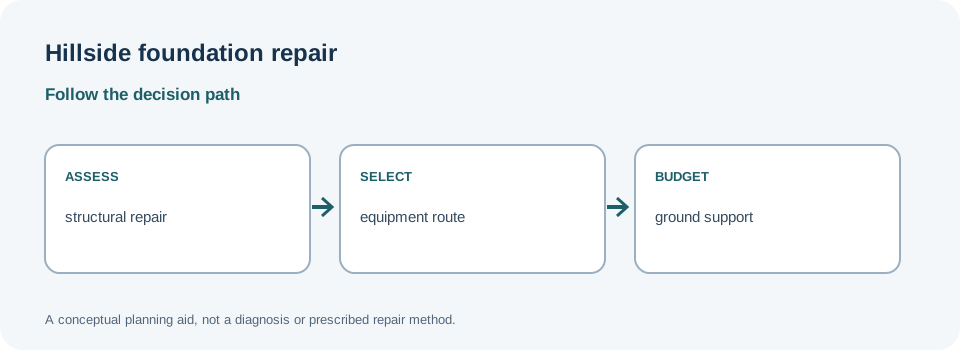
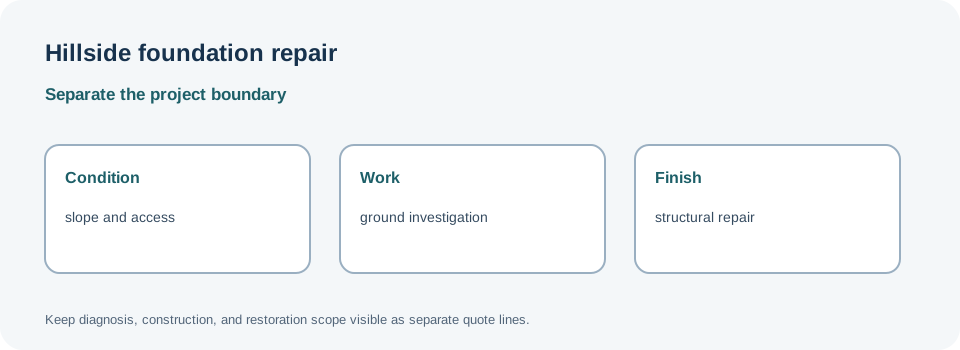 Drivers include slope geometry, soil and groundwater, movement extent, foundation type, excavation depth, access, shoring, support count, retaining interaction, utilities, engineering, permits, monitoring, disposal, and restoration.
Defined repair: A localized foundation defect is accessible and the slope condition is stable or independently addressed. The budget can remain focused, but the site assumptions must be stated.
Integrated stabilization: Foundation supports, drainage, excavation, and temporary support are coordinated. Compare the full sequence and who owns each interface.
Active or uncertain ground movement: The proposal involves ground improvement, retaining work, monitoring, broad underpinning, or relocation. Treat it as a major project with investigation and contingency rather than a normal foundation repair.
Quote questions
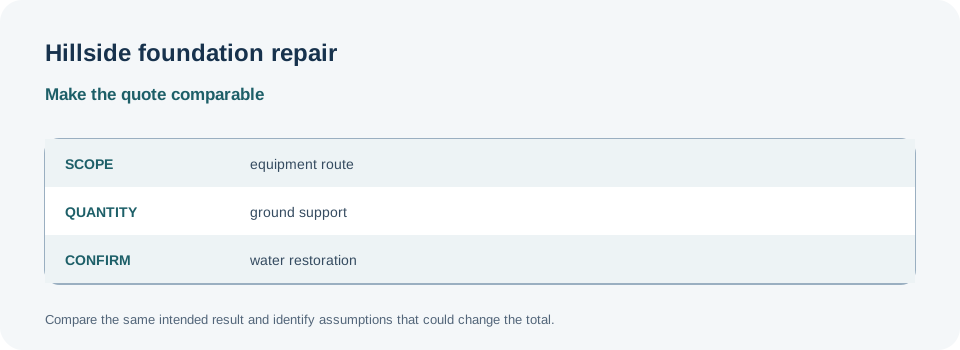 Ask what evidence supports the cause, whether a geotechnical or structural professional is involved, what movement is assumed, how equipment and spoil will be handled, who designs shoring, what drainage or retaining work is excluded, and how hidden ground conditions change price. Request separate stabilization and building-repair lines.
The best hillside budget makes site uncertainty visible. A contractor cannot remove that uncertainty by replacing it with a narrow fixed price.
Separate stable-site repair from active-ground work
Ask what evidence supports the assumption that the slope or retaining condition is stable. If the proposal depends on a geotechnical opinion, monitoring, drainage design, or shoring plan, price and schedule that work separately. A foundation contractor may be able to repair the building while not owning the site condition that caused the movement.
Compare a localized repair, a foundation stabilization, and a site-and-building intervention using the same access and restoration assumptions. Include spoil handling, equipment, neighbor or road access, utilities, landscape and hardscape restoration, and contingency. The most useful hillside quote is explicit about interfaces; its apparent precision should not conceal unpriced ground uncertainty.
Plan for the interface between site and house
The useful comparison is a sequence: protect and access the site, control water or ground conditions where designed, stabilize or repair the foundation, then restore surfaces and finishes. If those steps are assigned to different contractors, identify the handoff and the condition each trade assumes. Otherwise a drainage, retaining, or foundation dispute can become an unpriced change order.
Also compare the cost of preserving the existing building with partial reconstruction or a broader site solution. A small foundation repair may be false economy if it requires repeated access to a moving slope. Conversely, a full site intervention is not justified by a crack alone when the slope is stable and the structural defect is bounded.
Put site interfaces in writing
Ask who owns drainage, retaining conditions, soil investigation, shoring, access, spoil, utilities, landscape restoration, and monitoring. A structural contractor can repair the house while another scope controls the ground. Identify the handoff and the condition each trade assumes before accepting a combined “stabilization” price.
For long-term ownership, compare repeat access and active-ground risk with a broader site solution. For short-term ownership, a bounded foundation repair may be reasonable only if the slope condition is independently addressed or documented as stable. Do not turn a site-specific uncertainty into a false fixed price.
Access and stability are linked on a slope
On a sloped site, excavation, equipment placement, spoil handling, retaining, drainage, and temporary support can affect the house and the work area at the same time. A contractor may need a smaller machine, staged access, temporary stabilization, or a different sequence. The bid should state where equipment and materials go, who manages spoil, how runoff is controlled during work, and what temporary conditions are allowed.
Ask whether the foundation symptom is local or part of a broader ground movement, retaining, drainage, or erosion problem. A foundation-only repair may be appropriate on a stable slope, but it should not be priced as if the site were flat when the access plan is the main risk. Compare the total sequence and residual site condition, including temporary and permanent drainage, rather than comparing the structural material line alone.
Separate house movement from slope movement
The first economic distinction is whether the building has a localized support defect on a stable slope or whether the ground itself is changing. Cracks, settlement, or a leaning wall can be consistent with several mechanisms, and the visible structure does not establish the extent of the site problem. Ask what observations, survey information, soil investigation, drainage review, or professional assessment support the proposed boundary.
If the site requires retaining, erosion control, access stabilization, or broad drainage, those scopes may be owned by different trades or categories even when they are prerequisites for the foundation work. The structural quote should state the condition it assumes those scopes will create. A foundation contractor can repair a wall while leaving a site movement issue unresolved; a site contractor can stabilize a slope without repairing the building’s load path.
Price the access plan before the structural method
On a slope, mobilization, equipment size, haul routes, spoil placement, temporary weather protection, shoring, neighbor access, and restoration may determine which structural method is feasible. Ask where equipment will stand, how materials reach the work, how runoff is controlled during excavation, and what happens if the planned access route is unavailable. These are not minor logistics when the work area itself is part of the risk.
For long-term ownership, compare repeat access and monitoring with a broader coordinated site and foundation response. For short-term ownership, a bounded repair may be reasonable only when the slope condition and residual movement are documented. Keep event-specific ground evidence in its proper context; it can explain why site conditions matter without supplying a universal hillside price or repair prescription.
Define what the site must look like before construction
On a slope, the preconstruction condition can be part of the engineering decision. Ask whether access, temporary drainage, equipment pads, spoil storage, neighboring property, retaining conditions, and utility routes are included in feasibility. If excavation or shoring changes the site, the proposal should state who designs, monitors, and restores those temporary conditions. A structural quote that assumes a flat, open work area is not comparable with a staged hillside plan.
The final condition also needs a boundary. Does the project stabilize the foundation only, restore a wall, correct a drainage path, repair a retaining interface, or reduce a broader ground risk? These outcomes may involve different specialists and may not be delivered in one contract. Identify the handoff and the condition each party assumes before approving a combined price.
For long-term ownership, include monitoring, erosion or drainage maintenance, and future equipment access. For short-term ownership, preserve the evidence supporting a bounded foundation repair and document the broader site work left unresolved. A scenario-based budget is more honest than a single hillside average because access, ground behavior, and temporary works can dominate the structural material cost.
Use a site risk register, not one blended allowance
List the conditions that can change the work: wet weather, unstable access, spoil handling, groundwater, buried utilities, neighboring property, retaining elements, erosion, and the need to protect the house while the slope is opened. For each, state whether it is included, measured as an allowance, or outside the contract. This makes a hillside estimate easier to compare and gives the owner a decision point before temporary works become permanent.
The structural outcome should be recorded separately from the site outcome. A foundation may be repaired while access, drainage, or erosion work remains; conversely, site work may improve water movement without correcting a damaged support. For long-term ownership, preserve monitoring points and maintenance responsibilities. For short-term ownership, document the slope condition accepted and the trigger for further review. The useful price is a coordinated, staged plan rather than a national average applied to a difficult site.