
Expansive-soil work is especially difficult to price before the soil and movement pattern are understood. No comparable national installed range is supported for this combination of site investigation, moisture management, structural repair, and possible ground treatment; compare local proposals only after their assumptions and endpoints are explicit.
Published price context
HomeAdvisor’s U.S. foundation guide lists US$5,000–US$25,000 for settling or sinking, but does not identify expansive soil as the cause or price soil treatment. Use it only as a broad movement-related example. Separate the structural scope from soil investigation, moisture management, ground treatment, and restoration.
Why shrink-swell changes the decision
USGS describes expansive-soil damage as a result of volume change interacting with moisture. The soil may swell when wet and shrink when it dries, moving a structure or changing support conditions. The depth, mineralogy, moisture regime, groundwater, drainage, foundation design, and building load determine how much that mechanism matters.

The visible symptom may be a crack, uneven floor, sticking opening, or recurring movement. It does not prove that expansive soil is the cause. A foundation repair that ignores the ground or moisture condition can leave recurrence risk unresolved.
The repair may have two budgets
The first budget is structural: crack repair, reinforcement, underpinning, piering, leveling, or reconstruction. The second is ground or moisture management: grading, roof-runoff control, drainage, soil removal or replacement, moisture isolation, or stabilization. USGS identifies avoidance, removal and replacement where economical, moisture control, and chemical stabilization as different engineering approaches; they are not interchangeable homeowner packages.
Complete soil removal may be uneconomical when expansive layers extend deeply. Conversely, a structural support solution may be inappropriate if the movement mechanism is not understood. Treat geotechnical investigation and structural design as separate professional decisions when required.
Cost drivers
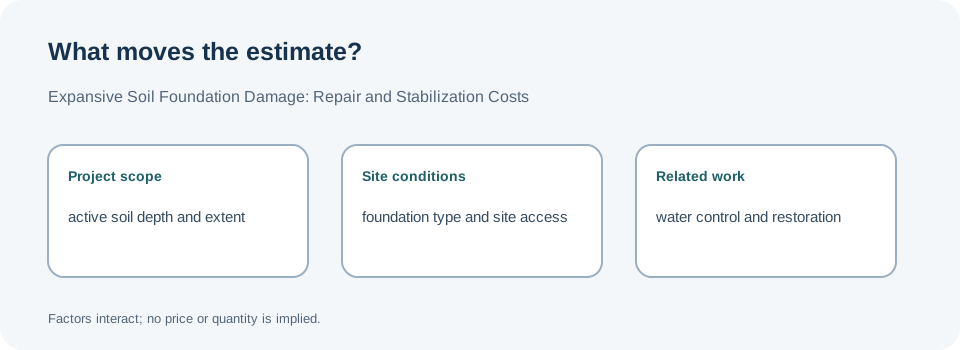
 Depth and extent of the active soil, foundation type, building geometry, support count, access, excavation, groundwater, plumbing or drainage, vegetation, finished spaces, utilities, and restoration all affect price. A compact slab home with no crawl-space access has a different pathway from a basement or pier-and-beam house.
Regional labor and climate matter, but there is no safe way to transfer one clay region’s price to another. A quote based on “expansive soil” alone is incomplete unless it explains the observed ground evidence and the correction being priced.
Scenario budgeting
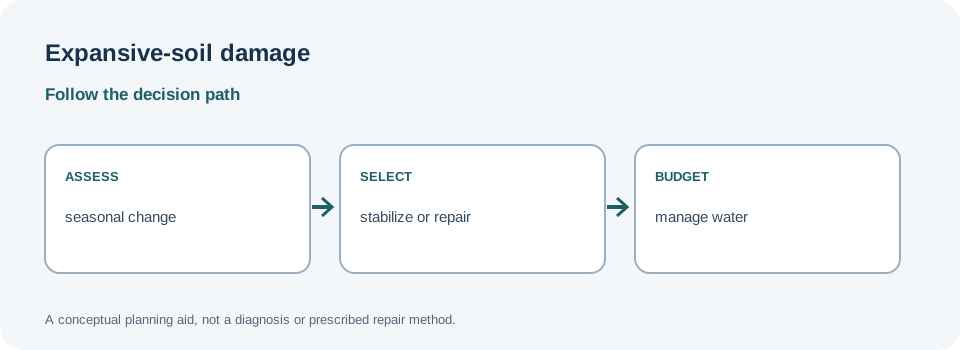 Limited movement: The cause is reasonably bounded and the work focuses on moisture control plus a local structural repair. Keep soil investigation and hidden conditions visible.
Recurring movement: Cracks reopen, several rooms show related changes, or seasonal movement is documented. Budget for a broader diagnosis, structural stabilization, and a ground/moisture plan rather than repeated cosmetic repairs.
Deep or distributed problem: The active soil extends below economical excavation, support conditions vary, or underpinning and lifting are proposed. The project can become a major structural and geotechnical undertaking.
Compare the quote by mechanism
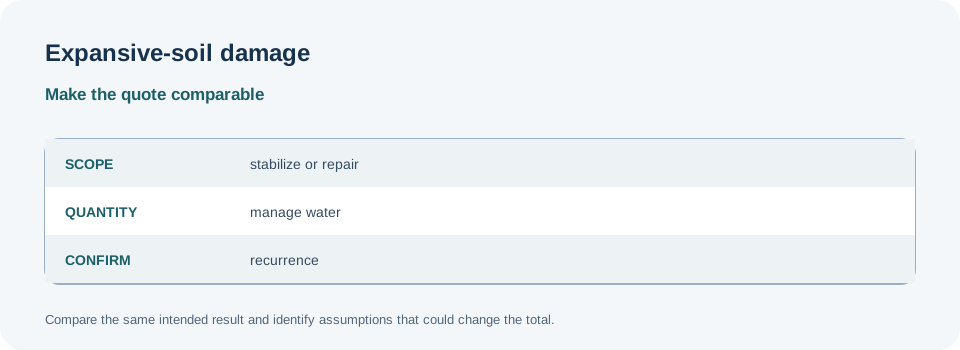 Ask what evidence supports the soil diagnosis, what moisture conditions are being corrected, what structural outcome is promised, whether the work stabilizes or levels, how many supports or areas are included, and who provides engineering or permits. Separate elective landscaping from required water management and distinguish repair from prevention.
Do not accept “soil stabilization” as a complete description. Ask which soil, what treatment, what depth and area, what design assumptions, what monitoring, and what residual movement are expected. Technical suitability is project-specific and should not be inferred from a product name.
Model recurrence, not just the first repair
Compare a structural repair that leaves the moisture regime unchanged with one that includes a designed ground or water correction. The second proposal may cost more immediately, but the relevant question is whether it reduces repeat cracking, repeat access, or the chance that a new support system will be exposed to the same movement. Do not treat a drainage recommendation as proof that drainage alone will solve the structure.
Ask how the proposal handles seasonal observations, monitoring, and conditions outside the tested area. For a short ownership horizon, documented limits and transferable records may matter. For a long horizon, the economics of recurring repairs, future additions, and access to the foundation can outweigh a lower initial intervention.
Price the soil question separately from the repair
If soil evidence is uncertain, an investigation or professional opinion may be a better next purchase than a large repair contract. Ask what the structural proposal assumes about soil depth, moisture, groundwater, and support, and whether those assumptions were measured or simply inferred from symptoms. A broad soil allowance should have a quantity and approval rule.
Do not let a water-management recommendation become an unsupported promise of structural correction. Compare structural stabilization, moisture control, soil treatment, and monitoring as separate decisions that may be coordinated. The best long-term budget is the one that explains how the ground mechanism and the building response fit together.
Three quote lines to keep separate
Ask for one line describing the structural response, one describing ground or moisture correction, and one describing investigation or monitoring. This does not require three contractors; it gives the homeowner a way to see whether the proposed repair treats the building, the mechanism, or only the symptom. Add excavation, utilities, and finish restoration as their own layers when they are material.
If the ground condition is uncertain, do not compare a highly specific treatment promise with a broadly defined repair as though they were equivalent. Ask what new evidence would change the method, cost, or expected outcome. A transparent allowance is more useful than a narrow number that assumes deep soil and moisture conditions are already known.
The water-control plan is part of the economics
A foundation repair on expansive soil can perform differently if soil moisture continues to vary. The quote should identify which part of the response addresses the structure and which part addresses grading, roof runoff, plumbing leakage, drainage, irrigation, or other moisture sources. Those controls may not be owned by the foundation contractor, but omitting them from the decision can make the repair look more durable than it is.
Ask what observation period, monitoring, or follow-up is expected and what evidence would trigger additional soil investigation. A deep support solution may reduce sensitivity to near-surface movement but does not make every site risk disappear. A lower-cost drainage or moisture correction may be important prerequisite work, while a structural repair may still be required. Compare the combined plan and the residual movement risk rather than treating a single installed method as a complete soil solution.
Distinguish evidence of soil movement from evidence of a damaged structure
The budget becomes more credible when it states what is known about the soil and what remains an inference from building symptoms. Moisture variation, seasonal timing, crack patterns, floor movement, plumbing history, drainage, vegetation, and foundation type may all inform an investigation, but no one observation proves expansive soil is the cause. Ask whether the proposal relies on testing, site history, selective opening, survey information, or a professional interpretation of the pattern.
This distinction prevents two opposite errors. A homeowner may pay for deep supports when a controllable water condition or a different structural defect is the main problem. Or a contractor may recommend drainage alone when the structure already needs stabilization. Separate the evidence and the intended outcome: ground control, support improvement, structural repair, monitoring, or reconstruction.
Make treatment quantities and performance limits visible
For removal and replacement, compare the area, depth, haul, disposal, and replacement material. For moisture control, identify which water source and site boundary are included. For chemical or other engineered stabilization, ask what soil conditions make the method applicable, how the treated area is measured, and what monitoring or verification is provided. For deep supports, compare the support layout with the soil assumptions and the residual movement the system is expected to leave.
For long-term ownership, include future monitoring, access, and recurrence risk. For short-term ownership, a bounded structural or moisture correction may be reasonable when the remaining uncertainty is documented. The choice depends on the ground profile, moisture conditions, building loads, and intended result; ask the contractor to explain which observed conditions support each proposed treatment.
Keep moisture control proportional and specific
Moisture control can include roof runoff, grading, surface drainage, plumbing leakage, irrigation, groundwater, or a barrier or drainage detail. These sources have different owners and different costs. Ask which moisture pathway the proposal addresses, what area is included, and what remains outside the contract. A broad recommendation to “control water” is not a completed site plan, but a specific correction can be an important prerequisite to structural work.
The structural response should also state whether it is intended to stabilize, lift, deepen support, repair cracking, or reconstruct a damaged element. A deep support may reduce sensitivity to one layer of movement while leaving another mechanism unresolved. A drainage correction may reduce movement without repairing damage already present. Compare the combined plan and the residual condition instead of treating either line as a universal cure.
For a short horizon, a bounded investigation and correction may be appropriate when the mechanism is well characterized and the remaining risk is recorded. For a long horizon, include monitoring, future access, seasonal observations, and the cost of repeat repair. Compare treatment options by their measurable scope, site conditions, performance limits, and remaining movement rather than treating any one method as a universal remedy.