
Cold-weather movement may call for very different work depending on whether the condition is seasonal, ongoing, or has damaged the structure. No comparable national installed range is supported across those scopes; establish the site and foundation assumptions, then compare local proposals that separate drainage, structural work, access, and restoration.
Published price context
HomeAdvisor’s U.S. foundation guide gives a US$2,225–US$8,133 typical range for mixed foundation repairs, but it does not isolate frost-heave work, a cold-climate foundation, or a correction to frost exposure. Do not use it as a frost-heave allowance. Ask proposals to separate the diagnosed movement, support changes, drainage or frost protection, attached structures, and finish restoration.
What frost heave is—and what it is not
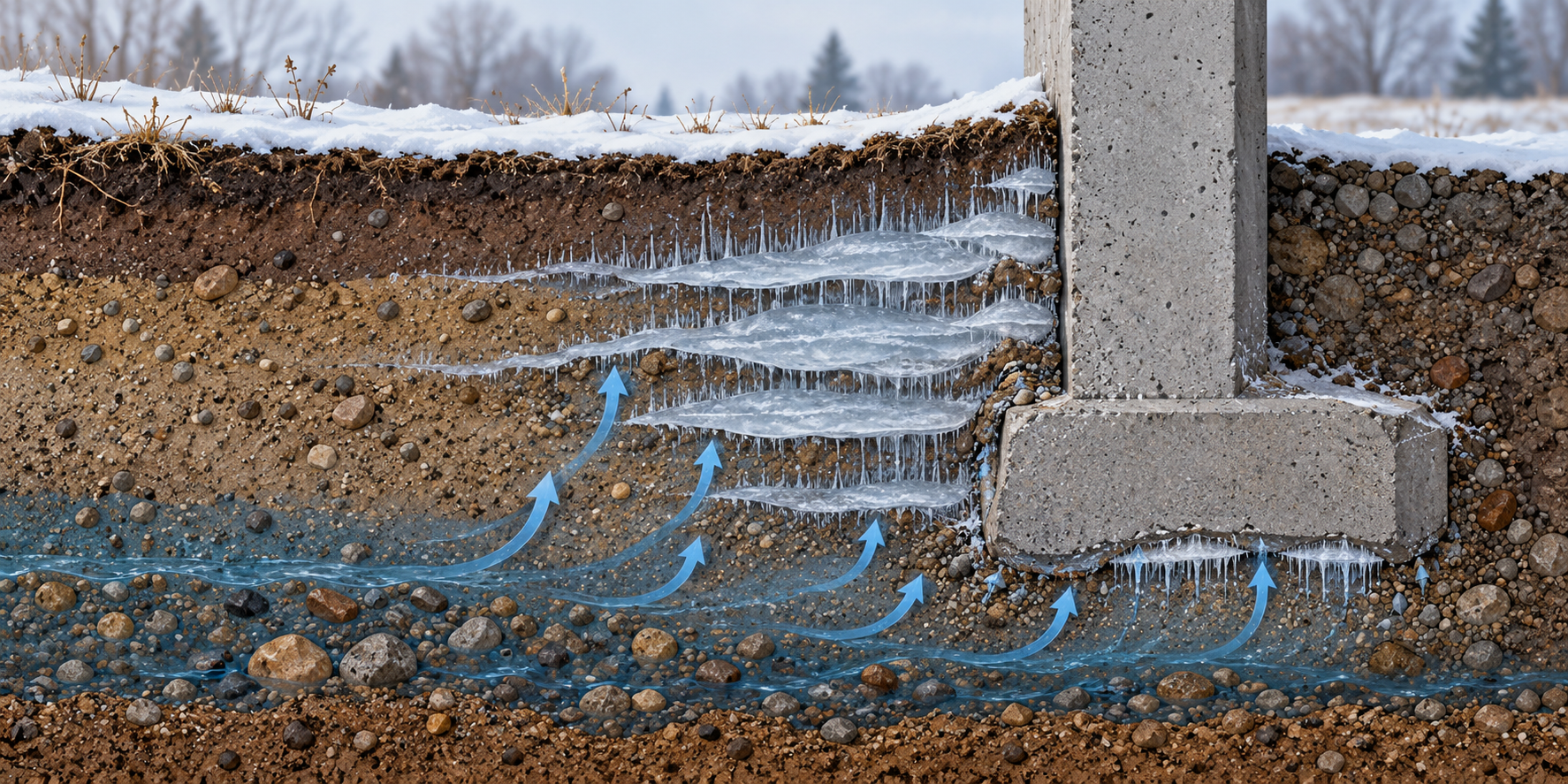
NRC explains frost heave through ice segregation: water moves toward a freezing zone in frost-susceptible soil and forms ice lenses that lift soil. Frost-susceptible material, sufficient water, and cooling conditions must interact. A foundation can move because of frost, but not every winter crack or shallow support problem is frost heave.
Permafrost thaw is a different northern ground condition. Government of Canada guidance identifies fine, ice-rich soils, poor drainage, settlement or heaving, sticking doors, and floors or roof lines out of true as possible concerns and limits its applicability to permafrost degradation. Do not use that guidance as a general diagnosis for all Canadian homes.
The budget follows the mechanism
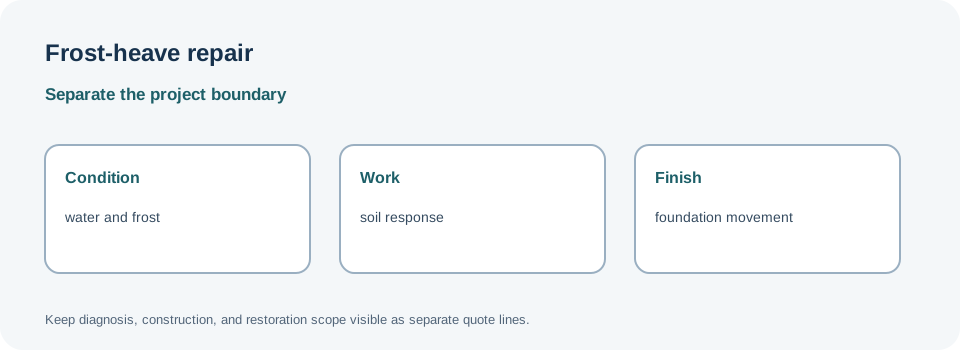 The structural scope may include repairing a crack, replacing a shallow support, stabilizing a wall, underpinning, or rebuilding a connection. The ground or water scope may include drainage correction, insulation or frost protection, excavation, soil replacement, or a foundation-system change. Prevention and repair are related but distinct costs.
An attached garage, porch, walk, or addition can move differently from the house. Repeated seasonal movement may damage finishes without proving that full foundation replacement is needed. A quote should state whether the aim is to limit future movement, repair existing damage, or both.
Cost drivers
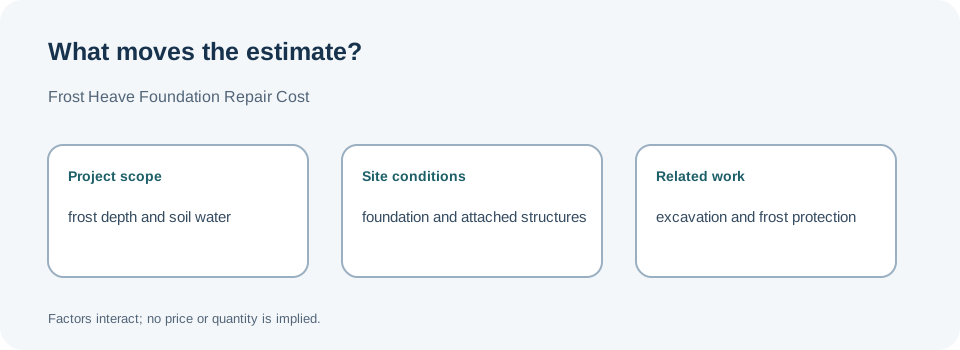 Soil type, water table, drainage, frost depth and climate, foundation depth, attached structures, access, excavation, utilities, support count, insulation or frost-protection design, temporary support, engineering, permits, and restoration matter. Local market data is weak enough that a warm-climate foundation average is not useful for a frost-sensitive site.
Three scenarios
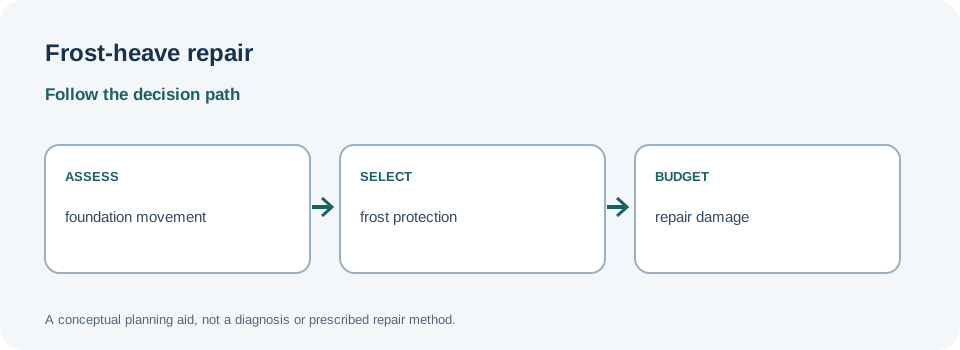 Limited: A recurring localized problem has a clearly bounded water or support cause. Budget for the structural repair and the root-cause correction separately.
Typical: Several supports or an attached structure move seasonally, requiring investigation, excavation, drainage, and repair. Include monitoring and finish restoration.
Difficult: Broad heave, permafrost-related change, unstable ground, or a proposed foundation-system change is involved. Expect professional ground and structural input, staged work, and a major uncertainty allowance.
Quote questions
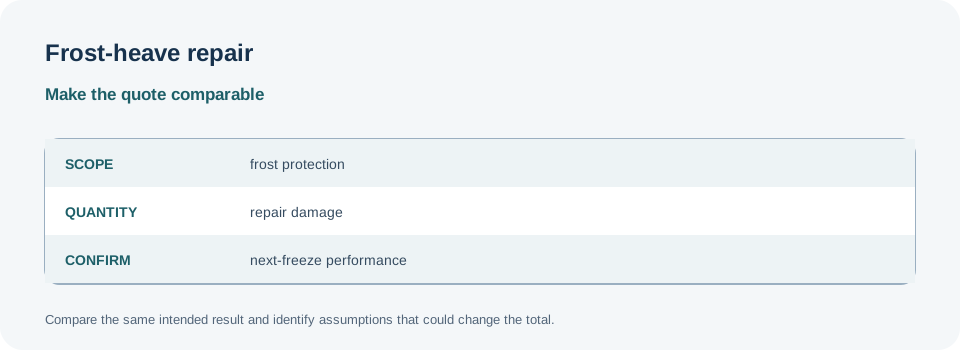 Ask what evidence identifies frost action, what is known about soil and water, which movement is being corrected, whether the proposal stabilizes or levels, how attached structures are handled, and what engineering, permits, excavation, drainage, and restoration are included. Do not approve a seasonal “leveling” price that cannot explain its intended permanent outcome.
Separate seasonal observation from permanent scope
The timing of a symptom can help a professional investigate, but it does not by itself establish frost heave. Ask whether the proposed work corrects water and soil conditions, changes foundation depth or support, repairs the structure, or merely adjusts a finish. A seasonal adjustment may be a maintenance response in one property and a sign of a larger movement problem in another.
For attached garages, porches, and additions, compare independent movement and connection work explicitly. For northern sites, document whether permafrost guidance is actually applicable; it should not be borrowed for ordinary seasonal freezing. The cost of the correct diagnosis is small compared with paying for a method that addresses the wrong ground mechanism.
Compare prevention with repair
A proposal may include drainage, soil replacement, frost protection, support changes, structural repair, or finish restoration. Ask which line is intended to reduce future heave and which only repairs the current damage. If the work is seasonal or staged, confirm how the contractor will decide that the condition is ready for the next phase.
For a short horizon, a limited correction can be reasonable when the movement is bounded and the residual condition is acceptable. For a long horizon, repeated winter access, attached-structure movement, and the cost of reopening finishes can justify a broader designed response. Keep permafrost-specific advice within its northern applicability boundary.
Ask what happens after the next freeze
The useful quote should state whether it expects no further movement, reduced movement, repaired damage, or only a seasonal adjustment. Ask how water, frost-susceptible soil, attached structures, and foundation depth or support are addressed. The source of movement may require a different contractor or professional service from the visible repair.
Normalize excavation, drainage, insulation or frost-protection work, structural repair, temporary support, engineering, permits, and finish restoration. For a long ownership horizon, include future monitoring and access. For a short horizon, document what remains unresolved so a limited correction is not mistaken for a permanent foundation solution.
A practical quote comparison
Ask what the proposal corrects: water, frost-susceptible soil, shallow support, structural damage, or a finish symptom. Separate drainage, excavation, frost protection, support changes, structural repair, engineering, permits, and restoration. A “seasonal leveling” line needs an explanation of what happens after the next freeze.
For attached structures, compare movement and connections separately. For northern sites, confirm whether permafrost guidance applies. The source, climate, and soil uncertainty should be visible in the budget rather than replaced by a generic cold-weather price.
Timing can change what the contractor can learn
Frost-related movement is seasonal, so the date and conditions of inspection matter. A quote based on a dry or thawed period may not explain what happens during the next freeze. Ask whether the scope includes drainage, insulation, water management, footing depth or bearing review, seasonal monitoring, or only repair of the visible displacement. Those are different responses to the same symptom.
For a limited, stable condition, observation and prevention may be more economical than immediate reconstruction, provided a qualified assessment finds no urgent structural risk. Where repeated heave affects a foundation, slab, walk, or connected framing, the decision may involve changing moisture and frost exposure as well as repairing the damaged element. Require the proposal to state the expected post-work condition and what remains dependent on future freeze-thaw behavior.
Separate the seasonal symptom from the permanent decision
The date of inspection, recent weather, and the location of the movement can change what a professional can observe. A garage, porch, shallow addition, walkway, and main house may not share the same foundation depth or drainage exposure. Ask whether the proposal is addressing one attached element, a connection between structures, or the main foundation system. A winter symptom can be real while still requiring a different repair from a broad house-leveling project.
The quote should state whether its goal is to prevent recurrence, repair damage already caused, improve bearing, or restore a finish. Frost protection, drainage, insulation, excavation, foundation depth, and structural repair may be separate layers. Do not treat a code or foundation-depth example from another jurisdiction as a universal requirement; confirm current local rules for the actual property.
Compare the next freeze as a project test
Ask what evidence will be reviewed after the proposed work and whether monitoring is part of the scope. If the remaining condition still depends on seasonal movement, the owner should know what change would trigger further investigation. A documented limited correction can be sensible where the mechanism is bounded; a recurring or distributed condition may justify a broader designed response even when the first visible damage is small.
For long-term ownership, include repeated winter access, attached-structure connections, drainage maintenance, and the cost of reopening finishes. For short-term ownership, preserve the record of what was corrected and what remains uncertain. A cold-climate price is not meaningful unless the soil, water, foundation type, and intended outcome are comparable.
Separate frost protection from damage repair
A proposal may combine a change to water conditions, insulation or frost protection, foundation support, structural repair, and finish restoration. Ask which line reduces future frost exposure and which line repairs the movement already present. A foundation-depth or insulation example from a technical guide can explain a mechanism without being a current local code requirement or a universal repair detail. Confirm current jurisdictional requirements for the property.
Attached garages, porches, walks, and additions deserve their own comparison because they may have different supports and may move independently. A connection repair may be more important than the visible crack in one building. In a permafrost setting, the northern applicability boundary must remain explicit; seasonal frost action and permafrost degradation are not interchangeable cost categories.
For long-term ownership, include seasonal monitoring, access, drainage maintenance, and the cost of repeated finish repair. For short-term ownership, a limited intervention can be reasonable when a qualified assessment finds the mechanism bounded and the remaining movement documented. A good quote explains what should happen after the next freeze instead of promising that a generic cold-climate method will end all movement.