
Rafter repair depends on member damage, roof access, weather protection, and how much roofing or interior finish must be opened. Current evidence supports structural scope distinctions but not a comparable national installed price; ask for the affected framing, temporary support, roofing boundary, engineering, and restoration in each proposal.
Published price context
A roofing replacement or roof-covering price does not establish the cost of repairing a rafter. Published estimates do not isolate rafter reinforcement from member design, roof access, temporary support, utility or finish protection, and covering replacement. Ask for a scoped structural price and a separate covering or restoration amount where both are involved.
Rafter work differs from roof-truss work
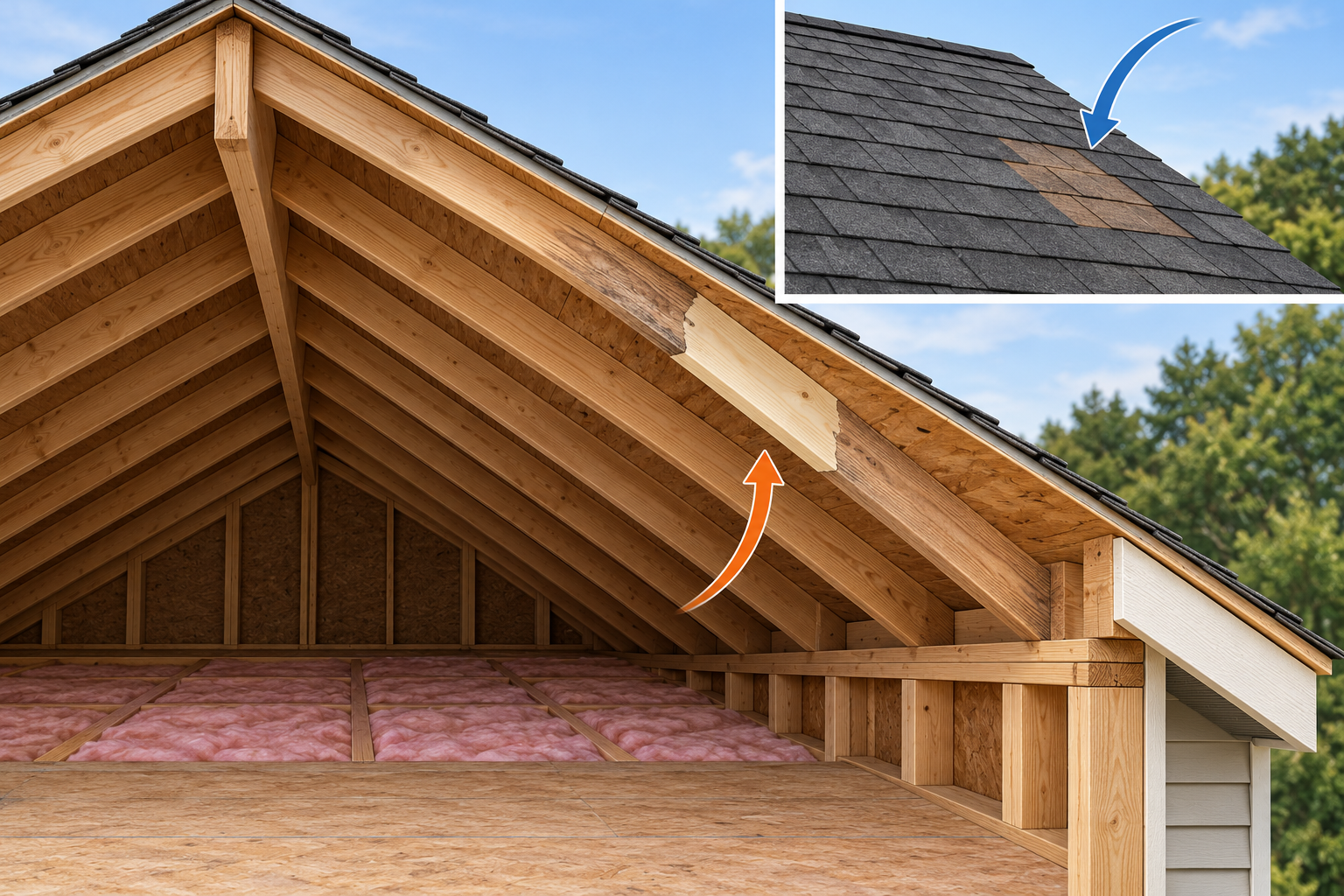
 Conventional rafters are individual sloped members connected to the roof and supporting assembly. A damaged, cracked, undersized, deteriorated, or altered rafter may be sistered, reinforced, locally replaced, or fully replaced, depending on the load path and condition. Engineered roof trusses have different design dependencies and should be priced separately.
Cosmetic rafter tails and fascia are not automatically structural. The quote should identify whether the main roof-framing member, connection, ridge support, or only an exposed tail is being repaired.
What drives cost
The number and length of rafters, roof pitch and height, attic clearance, roofing and deck access, insulation, ceilings, chimneys and penetrations, temporary support, utility conflicts, material handling, engineering, permits, disposal, and restoration matter. Opening the roof can add dry-in, flashing, covering, and interior repair.
Cuts, notches, rot, pests, moisture, or a sagging ridge can expand the scope. Cause correction belongs elsewhere when it is a roofing, envelope, pest, or foundation issue, but it must be visible in the total project plan.
Scenarios
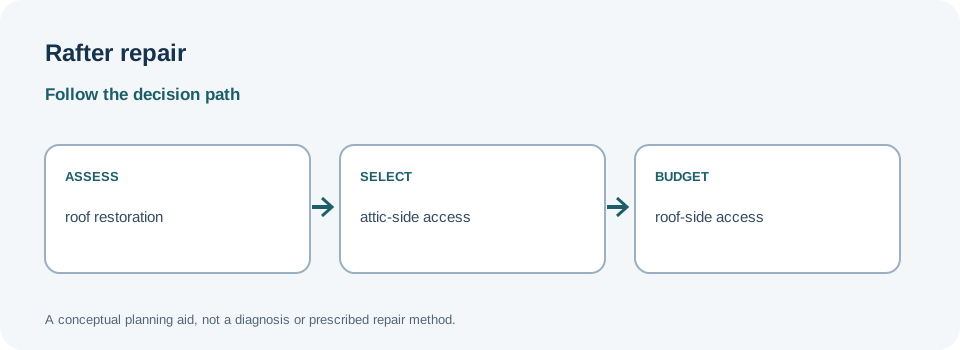 Attic-side repair: A limited rafter defect is exposed from an unfinished attic and the roof covering remains. Confirm the surrounding framing and connection are included in the inspection.
Roof-side repair: The member or connection requires covering or deck removal. Budget weather protection, replacement materials, and finish matching.
Broad framing problem: Several rafters, ridge supports, or lower structural elements are involved. Compare the repair with a broader roof-framing or support correction.
Quote questions
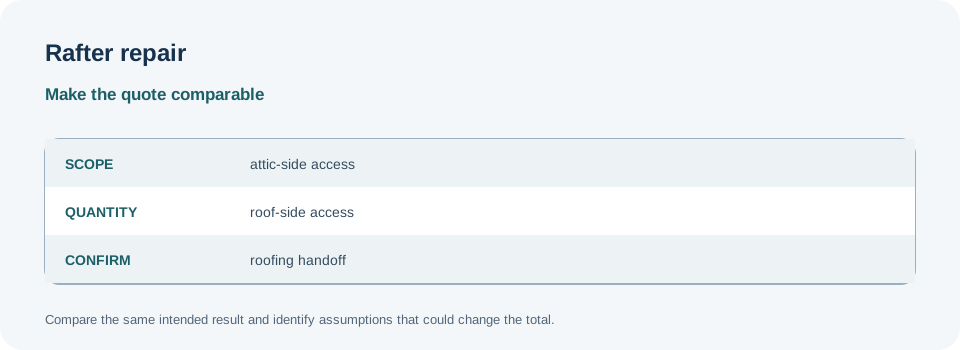 Ask which rafters are included, what repair method is proposed, whether geometry or load-path uncertainty requires design input, how temporary support is handled, what roofing and insulation work is included, and how hidden deterioration changes price. Do not use a generic reinforcement dimension or fastener schedule as a project specification.
Ask what “repair” preserves
Some proposals preserve the existing roof covering and work from the attic; others remove roofing or decking to reach the member. Compare the dry-in, flashing, insulation, ceiling, and cleanup consequences, not just the reinforcement material. A rafter-tail or fascia repair should be labeled separately from a main load-bearing rafter repair.
For a longer ownership horizon, include the cost of correcting the moisture, pest, or altered-framing condition that caused deterioration and the value of documenting the work. For a short horizon, avoid optional roof upgrades being bundled into the structural correction unless they are required by the actual project.
The best quote identifies what is retained as well as what is new. Record whether the roof covering, decking, insulation, ridge support, and adjacent rafters were inspected. If an opening exposes broader damage, use a defined unit price or written approval threshold. That makes a modeled rafter budget useful even when the final condition cannot be known before access is created.
Decide whether to phase the work
Phasing can be reasonable when one rafter area is clearly defective and the surrounding roof is serviceable. It becomes weaker when the same access, dry-in, or finish restoration would be repeated soon. Ask for the cost and residual condition of a focused repair, a larger framing correction, and any covering work that is already planned. Keep optional reroofing or attic upgrades separate so they do not inflate the structural comparison.
Before signing a rafter quote
Record the rafters and connections included, whether work is from the attic or roof, the covering and deck assumptions, temporary support, insulation and finish restoration, and the rule for concealed damage. A price for sistering is not comparable with a price for removing the roof unless access and buildback are normalized.
Compare a focused repair with a broader framing correction when the roof is already open. For long-term ownership, include source correction and inspection access; for short-term ownership, keep optional reroofing out of the structural decision unless it is required by the work.
Budget the boundary between rafter and roofing work
Ask whether the proposal preserves or removes the roof covering, what deck and flashing work is included, and how insulation and interior finishes are restored. Separate cosmetic rafter-tail work from repair of the main load-bearing rafter. Those scopes can look similar from the ground but have different labor and risk.
Use a measurable allowance for additional rafters or concealed deck damage. Compare a focused repair with broader framing work when one mobilization can avoid a second opening, while keeping optional reroofing separate.
A practical quote comparison
Record whether the repair is from the attic or roof, how many rafters and connections are included, what covering or deck is removed, and how insulation, flashing, and finishes are restored. A lower bid may be using easier access or retaining more of the assembly; ask for the retained condition.
Price concealed member and deck damage with a measurable rule. If the roof is near replacement, compare doing related structural access once with a focused repair now and a second opening later. Keep elective roof improvements separate from the necessary rafter repair.
Field conditions often decide whether reinforcement fits
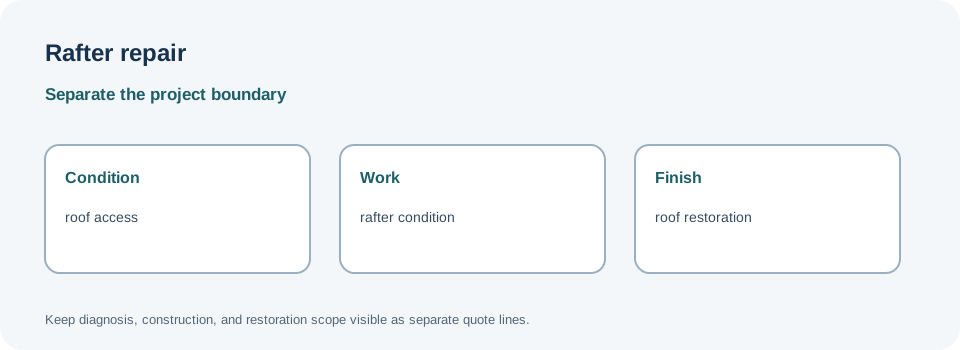
Rafter repair depends on roof pitch, attic clearance, insulation, wiring, ducts, sheathing, roofing layers, and whether the work is possible from inside or requires roof access. A reinforcement that fits on paper may require more demolition or temporary support in the actual roof. The estimate should identify the accessible length, bearing ends, connections, and any need to remove roofing or interior finishes.
Ask whether the objective is to restore a damaged rafter, reduce deflection, address a changed load, or correct a broader moisture problem. If water damage is active, replacing wood without correcting the leak can produce repeat work. Compare reinforcement, selective replacement, and a wider framing correction with the same weatherproofing and restoration endpoint. A rafter-specific price should also state whether trusses, lower walls, or roof coverings are excluded so the boundary is not mistaken for a complete roof project.
Define the accessible repair boundary
The same rafter can cost very differently depending on whether a crew can work from an unfinished attic, must remove insulation, or must open the roof and provide temporary dry-in. Ask which bearing ends, connections, adjacent rafters, ridge or wall supports, and deck areas were inspected. A proposal that reaches only the visible middle of a member may not have priced the connection or the cause of deflection.
Rafter tails, fascia, and main rafters should be separated in the scope. Tail repair may be an exterior finish or localized structural decision, while a main rafter can affect the roof load path and connected walls. If several rafters share moisture, alteration, or overload conditions, compare a coordinated framing correction with repeated individual repairs. Keep trusses outside a conventional-rafter method unless the design treats them separately.
Compare repair timing with roof timing
If the roof covering is near replacement, opening the assembly once may reduce duplicated dry-in and restoration. That does not make elective reroofing part of the structural cost. Price the necessary covering, deck, flashing, insulation, and interior restoration separately from optional upgrades, then compare a focused rafter repair with a broader correction at the same finished endpoint.
For long-term ownership, include source correction, records, and future access. For short-term ownership, a bounded repair can be appropriate when the surrounding roof framing is documented as serviceable. Neither decision should rely on a universal reinforcement dimension or a material-only price.
Compare access routes as part of the rafter decision
Working from an unfinished attic may preserve the roof covering but involve insulation, wiring, ducts, and limited clearance. Working from the roof may provide direct access to decking or connections but adds dry-in, flashing, weather, and finish restoration. Ask which route the quote assumes, which rafters and bearing ends were inspected, and whether the route changes if concealed damage is found.
The rafter can also be the visible part of a larger load path. Ridge supports, wall plates, beams, posts, foundations, and attached framing may change the repair. A proposal should state what it inspected below and beside the rafter and what remains outside the scope. If active moisture or pests caused the deterioration, price source correction separately and identify the condition required before new framing is closed.
For long-term ownership, compare a focused repair with doing related structural access during planned reroofing, without turning elective roofing into a structural requirement. For short-term ownership, document the retained roof assembly and residual uncertainty. The right result is a designed, weatherproof, inspectable roof system, not simply a newly installed companion member.